Your Guide to Texas’ Water Future
Securing Texas’ Economic Future Through Water Infrastructure and Innovation

Securing Texas’ Economic Future Through Water Infrastructure and Innovation
Last updated: June 23, 2026
Texas’ economy has grown by 291% since 2000. In 2025, the state’s $2.9 trillion economy accounted for over 9.4% of all U.S. Gross Domestic Product. Water infrastructure provides a key cornerstone for this tremendous growth.
Just as water infrastructure has supported Texas’ phenomenal growth, two challenges lie ahead.
First, Texas will need more water supplies for a growing state facing the constant specter of drought. Second, aging, deteriorating water systems are hurting Texas communities.
Water is essential to Texas’ continued economic growth, community prosperity, and quality of life. As Texas grows, strategic investments in water infrastructure, supply and resilience will be critical to supporting future generations.
Water is more than a natural resource. It is economic infrastructure. Reliable water supplies support Texas’ workforce, businesses, housing development, manufacturing, energy production, agriculture and community growth. That’s why Texas 2036 has made water a top priority in our policy research and advocacy.
Over the past five years, Texas 2036 has conducted significant research and advocated for long-term investments in reliable and resilient water infrastructure. This work included support for Prop 4, the constitutional amendment approved by over two million Texas voters in 2025.
As a result, the Texas Water Fund will receive $1 billion annually in state sales tax revenues for the next 20 years. The Texas Legislature also approved an interim endowment of more than $2.5 billion for water infrastructure funding that same year.
Over the past 25 years the Texas economy grew in unparalleled magnitude, at extraordinary velocity, and in an amount that materially expanded the state’s contribution to U.S. prosperity. The continuation of Texas’ economic miracle depends on the reliability of the state’s water infrastructure.
In 2024, Texas 2036’s Jeremy Mazur analyzed data from the 2022 State Water Plan and the EPA.
His analysis found that Texas must invest at least $154 billion over the coming decades to address water infrastructure challenges.
Moreover, this price tag will likely grow, especially with a draft 2017 state water plan that projects $174 billion in water supply infrastructure needs — an increase of 118% over the past five years, much of which will be paid by the state, with the remainder funded by local ratepayers.
In addition to the $154 billion price tag, the draft 2027 plan includes another first: it recommends the most water supply strategies and projects of any state water plan since 2002. The draft plan recommends 6,687 water management strategies, including 3,036 water supply projects.
Ultimately, as Jeremy Mazur observes in Foundation for Economic Growth: Assessing Texas’ Water Infrastructure Needs, Texas’ robust economy serves as testament to the success of our water infrastructure to date, and continued state investments in water infrastructure will help propel this miracle in the decades to come.
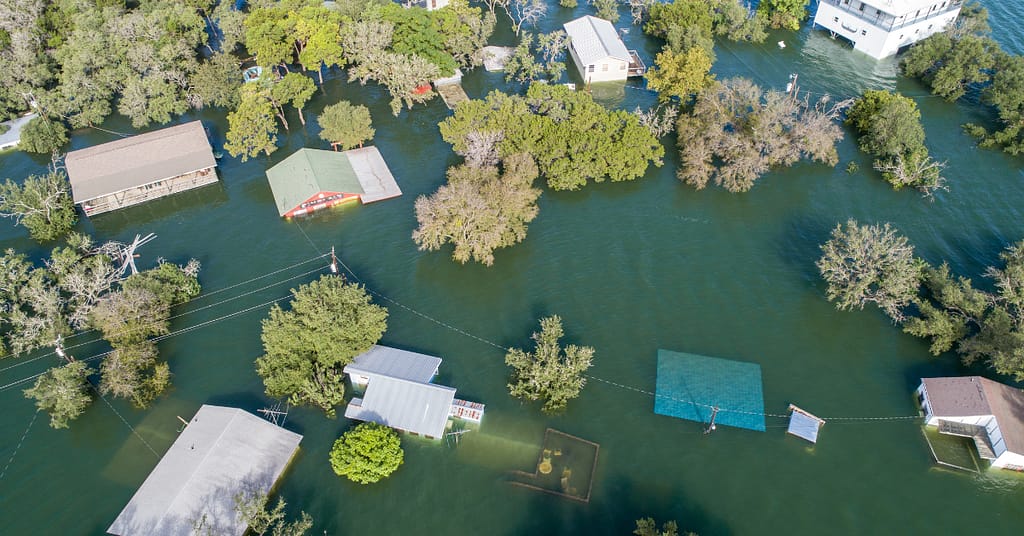
Without sufficient investment, aging infrastructure, water shortages and prolonged drought conditions could create significant challenges for Texas communities, businesses and local governments.
The economic costs of inaction extend beyond water systems themselves. Water shortages can disrupt business activity, slow economic development and increase future infrastructure costs. As Jeremy Mazur warns in his report:
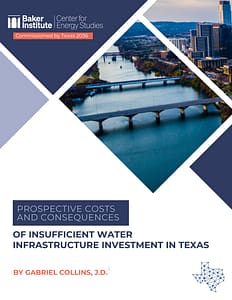
In contrast, Rice University’s Gabriel Collins notes in Prospective Costs and Consequences of Insufficient Investment in Water Infrastructure in Texas that $5 billion per year in water supply investments for a $2.5 trillion Texas economy suggests an effective “insurance rate” of 0.2%—less than what many private homeowners pay each year as a proportion of underlying home value.
The Texas Legislature made water a top priority in the 2025 legislative session, adopting policy solutions to help Texas secure its future water needs. These include:
In addition, water markets offer one tool for improving the efficient use of existing water resources. They can help reduce demand by encouraging water use to shift toward more efficient and higher-value uses.
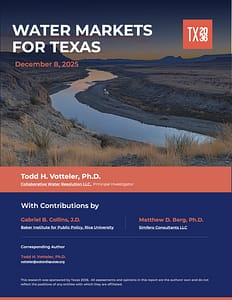
For example, Dr. Todd Votteler, co-founder and editor-in-chief of the Texas Water Journal, explains in Water Markets for Texas that developing new water markets is an efficient, effective and feasible way to reallocate water from lower-value uses to higher-value uses.
THE PATH FORWARD
The 2025 Legislature made the right call committing $20 billion over 20 years to water infrastructure. Importantly, that investment, paired with smart water markets and enhanced regional planning, could give Texas a realistic path to meeting its needs through 2070 and beyond.
However, legislation is a starting line, not a finish line. Turning funding commitments into pipelines, treatment plants, and resilient supply requires sustained attention from policymakers, businesses, and communities alike. Ultimately, the next decade of implementation will determine whether Texas’ water future matches its economic ambitions.
of GDP — the effective “insurance rate” of $5B/year in water investment.
EXPERT PROFILES

Jeremy is director of infrastructure and natural resources policy at Texas 2036. He leads the organization’s research and policy work on water, energy and infrastructure, helping develop solutions to secure Texas’ water future and support long-term economic growth.

Gabriel is the Baker Botts Fellow in Energy and Environmental Regulatory Affairs at Rice University’s Baker Institute for Public Policy. His research focuses on the intersection of water, energy and infrastructure, and he serves as an editor of the Texas Water Journal.

Todd is a Fellow of The Meadows Center for Water and the Environment at Texas State University. A leading voice on Texas water policy, he co-founded the Texas Water Journal and serves as editor-in-chief of both the Texas Water Journal and Texas+Water.
NEWS & ANALYSIS