

Last month the Texas Water Development Board published the draft 2027 State Water Plan. This is the sixth state water plan since Senate Bill 1 inaugurated the current planning process in 1997. The draft 2027 plan, like each plan published every five years since 2002, reflects the input from the “bottom-up,” regional water planning process. These plans are required, by state law, to serve as the state’s blueprint for the orderly development, management, and conservation of water resources and preparation for drought conditions.
A $174 billion plan.
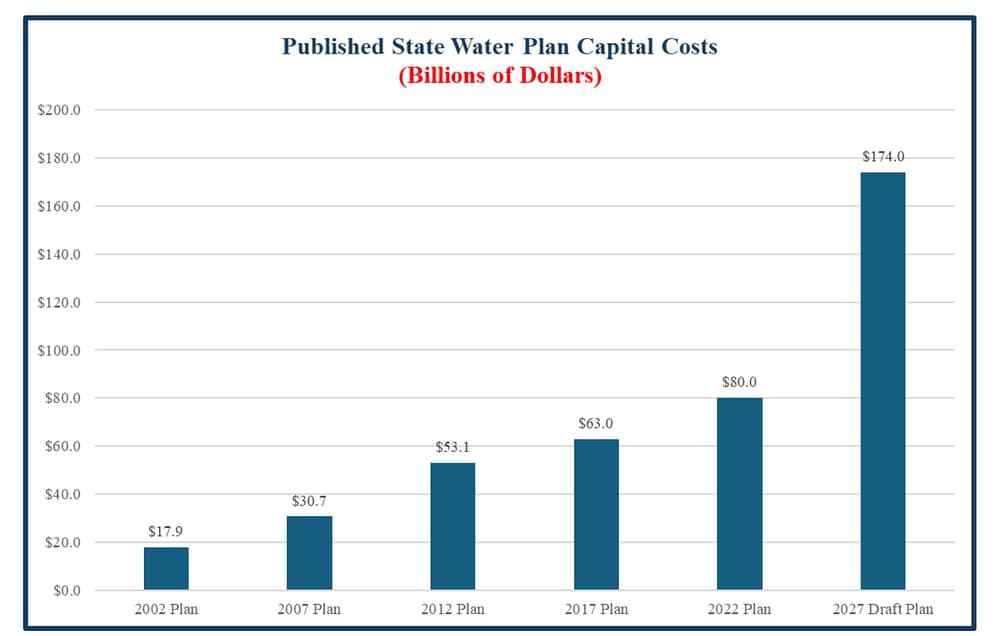
The draft 2027 plan comes with an eyebrow-raising $174.0 billion price tag, making it the most expensive water plan in state history. For comparison, and as illustrated in the chart, Published State Water Plan Capital Costs, the water supply projects within the first post-SB 1 water plan in 2002 totaled $17.9 billion. The last water plan in 2022 equaled $80.0 billion. Texas’ next blueprint for hydrological salvation from the terrors of drought equals over two times this amount.
Sources: 2002, 2007, 2012, 2017, 2022, and draft 2027 state water plans.
Inflation drives costs higher.
The Texas Water Development Board (TWDB) offers several explanations for the magnitude of the draft 2027 plan’s costs. One of those explanations involves inflation. To be sure, supply chain constraints combined with a diminished dollar value have increased water supply project costs.
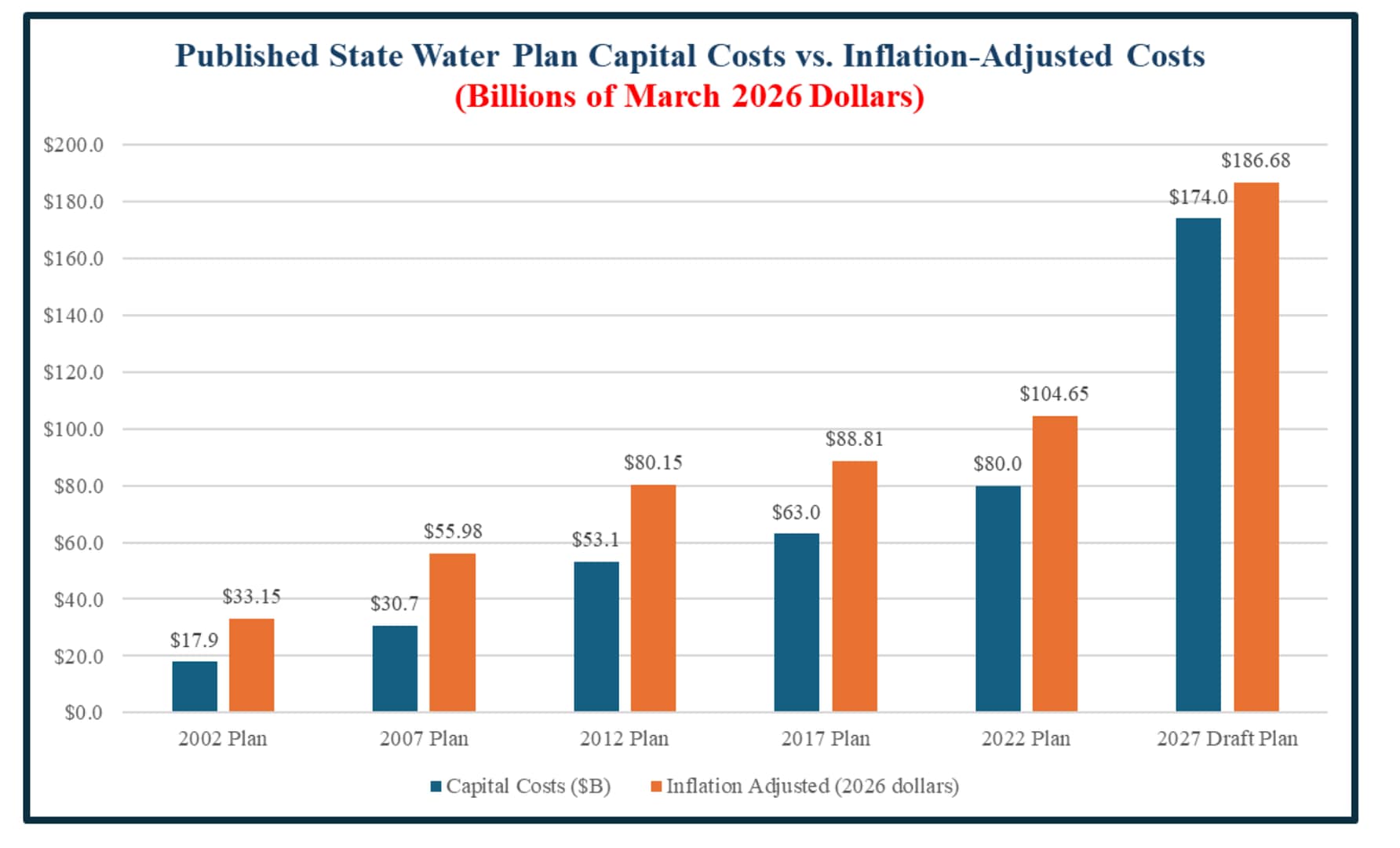
Indeed, inflation has served as a key driver towards increasing water plan costs. The chart, Published State Water Plan Capital Costs vs. Inflation-Adjusted Costs, depicts the water supply infrastructure costs for each published water plan adjusted to March 2026 dollars using the the US Bureau of Labor Statistic’s CPI inflation calculator (which tracks consumer prices and serves as a conservative proxy for construction cost growth). These data support TWDB’s observation on inflation’s effects. For example, the costs of the 2022 State Water Plan, originally based in September 2018 dollars, are 31% higher in current dollars. The price tag for the 2012 State Water Plan is 51% higher.
Unfortunately, the problem of inflation means that the draft 2027 plan’s costs are actually higher when described in current dollars. The costs in the draft plan are based on nominal 2023 dollars. After adjusting for inflation, its cost in March 2026 dollars equals $186.68 billion. This is $12 billion more than the $174 billion figure published in the draft 2027 water plan.
More water supply projects and strategies.
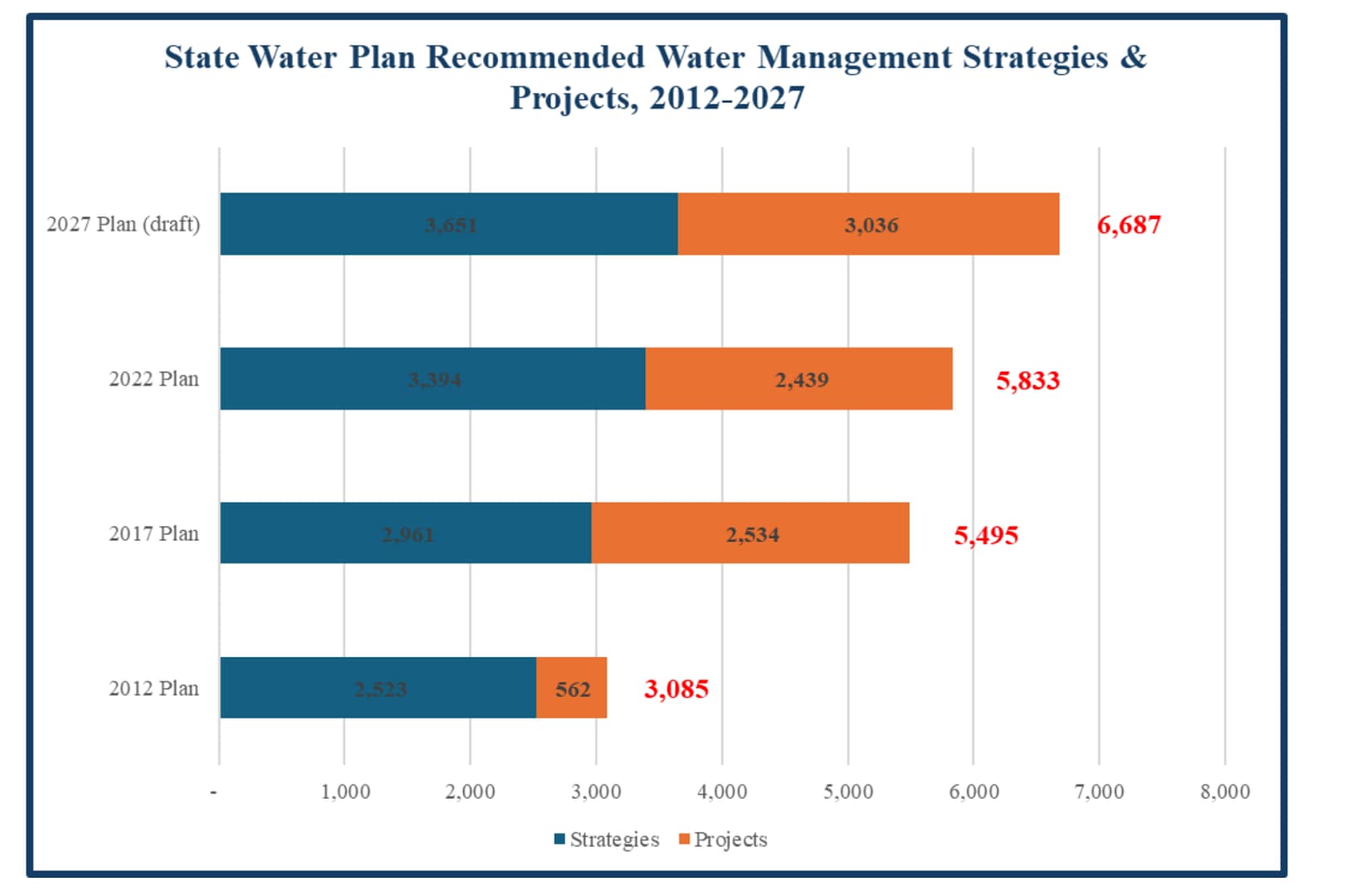
In addition to the $174.0 (or $186.68) billion price tag, the draft 2027 plan includes another first: it recommends the most water supply strategies and projects of any state water plan since 2002. The draft plan recommends 6,687 water management strategies, including 3,036 water supply projects.
When compared to the strategies and projects in the previous three plans in the chart, State Water Plan Recommended Water Management Strategies & Projects, 2012-2027, the new draft plan includes nearly 900 more strategies and 600 more projects than the previous plan in 2022. Notably, this is over two-times the total number of strategies recommended in the 2012 plan, and nearly six-times the total number of projects.
The growth in the number of strategies and projects shows that more Texas communities are thinking about securing their water future. While this is, in part, a good thing, the magnitude of this proliferation raises a reasonable question of how this represents the orderly development of water resources.
Sources: 2012, 2017, 2022, and draft 2027 state water plans.
The state’s role in water funding.
A larger state water plan price tag begs a logical question: how much more will the State of Texas need to invest in water supply infrastructure? The 2022 State Water Plan stated that $47 billion in state financial assistance was required for the $81 billion in recommended water supply projects. The draft 2027 plan does not specify how much of the $174 billion will require state financial assistance. To be sure, some of this amount will be paid by local ratepayers, and some by the state.
Fortunately, Proposition 4 approved by voters last year established a dedicated state financial strategy for addressing long-term water infrastructure needs, including paying for water plan projects. If leveraged appropriately, as has been successfully done with the State Water Implementation Fund for Texas, this $20 billion in dedicated sales tax revenues can underwrite a greater portion of the draft plan’s costs over the next 20 years. In fact, a recent white paper by the Boston Consulting Group suggests that this $20 billion commitment could translate into $70 billion in state financial assistance for water infrastructure projects over the next two decades.
A bigger, $174 billion water plan invites other big policy questions. These questions involve project prioritization, regional benefits, performance measurement, and, among others, the planning process itself. The answers here are essential to Texas’ water future.