

The 2026 STAAR results offer an important snapshot of student achievement across Texas. New data from grades 3-8 and End-of-Course assessments show where students are making progress and where challenges remain.
We break down the latest findings, what they tell us about student readiness and what we’re watching as Texas prepares to transition to a new statewide assessment system under House Bill 8.
2026 STAAR Grades 3-8 Results
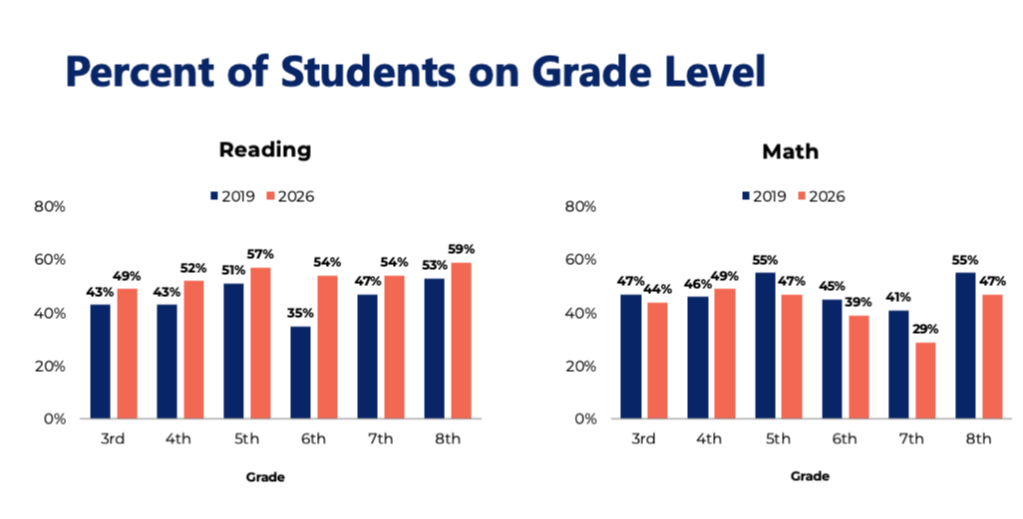
The Texas Education Agency released 2026 STAAR results for students in grades 3-8 today. The results give us a first look at student performance in reading language arts, math, science and social studies.
Key Findings
- Reading Language Arts: Performance remained above pre-pandemic levels across all tested grades. Grade 8 reading led the way, with 59% of students meeting grade-level expectations in 2026, up from 56% in 2025 and 53% in 2019.
- Mathematics: Results were mixed across grade levels. Grade 4 mathematics improved to 49% of students meeting grade-level expectations, up from 45% in 2025 and 46% in 2019, while Grade 7 mathematics remained 12 percentage points below pre-pandemic performance.
- NOTE: Among students who took the Grade 7 math test, 29% met grade level. That figure excludes high-performing seventh graders who took either the Grade 8 math STAAR or the Algebra I EOC instead. In total, 42% of all seventh graders met expectations in math in 2026, up from 41% in 2025.
- Social Studies: Nearly a third, or 32%, of Grade 8 students met grade-level expectations in 2026, up from 30% in 2025 but below the 35% recorded in 2019.
- Science: Combined science results for grades 5 and 8 will be released July 31, 2026, to allow time for the standard-setting process following recently implemented science standards.
Dive deeper: Texas 2036’s Guide to 2026 STAAR Results

Learn More: Senior Research Analyst Carlo Castillo breaks down the top takeaways from the Grades 3-8 STAAR results.
2026 STAAR End-of-Course (EOC) Results
Percentage of Students on Grade Level By Subject
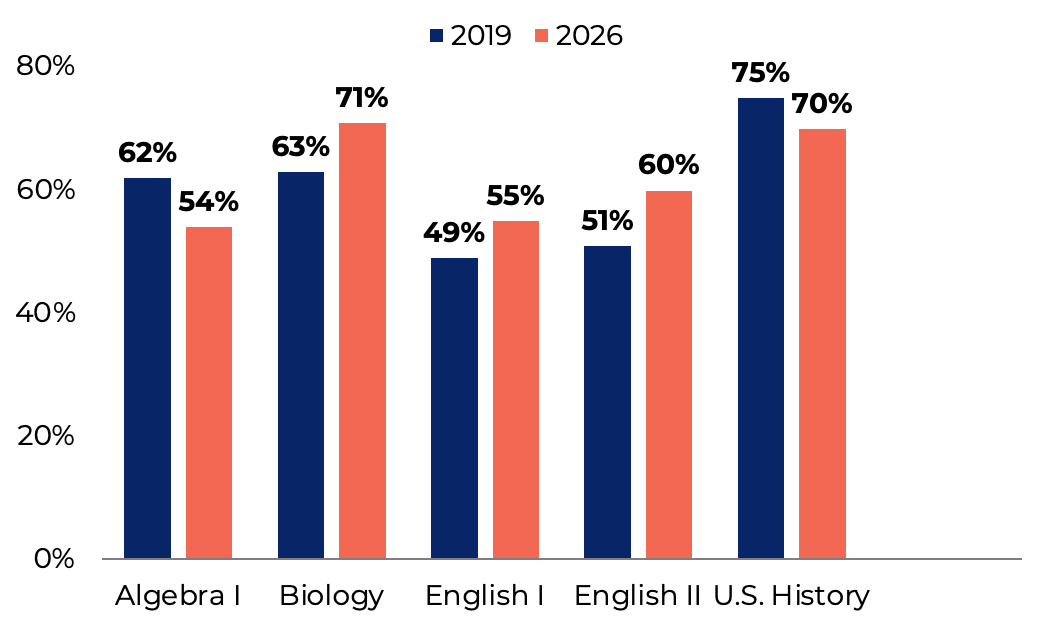
TEA released 2026 STAAR results on June 10 for Algebra I, Biology, English I, English II and U.S. History.
What we found: Texas students showed improvement across all five STAAR EOC subjects in 2026, with the largest gains occurring in Biology and Algebra I. While the results signal continued academic recovery, performance in Algebra I and U.S. History remains below pre-pandemic levels.
Key Findings
- Biology: 71% of students met grade-level expectations in 2026, up from 63% in 2025 and 64% in 2019.
- Algebra I: 54% of students met grade-level expectations in 2026, up from 47% in 2025 but below the 62% recorded in 2019.
- English I: 55% of students met grade-level expectations in 2026, up from 51% in 2025 and above the 49% recorded in 2019.
- English II: 60% of students met grade-level expectations in 2026, up from 56% in 2025 and above the 51% recorded in 2019.
- U.S. History: 70% of students met grade-level expectations in 2026, up from 68% in 2025 and below the 75% recorded in 2019.
→ Read the 2026 STAAR EOC Subject-by-Subject Breakdown
→ Read the 2026 STAAR EOC Results: Key Takeaways
📊Data Spotlight: Wheatley High School
Three years after the state intervention in Houston ISD, 58% of Wheatley students met grade-level expectations in Algebra I, above the statewide average and higher than several well-known Texas high schools.
The results offer a promising example of academic progress at one of the state’s most closely watched campuses.
2026 STAAR Results: An Algebra Success Story at Wheatley High School

For Parents: Understanding Your Child’s Results
Vice President of Data and Research Dr. Tracy Ayrhart shares practical guidance on understanding scores, performance levels and what families should know.
- How to Read Your Child’s STAAR Results: A Step-by-Step Guide for Texas Parents
- What Your Child’s STAAR Results Actually Mean — and What They Don’t
Texas 2036 Analysis

Three themes stand out from this year’s STAAR Grades 3-8 and EOC results.
1. Student Achievement Continues to Improve
The 2026 results show progress across multiple grade levels and subjects. Reading language arts performance exceeded pre-pandemic levels across all tested grades, while all five EOC subjects improved from 2025. Together, the results suggest Texas students continue to make steady academic gains.
2. Math Remains the Biggest Opportunity
While Algebra I posted one of the largest gains among EOC subjects in 2026, performance remains below 2019 levels.
A similar pattern emerged in grades 3-8 mathematics, where several grades improved since 2025 but most remained below pre-pandemic benchmarks. Continued improvement in math achievement will be critical to long-term student success.
3. Readiness Requires Sustained Progress
Strong performance in foundational subjects such as reading, writing, science and math helps prepare students for success after high school.
While the results are encouraging, continued progress will be important as Texas works to ensure more students are ready for college, careers and military service.
📊 Research Spotlight
For a deeper dive into this year’s results, explore Senior Research Analyst Carlo Castillo‘s analysis of both the STAAR End-of-Course and grades 3-8 results.
Carlo also dug into regional differences in STAAR performance.
- 2026 STAAR EOC: Is pre-pandemic performance the goal?
- 2026 STAAR EOC Results: Math Varies By Region In Texas
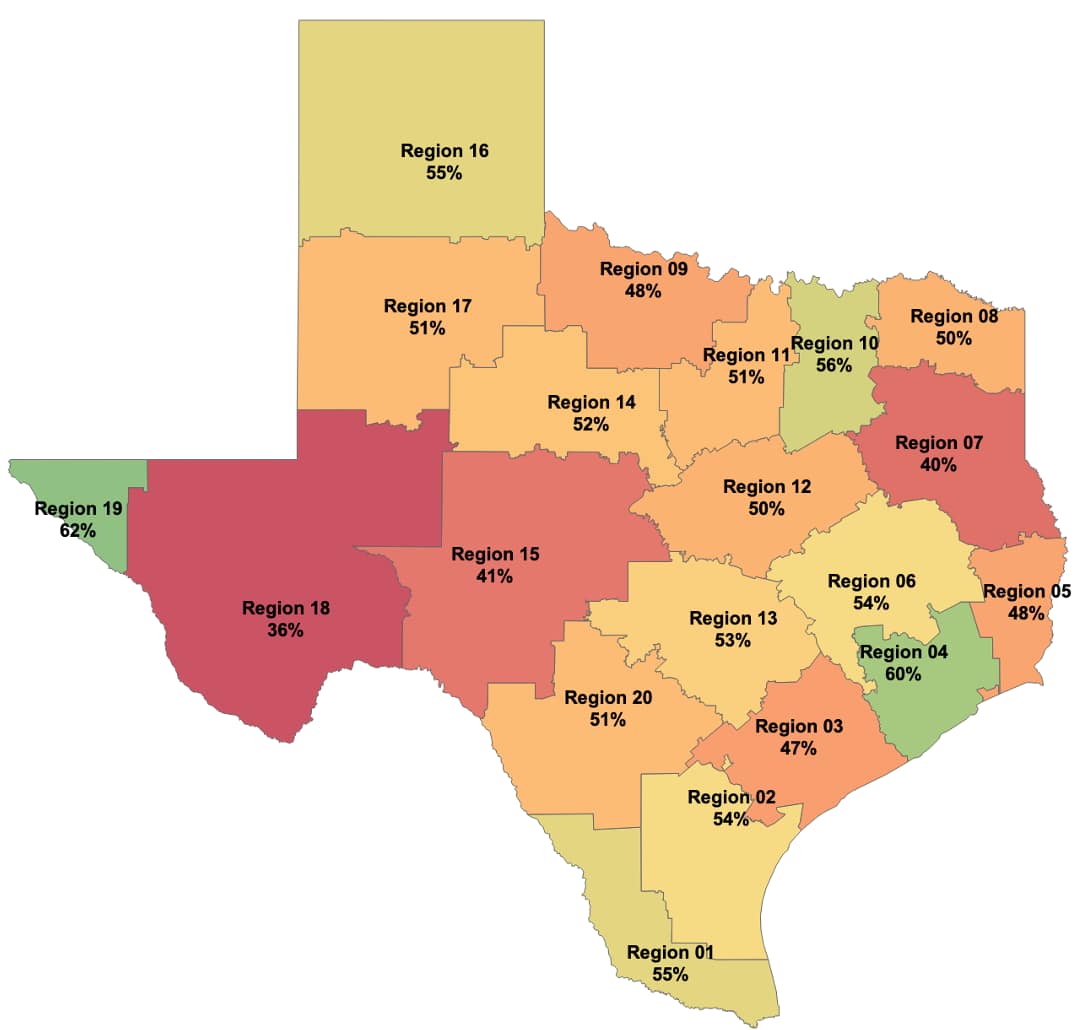
Percent of Students on Grade Level in Algebra I in 2026, by ESC Region
What Comes Next After STAAR?

Beginning in the 2027-28 school year, Texas will transition to a new assessment system under House Bill 8.
The new Student Success Tool (SST) will replace STAAR across Texas public schools. The shift represents a fundamental rethinking of when, how and why students are tested:
- Testing will measure student progress throughout the year. Instead of a single end-of-year exam, students in grades 3-8 will take shorter assessments in core subjects at the beginning, middle and end of the school year, giving teachers and families timely information to act on.
- Assessments become adaptive. The beginning- and middle-of-year tests will be adaptive, meaning the questions adjust based on how a student is responding, providing more precise data about where each student is and how much they’re growing.
- Elimination of English II exam. High school students will continue to be assessed in Algebra I, Biology, English I, and U.S. History, while the English II exam will no longer be required for graduation.
Watch our explainers on the new testing model:
What We’re Watching Ahead of 2027 Session

The 2026 STAAR results provide an important benchmark as Texas continues to invest in student achievement.
Looking ahead, Texas 2036 will be watching:
- Math achievement: Whether gains in Algebra I continue and students close the gap with pre-pandemic performance levels.
- Academic recovery: Whether improvements are sustained across grades, subjects and student groups.
- College, career and military readiness: How investments in dual credit, industry credentials and other pathways translate into student success.
- Implementation of House Bill 8: How Texas transitions to a new assessment system beginning in the 2027-28 school year.
Results Are In. What’s Your Question?
Now that you’ve seen the 2026 STAAR results, what’s the biggest question still on your mind? Share Your Thoughts.