
Earlier this week, we shared that Spring 2026 STAAR End of Course (EOC) results showed growth compared to 2025 in every subject and across every major student group statewide. When you examine how performance varied across Texas’ 20 Education Service Center (ESC) regions, that headline mostly holds, but the story of growth underneath it is more uneven.
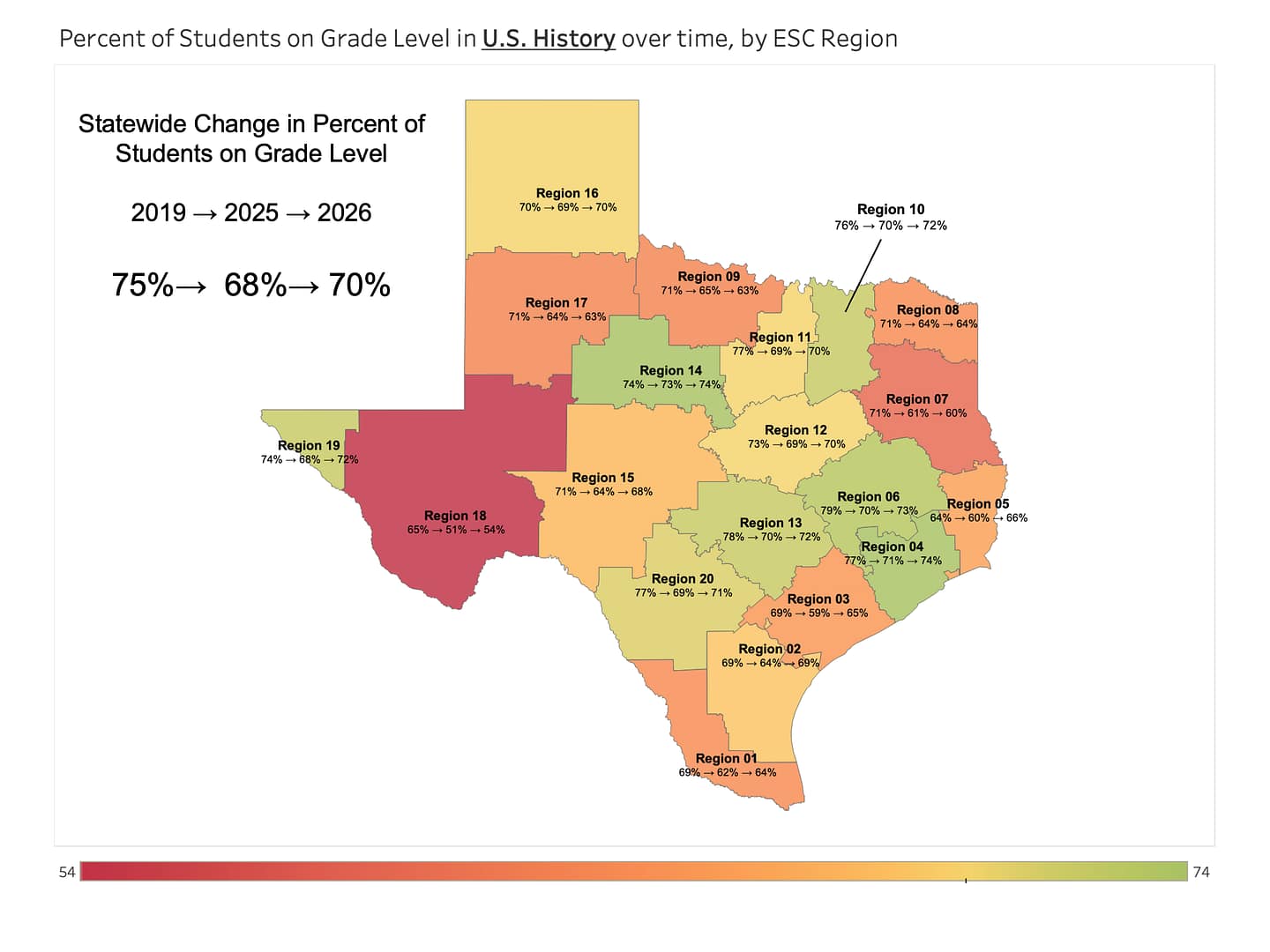
Compared to Spring 2025, the share of students meeting grade-level expectations increased in every region in nearly every subject. That means the statewide growth isn’t hiding regional declines in these subjects. U.S. History is the exception: three ESC regions posted a slightly smaller share of students on grade level than they did last year. The overall direction, even in U.S. History, remains positive for most of the state.
Performance Relative to 2019
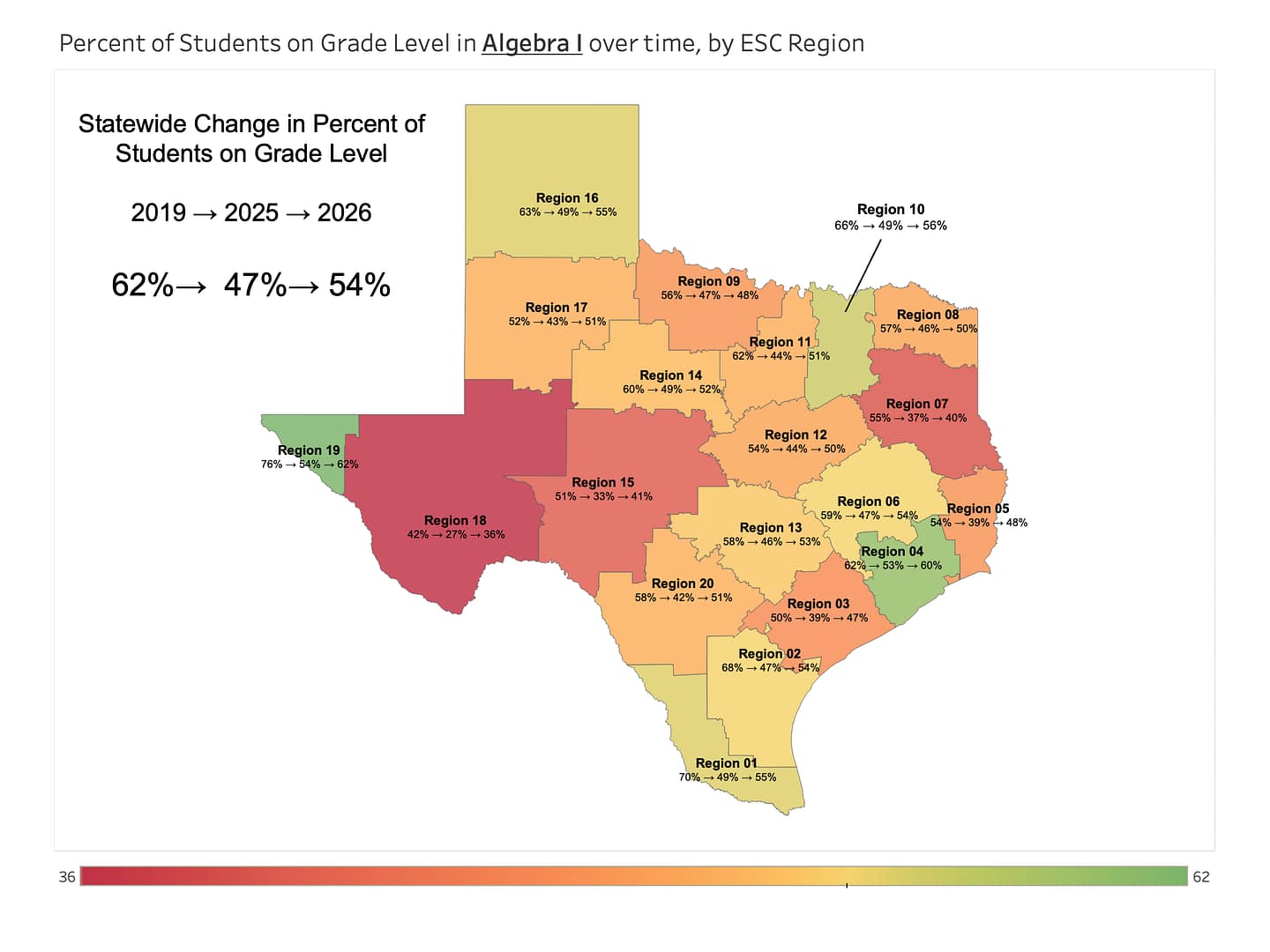
How close each subject is to pre-pandemic levels varies considerably. While every region is at least three percentage points above pre-pandemic levels in English II, no region has fully returned to where it was in Algebra I before the pandemic .
Is pre-pandemic performance the goal?
Much of the conversation in the last five years about STAAR results has centered on whether Texas has recovered to pre-pandemic levels. While getting back to pre-pandemic levels is important, we should keep in mind that pre-pandemic performance (roughly 50-60% of students on grade level in most EOC subjects) was not a high enough standard for Texas students. Getting back to that baseline is progress, but it is not the finish line.
The State of Texas Student Achievement, Mapped
The maps below show how students across Texas performed on five STAAR end-of-course exams — Algebra I, Biology, English I, English II, and U.S. History — in 2026 and how that performance has changed since 2019. Each map covers one subject and displays results for all 20 Education Service Center (ESC) regions.
How to read the maps:
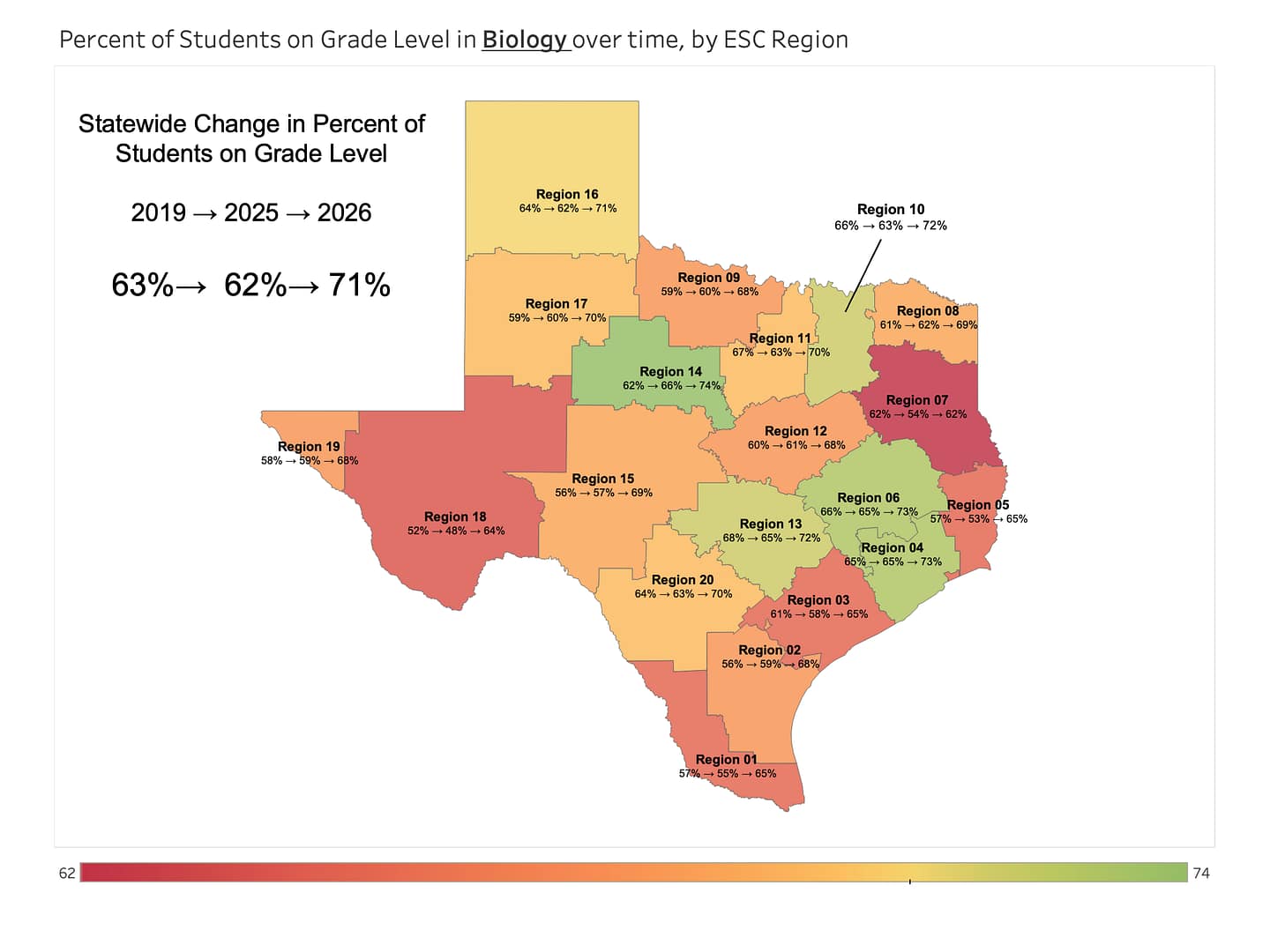
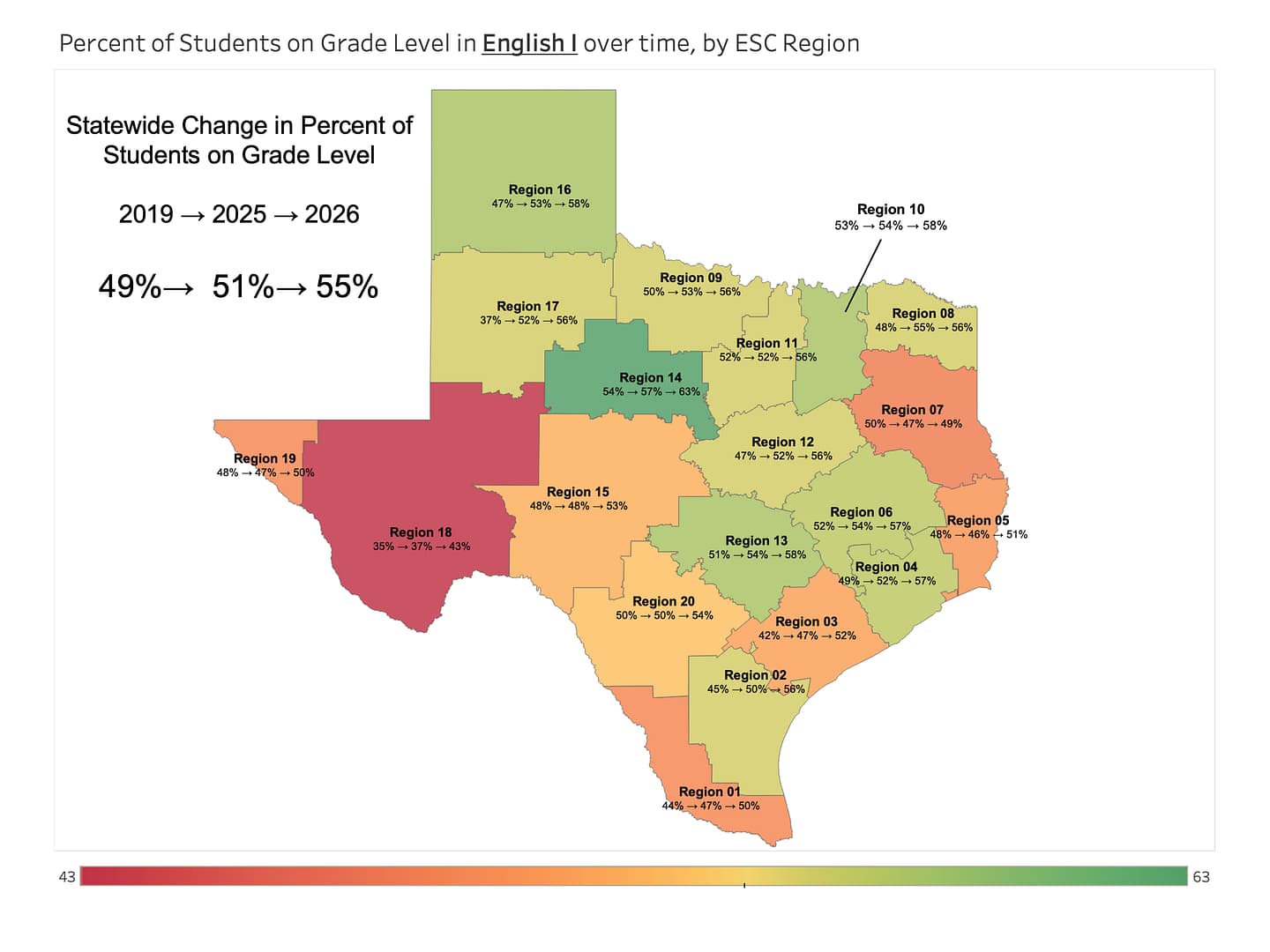
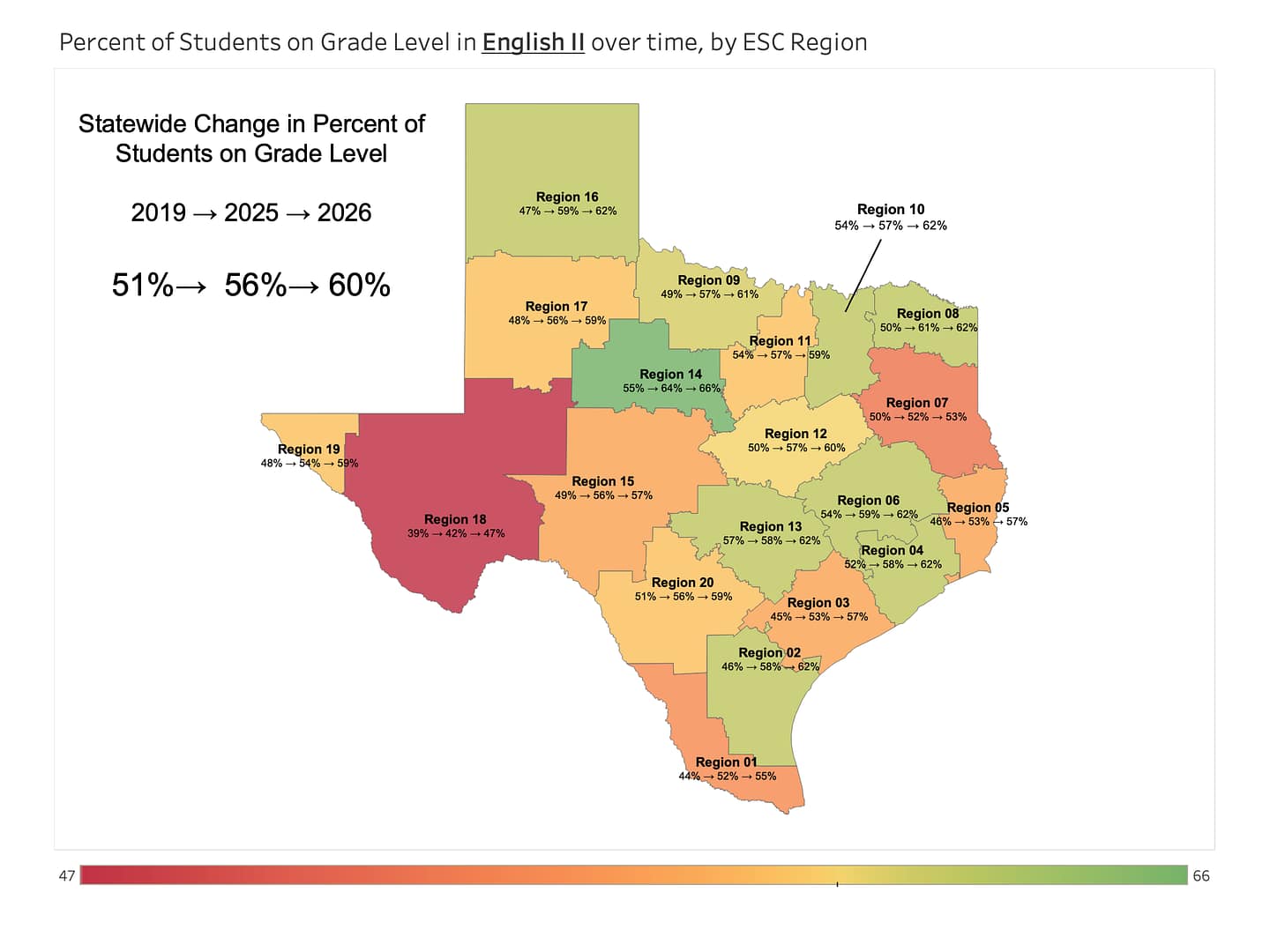
- The color of each region reflects how the region’s 2026 “meets grade level” rate compares to the statewide average. Regions shaded in red are performing below the state average — the deeper the red, the larger the gap. Regions in green are above the state average, and yellow indicates performance close to the statewide rate.
- Beneath each region label, three numbers show the share of students meeting grade-level expectations in 2019, 2025 and 2026, allowing you to track how a region has trended over time and across the pandemic recovery period.
Algebra I: Progress Everywhere, Pre-Pandemic Levels Nowhere
-
- While every region improved relative to last year, no region has returned to its 2019 Meets rate. Two regions are getting close: Region 4 (Houston-area) is at 60%, just two points short of its 2019 mark, and Region 17 (Lubbock area) is at 51%, one point short. But other regions remain further from where they were before the pandemic.
 Biology: Every Region Has Fully Recovered
-
- Nearly every ESC region now has a larger share of students meeting expectations in Biology than it did in 2019. Region 7 has the same share of students on grade level as it did in 2019.
 English I: Nearly Every Region Has Fully Recovered
-
- Nearly every ESC region now has a larger share of students meeting expectations in English I than it did in 2019. Region 7 has a slightly smaller share of students meeting expectations than it did in 2019 (49% in 2026 v 50% in 2019).
 English II: Every Region Has Fully Recovered… And Then Some
-
- Every ESC region now has a larger share of students meeting expectations in English II than it did in 2019.
 U.S. History: Three Regions Back to 2019, the Rest Still Trailing
-
- In U.S. History one region has surpassed its 2019 Meets rate, and two — Region 2 (Corpus Christi area) and Region 17 — are now exactly at their 2019 levels.
 Beyond Recovery
Spring 2026 is a year of genuine, distributed progress, but the regional data makes clear that the recovery is unfinished and uneven. English II and Biology show that full recovery is achievable; Algebra I shows how far some regions still have to go. As grades 3–8 results arrive next week, the question worth carrying forward isn’t just whether Texas is back to where it was in 2019; it’s whether the state is building toward something meaningfully better for Texas students.