

Statewide, 54% of Texas students met grade-level expectations in Algebra I this spring. But that number conceals a wide range of performance across the state’s 20 Education Service Center regions. That range becomes visible when you look at the map below.
Percent of Students on Grade Level in Algebra I in 2026, by ESC Region
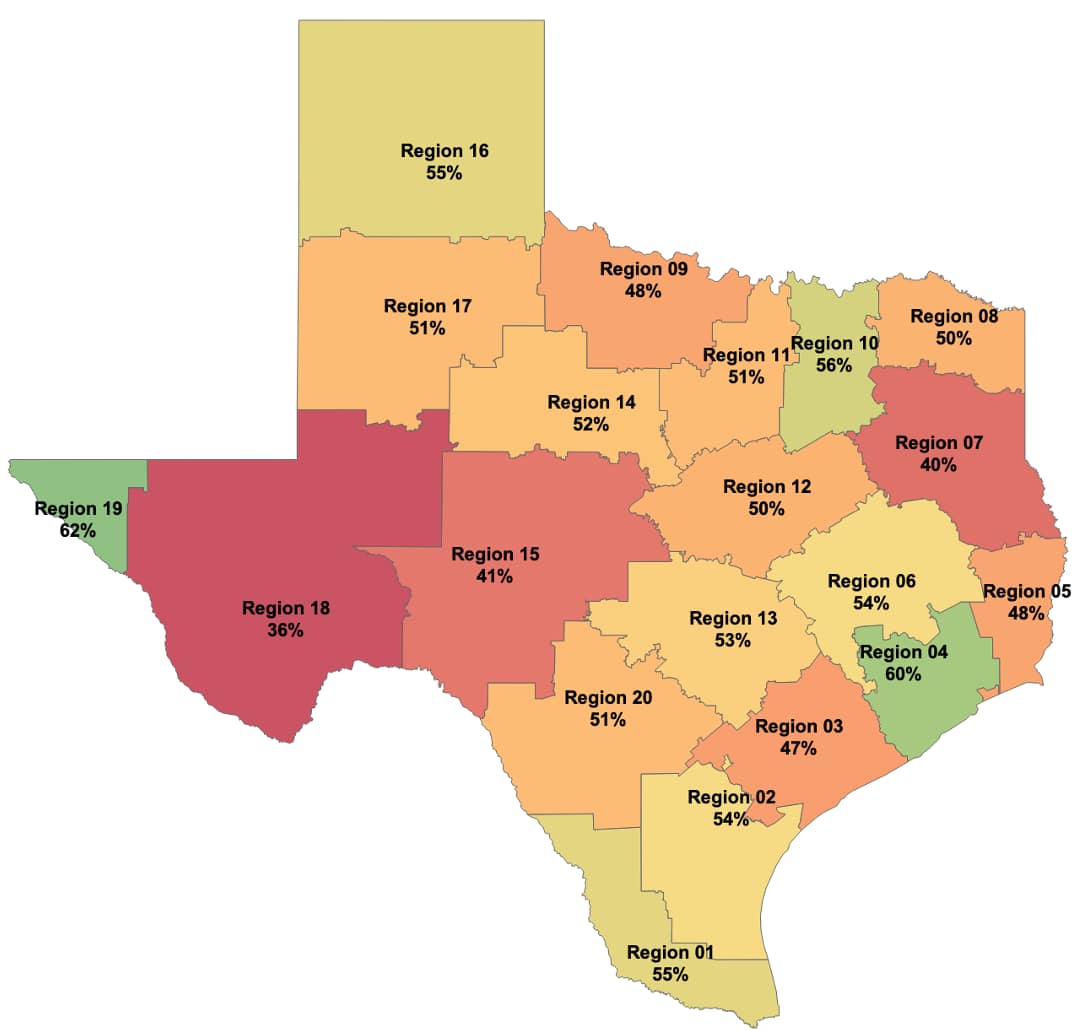
The color coding tells the story quickly: green regions are performing above the statewide average, red and orange regions are below it, and yellow regions are close to the statewide average.
Two regions anchor the high end. Region 19, which serves El Paso and Far West Texas, leads all regions at 62%, eight points above the statewide average. And Region 4, covering the Houston area, is close behind at 60%.
Region 18 in Midland and Odessa sits at 36%, eighteen points below the state average and the lowest of any region in the state. Region 7 in East Texas (40%) and Region 15 in San Angelo (41%) are the next lowest. These are not minor variations from the average; they represent places where well under half of students are meeting grade-level expectations in a foundational math course.
The middle of the map clusters loosely around the state average, including the Austin (Region 13) and Abilene (Region 14) areas. Fort Worth (Region 11), Waco (Region 12), and San Antonio (Region 20) all land just below the statewide mark, in the 50–51% range.
The Algebra I map is useful because it shows how a statewide number varies across regions. While, the state’s average provides an overall snapshot, it also masks regions that are doing meaningfully better.
At the same time, it can obscure regions where the challenge of getting students to grade level in math is considerably steeper than the headline suggests.