

The share of students reading on grade level continues to surpass pre-pandemic levels, but math tells a different story.
Texas released its Spring 2026 STAAR grades 3–8 results today. When we previewed what to watch ahead of this release, we flagged the reading/math divide, where the share of students reading on grade level surpasses pre-pandemic levels, but the growth in math has not yet reached what we observed in 2019. With this latest release, that trend has continued.
Sustained Recovery in Reading
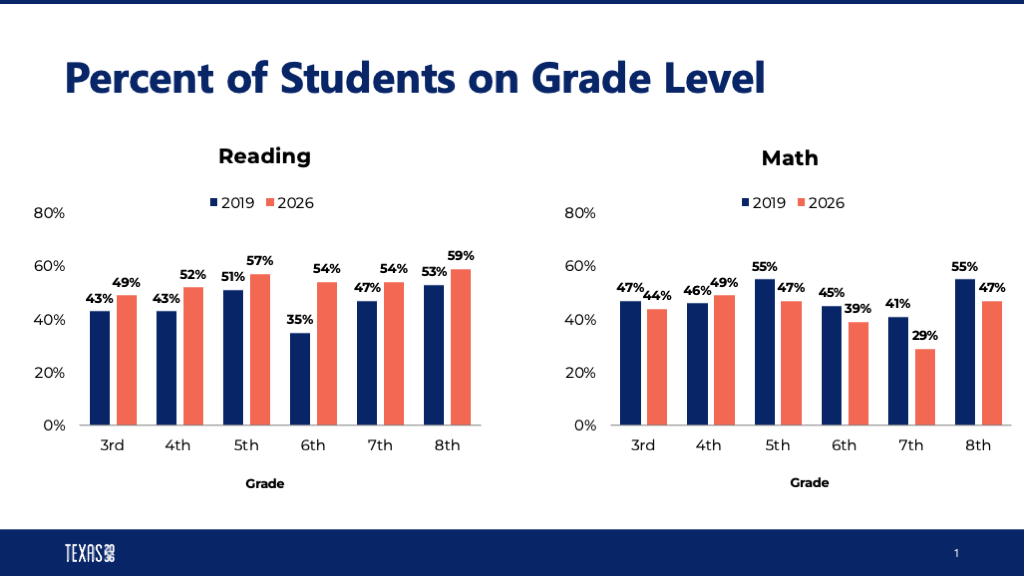
In reading and language arts, every grade is performing above where it was before the pandemic, and several are well above it. Sixth grade stands out most: 54% of students met grade level in 2026, compared to just 35% in 2019.
Year over year:
- Third grade dipped one point from last year to 49%, but remains six points above its 2019 mark.
- Grades 4, 5, and 6 held steady from 2025.
- Grades 7 and 8 posted modest gains of two and three points respectively.
Most grades sit six to nine percentage points above pre-pandemic performance, which reflects real progress.
Growth in Math this Year, but Still Below Prepandemic Levels
Math is a more complicated story. Year over year:
- Grade 3 held flat. 44% of tested 3rd grade students were meeting expectations in 2025 and that continued in 2026.
- Grades 4, 5, 6, and 8 all posted gains ranging from one to four percentage points. Grade 4 is the only math grade to have fully recovered to pre-pandemic performance: 49% meeting grade level compared to 46% in 2019.
- Grade 7 dropped two points to 29% meeting grade level. That’s the lowest rate of any grade in any tested subject this year, and it sits twelve points below where Grade 7 math was in 2019.
The Grade 7 math figure requires important context. Among students who took the grade 7 math test, 29% met grade level, but that number excludes the high-performing 7th graders who were enrolled in advanced coursework and took either the Grade 8 math STAAR or the Algebra I EOC instead. When those students are included, 42% of all 7th graders met expectations in math in 2026, up from 41% in 2025. In other words, the share of students meeting expectations on the Grade 7 math STAAR understates overall Grade 7 math performance, and the full picture is more encouraging than it first appears.
The pattern for most grades mirrors what we saw in the EOC Algebra I results released last week: progress is real, but the pre-pandemic gap in math has not closed.
What to Take Away
While returning to pre-pandemic levels isn’t the end goal, across both grades 3–8 and high school end-of-course assessments, reading and language arts results tell a consistent story of recovery and sustained growth. In grades 3–8, every grade is performing above pre-pandemic levels in reading, with most grades sitting six to nine percentage points above their 2019 marks. That progress extends into high school: English I and English II results released last week showed 55% and 60% of students meeting grade level respectively, above pre-pandemic baselines of 49% and 51%.
Math results across grade levels tell a different story. In grades 3–8, most grades posted year-over-year gains in 2026, but nearly every grade except 4th remains below pre-pandemic levels. Similarly, while year over year growth was observed in Algebra I (a 7 point increase from 47% to 54% of students meeting expectations), the growth falls short of 2019 performance levels. Across grades 3-8 and Algebra I, the math recovery is happening, but remains incomplete.