

Source: Austin Community College, Collins College, Del Mar College, Panola College and Texas State Technical College
This is a preview of our Texas 2036 newsletter discussing the strong early results from changes to the community college funding system. To receive this weekly look at our work, sign up here.
Back to School: Community College Edition
This week, 745,000 Texas community college students are heading back to class. They include working adults, first-generation college students, career changers and roughly 282,000 high schoolers earning college credit (dual credit) before graduation.
We’re marking their return by looking at how community colleges are helping more Texans build skills, earn valuable credentials and prepare for what comes next.
New Texas Funding Model Delivers Results
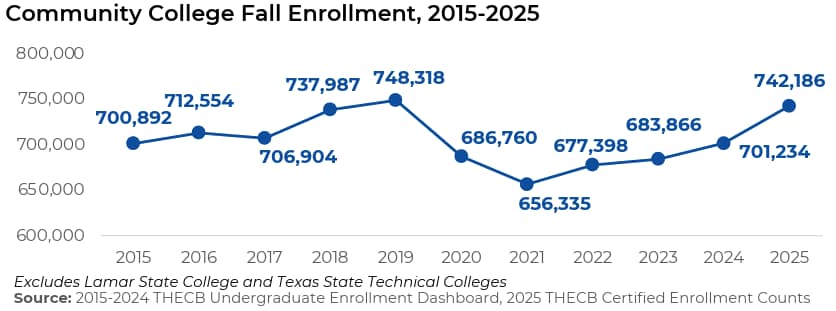
This back-to-school season brings another reason to celebrate: Early evidence suggests the state’s new approach to funding community colleges is producing the results it was designed to encourage.
As Texas approaches its 2036 bicentennial, community colleges are becoming one of the most direct pathways to stronger skills, better careers and new economic opportunities.
In 2023, House Bill 8 shifted Texas from a system that largely funded community colleges based on enrollment to one that rewards student success, workforce value and economic opportunity when students complete credentials, degrees and certificates that lead to jobs.
The idea at the heart of the reform is straightforward: when Texas rewards community colleges for helping students succeed, colleges have a stronger incentive to produce more of those outcomes.
Credentials On Rise, Outcomes Are Growing
Two years into that shift, our new report, The Texas Model: Rewiring Community College Finance for Student Success, shows students and community colleges are responding to outcomes-based incentives in encouraging ways.
Early Results: Outcomes That HB 8 Rewards Are Rising
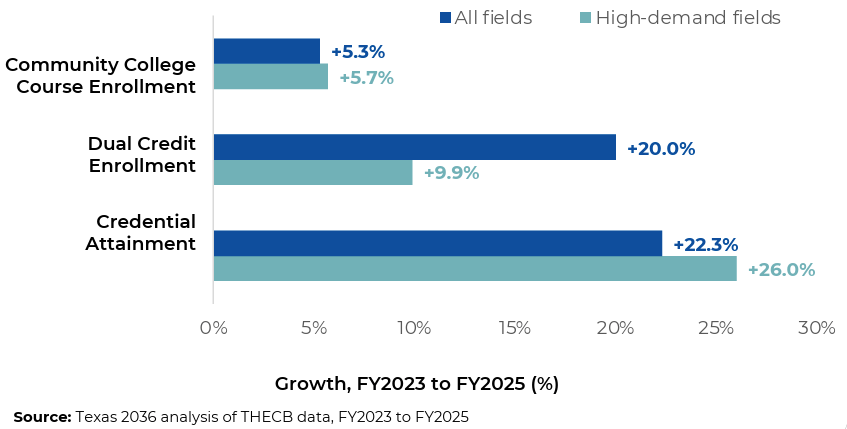 Credential attainment is up 22% statewide. In high-demand fields like health tech, skilled trades and information technology, it’s growing even faster, at 26%.
 Source: Austin Community College
Short-term, workforce-aligned credentials that get Texans into jobs fastest drove nearly three-quarters of that growth in attainment.
The gains are statewide: 43 of 50 community college districts increased credential attainment.
Early results suggest the new formula is rewarding outcomes across institutions of all sizes, rather than concentrating gains among the largest colleges.
From FY24 to FY25, outcomes funding grew fastest at small colleges (6.6%), followed by medium-sized colleges (4.9%), large colleges (4.0%), and the largest districts (2.6%).
Student Outcomes Grow Faster Than Expected
Source: Austin Community College
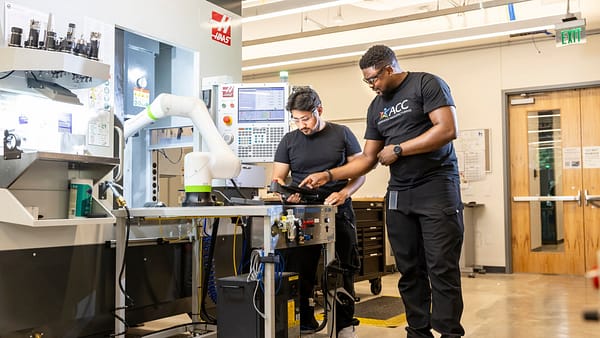
Community colleges are helping more students achieve the outcomes HB 8 was designed to reward, doing so faster than the state originally expected.
In FY 2025, the Legislature added roughly $89.5 million in supplemental funding to fully fund the outcomes colleges earned under the new model, reflecting stronger-than-anticipated performance in the first years of implementation.
The state has also continued refining the model as it has been implemented. Senate Bill 1786, passed in 2025, updated which credentials qualify for funding and added a wage standard to help ensure those credentials lead to meaningful workforce value.
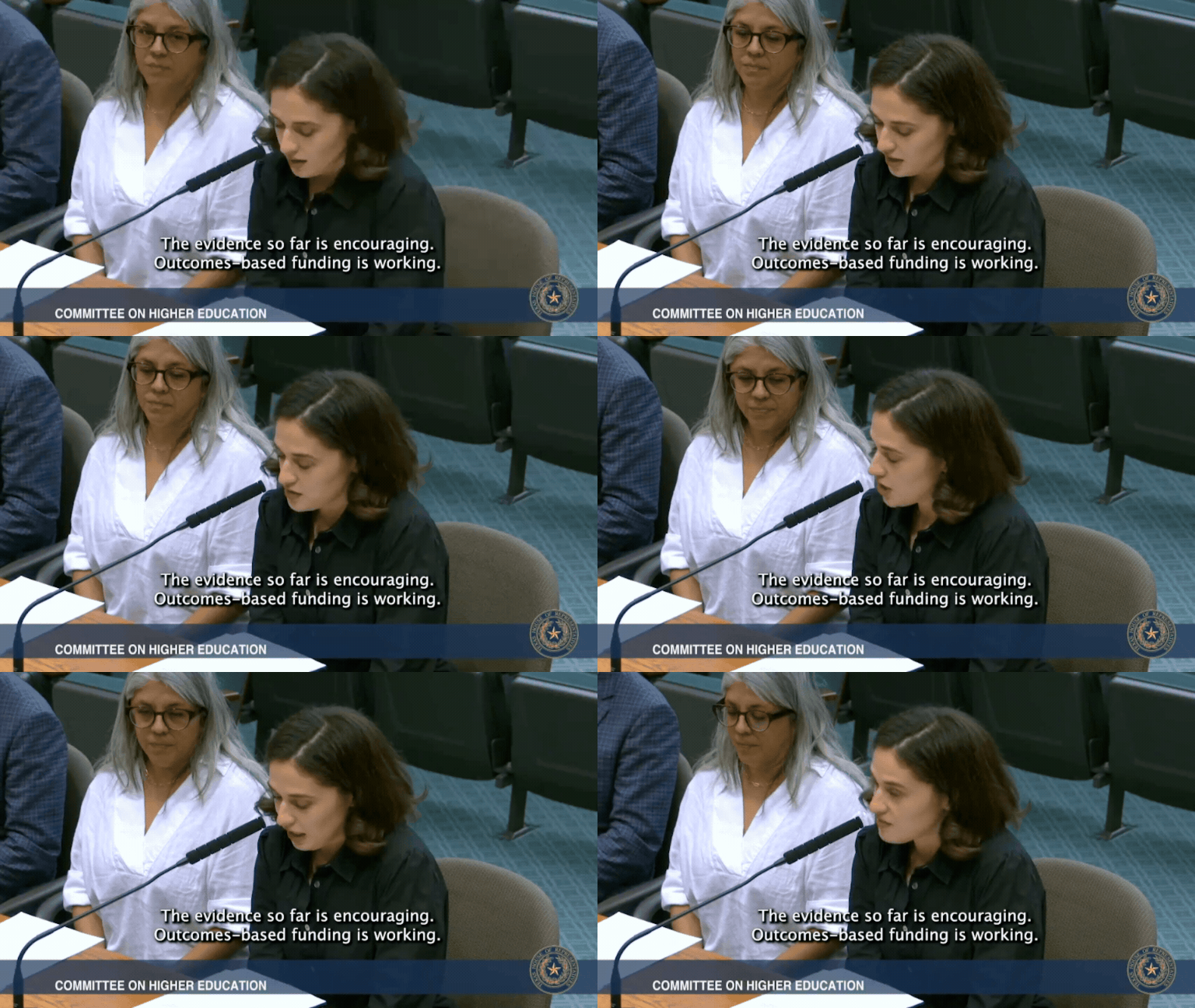
Grace Atkins, Texas 2036’s postsecondary and workforce policy advisor, testified last week before the House Committee on Higher Education on the early results of HB 8’s community college funding reform.
📺 Watch Grace’s testimony
📺 More coverage: Texas community colleges fall victim to own successes, ask lawmakers for more predictability, KXAN-TV
Dual Credit: Building Momentum Toward Credentials
Nowhere is the connection between K-12 and community college more visible than dual credit. More Texas high school students are taking college courses than ever before.
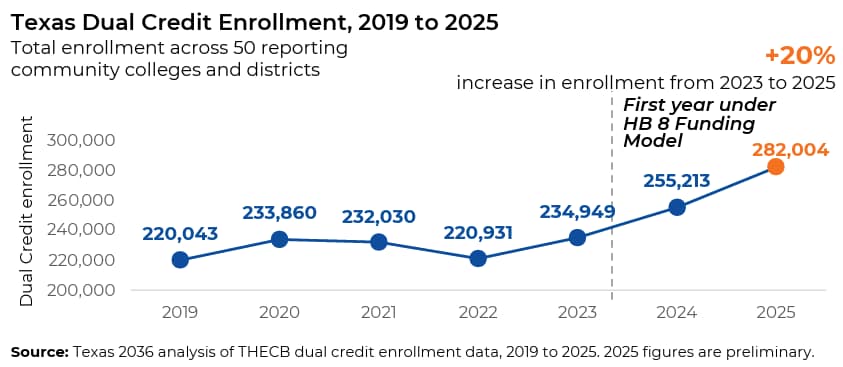
Dual credit enrollment hit an all-time high of more than 282,000 students in 2025 — up 20% since HB 8 took effect and 28% since 2019.
One key driver: the Legislature’s Financial Aid for Swift Transfer (FAST) program, which pays tuition for eligible high schoolers taking dual credit classes. That means a student can graduate high school with college coursework — or even a full degree — already done.
Not All CCMR Pathways Are Created Equal
But growth isn’t the whole story. Researchers who tracked nearly 1 million Texas graduates found that how much advanced credit a student takes — and in which subjects — matters more than simply signing up for a class.
Some popular options showed no real benefit at all; one was even linked to worse earnings outcomes down the road.
Texas is already moving toward a more outcomes-focused approach. Starting with the high school Class of 2030, the state will grade high schools not just on whether a student checks the “college-ready” box, but on which pathways actually help students succeed afterward.
Real Annual Earnings Difference at Year 6 — All Graduates
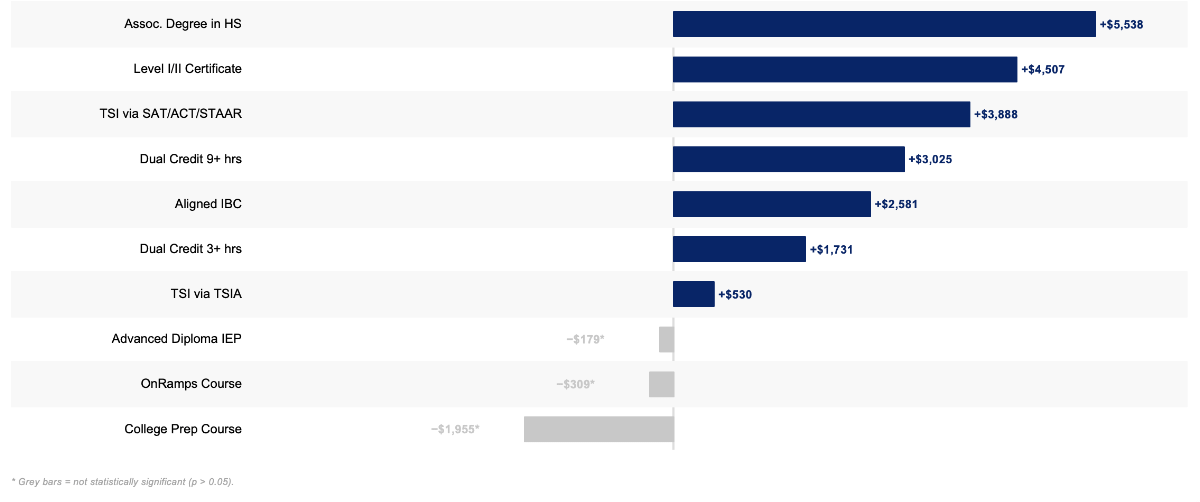 Associate Degree in HS shows the largest six-year wage advantage. Advanced Diploma IEP, OnRamps and College Prep Course show no significant wage effect. Dollar advantage in annual wages 6 years after graduation (2024 dollars). Comparison: graduates with no CCMR indicators. 2016–2018 cohorts. Source: Kirksey, Freeman, Edwards, Holzman & Lee, “The Uneven Promise of Readiness,” Texas Tech CIRCLE, 2024 dollars.
New Tool for High School and Community College Administrators’ CTE Programs
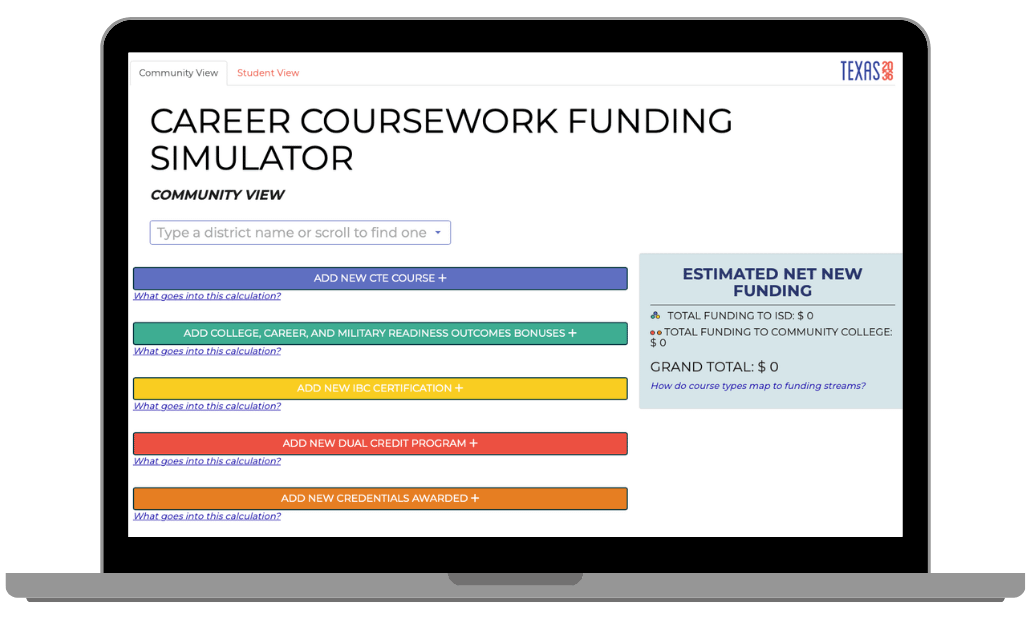
For high school and community college administrators building out career and technical education (CTE) programs, Texas 2036 has launched a tool to help local leaders see how they can put those funding streams to work.
Texas 2036’s new Career Coursework Funding Simulator is a free, interactive tool that matches career and technical education program expansion to available state funding.
The simulator connects the policy decisions Texas has made over the past several years to a more practical question:
What could we build for students in our community — and what funding is already available to make that happen?
The financial resources available from the state for schools and colleges through its funding formulas are substantial:
- If every Texas high school graduate from 2024 had met the state’s college, career, and military readiness benchmarks, school districts would have received approximately $1.23 billion in additional outcomes bonus funding.
- If every Texas high school graduate from the 2022-2023 school year had completed a Career and Technical Education (CTE) Program of Study, school districts would have generated an additional $449 million in gross CTE funding.
While the exact opportunity will look different in every Texas community, the simulator helps communities connect local workforce needs with the education pathways — and the public funding — that can help students prepare for them.
Explore your district’s opportunities here.
Where is Texas’ biggest opportunity in community colleges?
The data shows where Texas students are gaining skills at community colleges — through dual credit in high school or after graduation. Now we want your perspective.
Answer two quick questions about where Texas could make the greatest difference for community college and dual credit students in the years ahead.