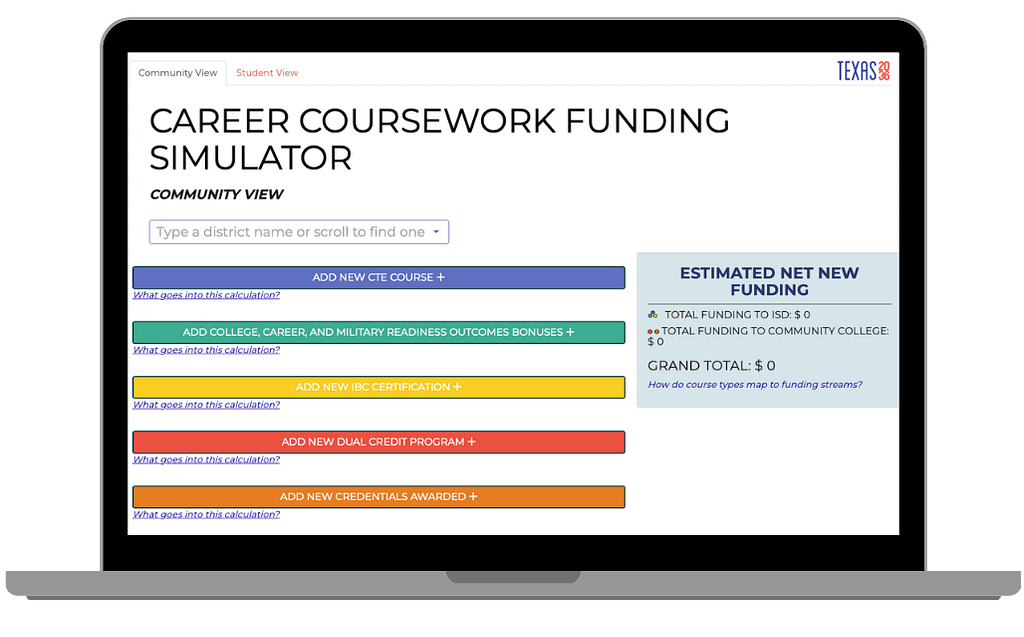
Texas Career Coursework Funding Simulator
Improving Access to High School Courses That Maximize Postsecondary Success

Improving Access to High School Courses That Maximize Postsecondary Success

No two Texas communities are preparing students for exactly the same future. As industries grow and local economies evolve, school district administrators and community college leaders face an important question:
Which education investments will best prepare students for the opportunities ahead?
IMPACT
The interactive Career Coursework Funding Simulator allows Texans to estimate how much additional funding would be available to public K-12 schools and community college systems based on public school student participation in dual credit programs and attainment of a postsecondary credential prior to graduation.
Whether expanding advanced manufacturing, strengthening health care pathways, or preparing students for careers in logistics and aerospace, the Career Coursework Funding Simulator helps communities evaluate investments that reflect their local economy.
IMPACT
The financial resources available from the state for schools and colleges through its funding formulas are substantial:
AUDIENCE
PUBLIC SCHOOLS

Public school administrators in Texas are working hard to prepare their students for success after high school. The Career Coursework Funding Simulator helps them identify opportunities to work with local community colleges to expand available coursework and credentials to their students, and funding streams to help make it possible.
COLLEGES

As community college administrators evaluate the needs of their students and their communities, the Career Coursework Funding Simulator helps them understand what funding opportunities are available based on what courses and credentials are available to students.
METHODOLOGY
The Career Coursework Funding Simulator calculates potential funding available to educational institutions based on district level attendance rates using data on Career and Technical Education courses and their corresponding funding tiers to assign the applicable funding weight based on the course selected by the user.
The data underlying our analysis comes from publicly-available data sets published by the Texas Education Agency, the Texas Higher Education Coordinating Board and the United States Department of Education. A detailed discussion of the specific data sets and their application is available in the project’s methodology.
EXPERT PROFILES

Mary Lynn Pruneda is Director of Education and Workforce Policy for Texas 2036. She is an expert in the most complex public education topics, including assessment, accountability and school finance.

Renzo Soto is Deputy Director, Education and Workforce Policy at Texas 2036 where his work focuses on school finance, assessment and accountability, and the intersection between technology and education.

Grace Atkins is a policy advisor at Texas 2036 focusing on community college finance, including the state’s shift to outcomes-based funding under House Bill 8.
NEWS & ANALYSIS