
This is the first installment of a three-part series exploring Texas 2036’s new report, The Next Generation of the Texas Miracle.
Over the past decade, Texas has built one of the nation’s most comprehensive strategies for connecting education to careers. Rather than treating K-12 schools, college, and workforce as separate systems, state leaders have increasingly aligned them around a shared mission: preparing Texans for jobs earning a family-sustaining wage.
That work begins in Texas public schools.
Recent legislative reforms have aligned school finance, accountability, and college and career pathways around helping students graduate prepared for what’s next. The results are already clear. Since 2018, the number of postsecondary credentials earned by Texas students while still in high school has increased by 532%, and dual credit participation has grown by 35%. These gains reflect the state’s continued investment in opportunities that allow students to begin earning college credit and workforce credentials before they graduate.
A New Definition of Readiness
One of the strongest drivers of this shift has been Texas’ emphasis on College, Career, and Military Readiness (CCMR). House Bill 3 (2019) helped accelerate that work by creating CCMR Outcomes Bonuses, providing districts with additional funding when graduates meet key CCMR benchmarks. Today, CCMR accounts for roughly 40% of a high school’s A-F accountability rating, creating a strong incentive for schools to expand access to rigorous pathways and programs such as dual credit, Career and Technical Education (CTE), Early College High Schools, Pathways in Technology Early High School (P-TECH) campuses, and Rural Pathway Excellence Partnerships (R-PEPs).
Texas 2036’s report, “The Next Generation of the Texas Miracle”, highlights that these pathways are associated with stronger postsecondary and workforce outcomes, including higher rates of credential attainment and increased earnings after high school. Students who complete more rigorous dual credit courses are increasingly likely to earn a postsecondary degree or certificate. Likewise, greater participation in CTE is associated with higher annual earnings after high school. For rural students, completing pathways blending college coursework and career preparation is associated with an estimated $17,170 wage premium six years after graduation, compared to $13,151 statewide.
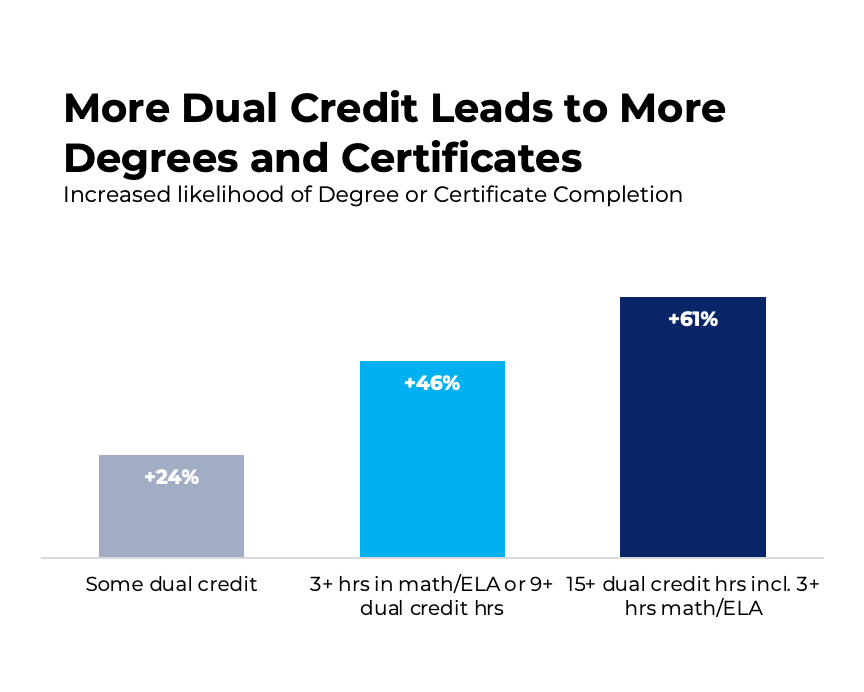
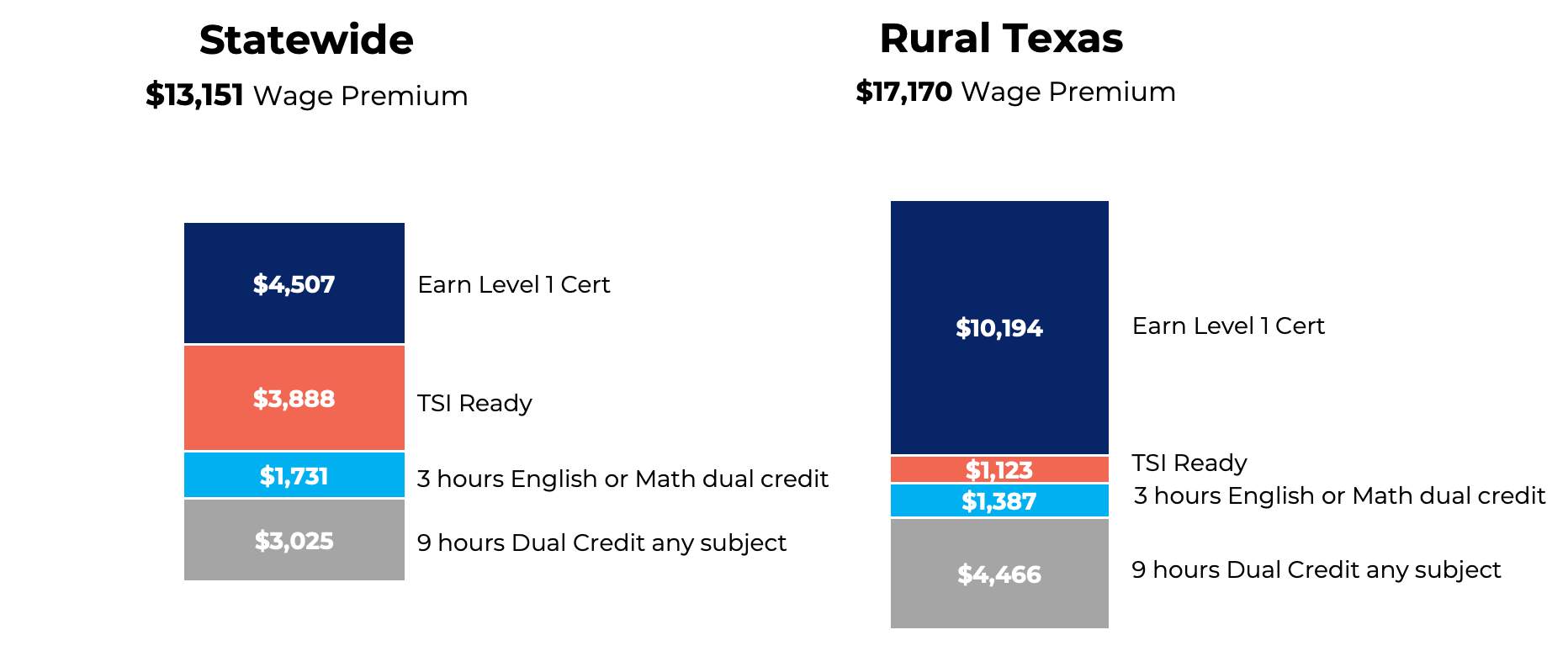
As Texas continues expanding these opportunities, it is also refining the measures of success. Research featured in the report shows that not every CCMR indicator has an equal associatiation with postsecondary success. Beginning in the 2027-2028 school year, House Bill 8 (89-2, 2025) directs the Texas Education Agency to weight CCMR indicators based on their connection to postsecondary outcomes, placing greater emphasis on pathways shown to deliver stronger results for students.
Degree Completion Likelihood by CCMR Indicator
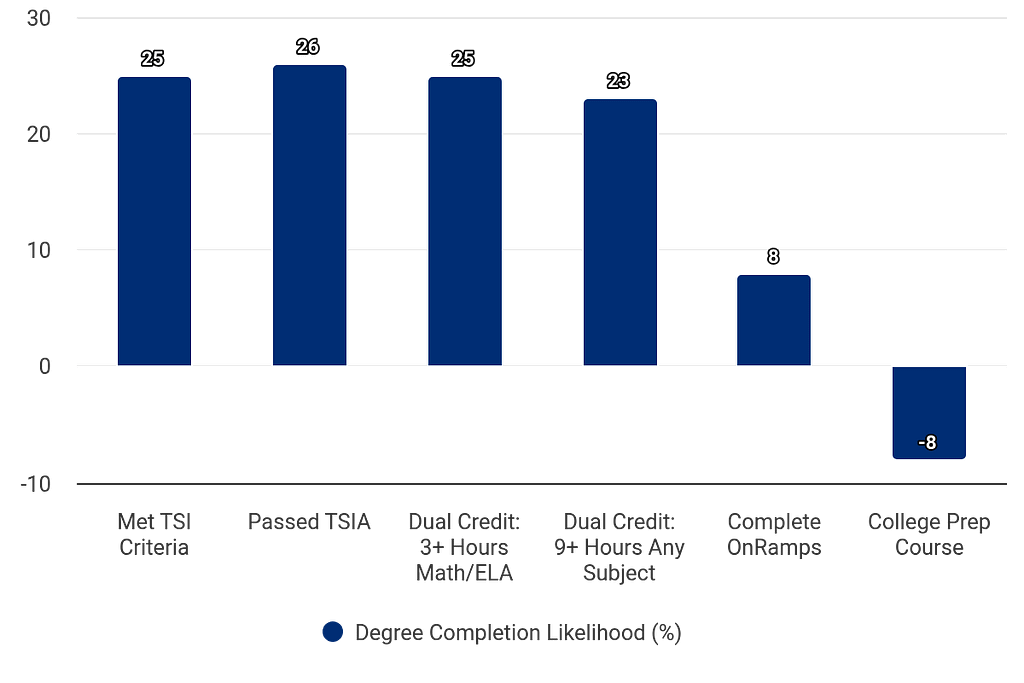
otherwise similar students who met no CCMR indicators.
Meeting TSI Criteria, passing the TSIA, earning dual credit, completing OnRamps are all associated with a meaningfully higher likelihood of degree completion.
Looking Ahead
Texas’ K-12 reforms are helping more students graduate with experiences associated with stronger educational attainment and workforce outcomes. But preparing students for success after high school is only one part of the equation. Students also need postsecondary institutions that reward completion and credentials that lead to opportunity.
The next installment in this series explores how Texas transformed community college funding to better align state investments with student success and workforce value.
Read the full report, The Next Generation of the Texas Miracle, to learn how Texas is aligning K-12 education, higher education, and workforce policy around student success.