

Statewide, 45% of Texas students met grade-level expectations in math (3-8 math & Algebra I EOC) this spring, and 55% of Texas students met grade-level expectations in reading (3-8 reading & English I & English II). But those numbers conceal a wide range of performance across the state’s 20 Education Service Center regions. That range becomes visible when you look at the maps shared in this blog.
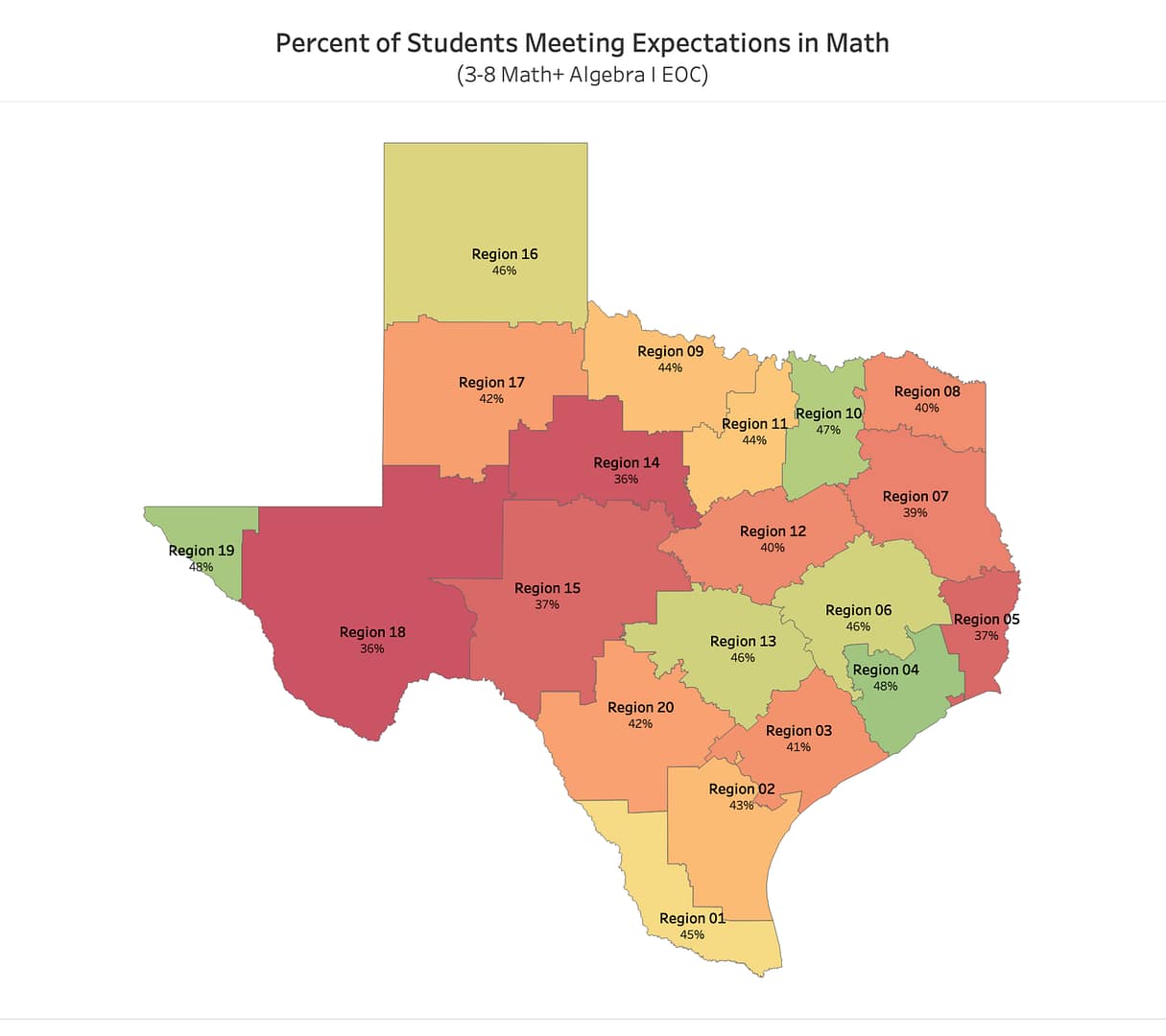
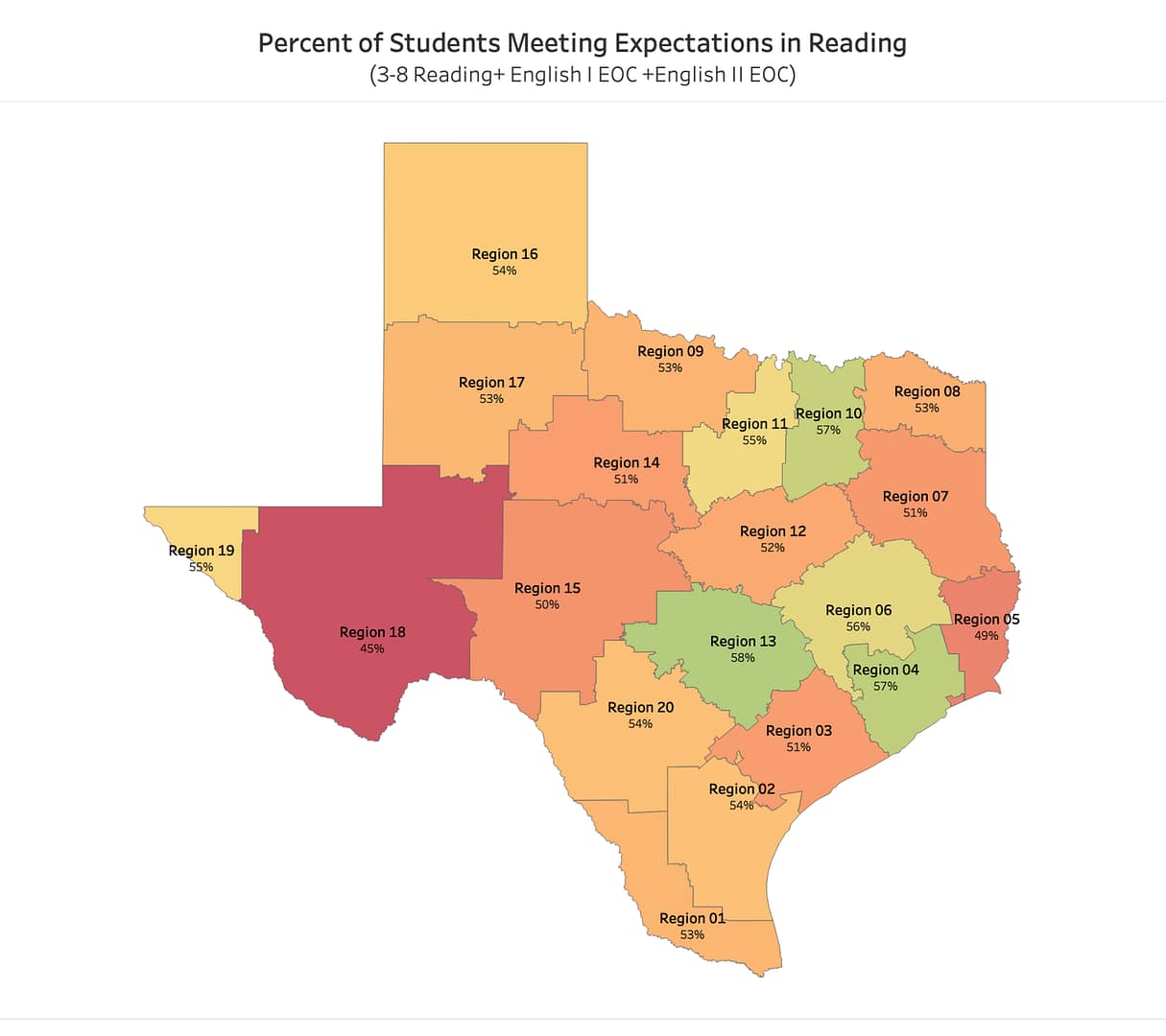
The color coding in these maps tells the story quickly: green regions are performing above the statewide average, red and orange regions are below it, and yellow regions are close to the statewide average.
A 12-Point Gap in Math
Across Texas’ ESC regions, the share of students on grade level ranges from a low of 36% in Regions 14 (Abilene) and 18 (Midland) to a high of 48% in Regions 4 (Houston) and 19 (El Paso) — a 12 percentage point gap.
In some of the state’s more populated regions, performance was at or above the state average, with Region 4 (Houston, 48%), Region 19 (El Paso, 48%), and Region 10 (Richardson, 47%) ranking among the strongest performers statewide. Weaker performance was concentrated in West and South Texas, particularly Regions 14 (Abilene), 15 (San Angelo), 18 (Midland), and 5 (Beaumont), where fewer than 38% of students met expectations.
A 13-Point Gap in Reading
As with math, some of the state’s more populated regions performed at or above the state average: Region 13 (Austin, 58%), Region 4 (Houston, 57%), and Region 10 (Richardson, 57%) led the state, while Regions 1 (Rio Grande Valley) and 19 (El Paso) each came in near the statewide average. Region 18 (Midland) was the lowest-performing region in reading at 45%, and Regions 15 (San Angelo) and 14 (Abilene) also lagged the statewide average, each at or below 51%.
Looking Ahead
In Spring 2026, just under half of Texas students met expectations in mathematics (45%), while a slight majority did so in reading (55%). While the reading figure offers some reason for optimism, both numbers underscore a key challenge. A significant share of Texas students are not yet meeting grade-level expectations in these core subjects that provide the foundational skills needed for life after high school. Closing that gap will require policy solutions, particularly in regions where performance trails the state average by wide margins.