Symptoms of an Unhealthy Market
Why Texas families, employers and taxpayers are paying more for healthcare — and what’s driving prices.

Why Texas families, employers and taxpayers are paying more for healthcare — and what’s driving prices.
Last updated: July 14, 2026
In 2025, the average annual premium for a family with employer-sponsored health insurance coverage came to nearly $27,000, or about a third of the median Texas household income. But premiums are only part of what families pay. In 2026, once deductibles and other out-of-pocket costs are added in, a family of four will spend roughly $38,000 on healthcare, or nearly half of that median income.
Every dollar Texas families spend on healthcare is a dollar that can’t go toward housing, groceries, childcare or college savings. For employers, rising health insurance prices make it harder to raise wages and invest in growth. For taxpayers, higher healthcare spending strains state and local budgets.
89% of Texans express some level of concern about healthcare costs. And 63% have skipped or postponed care in the past year because of cost. Both numbers reflect a Texas healthcare market that isn’t functioning effectively.
Healthy markets give consumers the information they need to make good decisions. They also encourage competition that rewards value and holds participants accountable for results. Increasingly, Texas’s healthcare market falls short on all three.

Healthcare affordability has broader implications that impact workforce participation, business competitiveness, local government budgets and Texas’ long-term economic success. That’s why Texas 2036 brings together data, research and policy expertise. Our goal is to identify reforms that make healthcare markets work better.
The four reports below each diagnose a different symptom of an unhealthy market and point to reforms that can strengthen one of those pillars.
Momentum for these ideas is already building. This interim, the House Select Committee on Healthcare Affordability examined many of these same issues. So did the Senate Health & Human Services Committee. Those conversations create an opportunity for lawmakers to advance meaningful reforms during the 2027 legislative session.
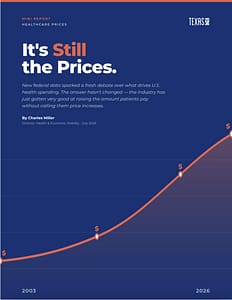
For decades, researchers have reached the same conclusion: Americans spend more on healthcare mainly because they are getting charged more for the same amount of care, not because patients use substantially more care. New federal data has prompted questions about whether that conclusion is changing. Texas 2036’s report, Prices Versus Utilization, explains why it is not.
By the numbers
Recent federal data appeared to show medical prices stabilizing. Yet those measures only track the same provider charging the same billing code over time. They often miss the ways healthcare becomes more expensive for families without showing up as a traditional price increase. For example:
The listed price may never change, but the patient’s bill still grows. The industry has gotten better at raising what patients pay without calling it a price increase.
These patterns point to one conclusion: prices, not utilization, remain the core problem.
And that is precisely why who directs a patient’s care matters so much. Prices for the same service vary enormously from one provider or setting to the next. When the problem is price rather than utilization, the choice of where a patient is treated often shapes the final bill more than how much treatment they receive. This is what makes steering so powerful. When an employer or insurer can direct a patient toward a lower-price provider of comparable quality, spending falls without anyone getting less care. In a system where price variation, not overuse, is doing the damage, steering is one of the most direct tools available for holding prices down.
A hospital system or insurer that owns providers can just as easily steer patients into its own higher-priced facilities, turning a cost-control tool into something that drives up prices. The question is not whether to permit steering, but whom it is designed to serve.
Texas has already taken a step toward addressing one piece of it — HB 711 bars providers from imposing contract terms that promote anti-competitive practices and SB 926 requires insurers to act as fiduciaries, steering for the enrollee’s benefit rather than their own. Extending a similar duty to physician referrals would close the other half of the gap.
Transparency is essential for a competitive and efficient market. Markets work best when businesses and consumers know what they’re buying and what it costs.
Healthcare often works differently. Patients frequently don’t know who owns their physician’s practice. They often don’t learn that the hospital system acquired it. They may not know a routine visit includes a facility fee until the bill arrives.
That lack of transparency makes it hard for families to compare prices, plan for expenses or choose lower-cost options. It also makes it harder for businesses and state agencies to design benefit plans that balance price and quality.
Texas 2036’s report, Understanding Facility Fees, examines how they raise prices, weaken transparency and leave Texans with unexpected charges.
Health Care Cost Institute data backs this up: a primary care visit averaged $116 in a physician’s office but $217 in a hospital outpatient department, an 87% increase for the same service. Similar gaps show up for an ultrasound ($164 to $339) and a biopsy ($146 to $791).
Competition can help hold down prices and encourage innovation by providing patients with better-value options for care as providers work to gain patient trust by improving service and/or reducing price. But many healthcare markets have become increasingly concentrated. The numbers tell the story:
Texas has already taken initial steps to curb anti-competitive contracting, including HB 711 in 2023. But more work remains. Closing loopholes that allow all-or-nothing contracting, or preventing tying clauses, or clauses that guarantee large health systems placement on a preferred tier, would give employers, insurers and patients more meaningful choices. So would improving ownership transparency and strengthening state oversight of mergers and acquisitions. Together, these steps would push providers to compete on price and quality.
9 of 9: Texas metro areas where only one or two hospital systems operate. Even Austin isn’t immune — just two of its four systems control 89% of inpatient care.
Texas 2036’s report, Hospital Consolidation in Texas, shows how mergers drive healthcare spending. It also shows how they’re reshaping healthcare markets across Texas and the nation.
BY THE NUMBERS
Texas was one of the first states to protect patients from surprise medical bills. Those reforms largely succeeded in removing patients from billing disputes between insurers and providers.
Today, however, both the dispute resolution processes for the state and in the federal No Surprises Act have become an increasingly expensive part of the healthcare system. Arbitration volumes have surged, and providers have billed dramatically higher amounts. A relatively small number of sophisticated organizations now account for a significant share of cases.
$121 million: Uncapped fees Texas health plans and providers paid arbitrators and mediators from 2020 through 2023. Dispute volume grew more than tenfold over that same span.
$5 billion: The total estimated cost of the federal IDR process from 2022 to 2024.
Arbitration awards tell a similar story. The average award reached $2,342 in 2023, up from $937 in 2020 — roughly eight times the average original payment offered by the health plan, which was just $289. Provider billed amounts rose even faster, climbing sixfold from $2,829 to $18,577 over the same period.
Texas 2036’s report, The True Cost of Dispute Resolution, finds that the growing use of the IDR system may be increasing healthcare spending, leading to increased premiums. The federal system shows the same dynamic at a greater scale: providers won more than 85% of federal arbitration cases by the end of 2024, up from 68% in early 2023.
When healthcare rewards results instead of volume, everyone benefits.
THE PATH FORWARD
Texas has an underused lever for improving its own health benefit plans: its own purchasing power. The Texas state government is one of the largest healthcare purchasers in the state. The Employee Retirement System and Teacher Retirement System of Texas together cover hundreds of thousands of state employees, retirees and their dependents
TRS-ActiveCare is a telling example. Teachers saw premiums rise 10% on average statewide last school year, and they’re bracing for another increase this year. The prices the state pays for healthcare services are driving that trend, and are having an impact on teacher pay. The Legislature recently made a real investment in keeping educators in the classroom, creating the Teacher Retention Allotment through House Bill 2. But a teacher’s compensation is not the number on a salary schedule; it is what actually lands in their bank account when they deposit their paycheck after other contributions are taken out, including health insurance premiums.
Rising health care prices, reflected inTRS-ActiveCare premiums, are quietly eating into that raise. Depending on coverage tier, district size, and years of experience, a single year’s premium increase can have varying impacts on a teacher’s retention allotment. Consider the example of a fourth-year teacher in a small East Texas district with family coverage: her $4,000 Teacher Retention Allotment met a $1,860 premium increase this year for coverage for her family, absorbing 46.5% of it before it ever reached her.
This is not an issue with TRS or how they operate, it is a broad national problem that is having an impact on all large employee health benefit plans. Texas has an opportunity to lead by expanding value-based purchasing and aligning incentives around quality, efficiency and patient outcomes. If these reforms work in TRS-ActiveCare, they become a proof of concept. Private employers, individual school districts and local governments facing the same pricing issues could replicate them.
Even with better information and stronger competition, healthcare markets work best when providers and insurers stay accountable to patients. In healthcare, the principal — patients, employers, taxpayers — relies on agents, including insurers, providers and PBMs, to act in their best interest. Too often, incentives push in the opposite direction. Health benefit plan design is one of the most powerful tools for realigning them: it determines how patients are steered, what providers are paid, and whose interests the intermediaries actually serve, making it a direct lever for a more accountable market and better incentives.
EXAMPLE TEACHER
Share of teacher retention allotment going to healthcare premiums
 Texas has built one of the nation’s strongest economies by embracing competition, innovation and accountability. Our healthcare system should reflect those same principles.
A healthier healthcare market won’t emerge from a single policy change. It will require giving patients better information, encouraging real competition and spending healthcare dollars more effectively.
Texas families deserve a healthcare market that works for them, not against them. Texas 2036 is committed to making that future a reality. We’ll do it through data-driven research and practical reforms that put patients, employers and taxpayers first.
EXPERT PROFILES

Charles is director of health and economic mobility policy at Texas 2036. Charles joined Texas 2036 after serving as a budget and policy advisor for Governor Greg Abbott where he advised on a broad range of issues, including healthcare, insurance, workforce development, elections, information resources, cybersecurity, and first amendment issues and civil law.

Alec Mendoza is a policy advisor at Texas 2036, where he focuses on improving healthcare affordability across the state. In this role, he supports the development and execution of Texas 2036’s healthcare policy strategy, driving efforts that foster market reforms and ensure Texans have access to high-quality, affordable care.
NEWS & ANALYSIS