Poll: Texans Want Healthcare Transparency, Reject Status Quo
Texas voters have noticed the gap between what they can see and what is actually happening to their healthcare, and there is agreement to keep it in check.
Healthcare consolidation in Texas has accelerated as hospitals acquire physician practices, insurers extend their reach into pharmacies, and private equity firms take ownership stakes across the healthcare delivery system.
In our 10th Texas Voter Poll, we find that Texas voters have noticed the gap between what they can see and what is actually happening to their healthcare, and there is agreement to keep it in check.
Key Takeaways
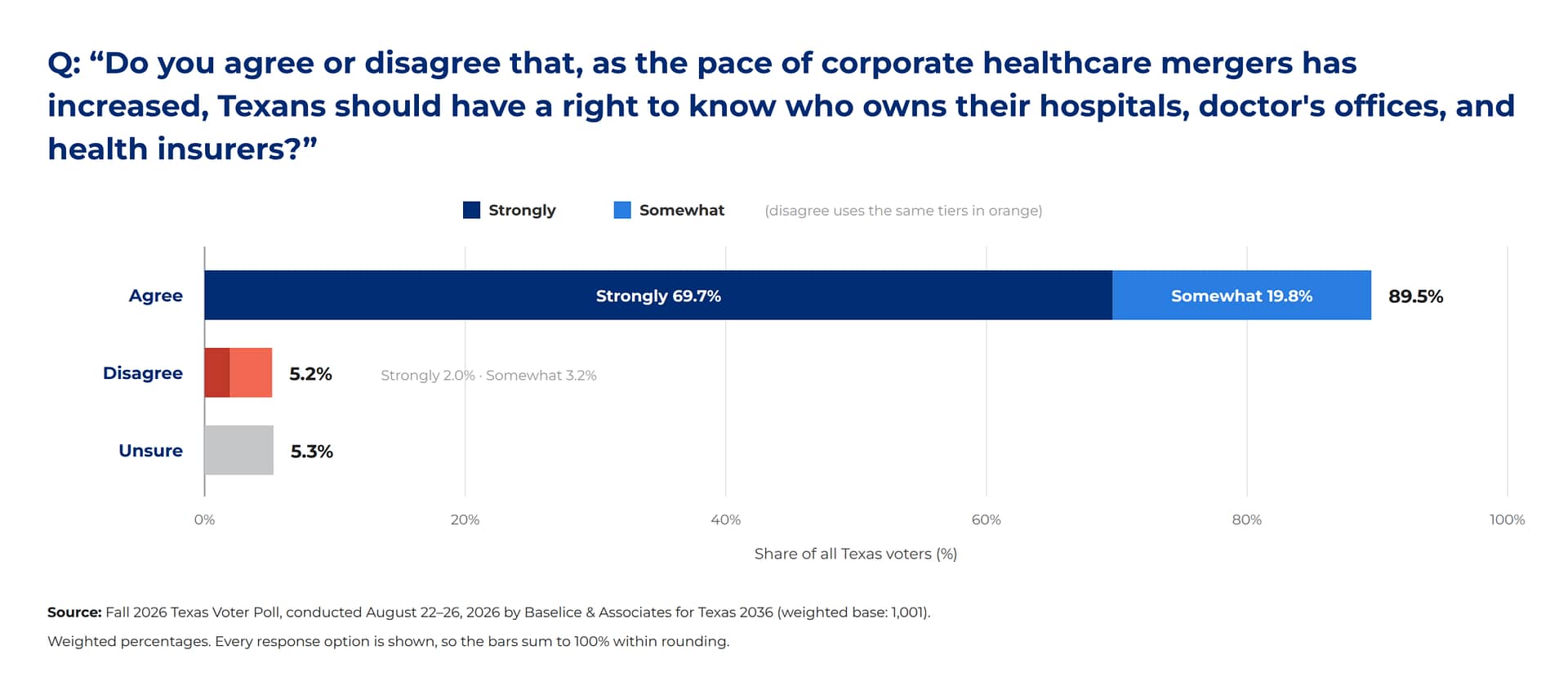
Ownership transparency is close to universal: 89.5% of Texas voters agree Texans should have a right to know who owns their hospitals, doctor’s offices, and health insurers, including 69.7% who agree strongly — the most intensely held position tested anywhere in the poll.
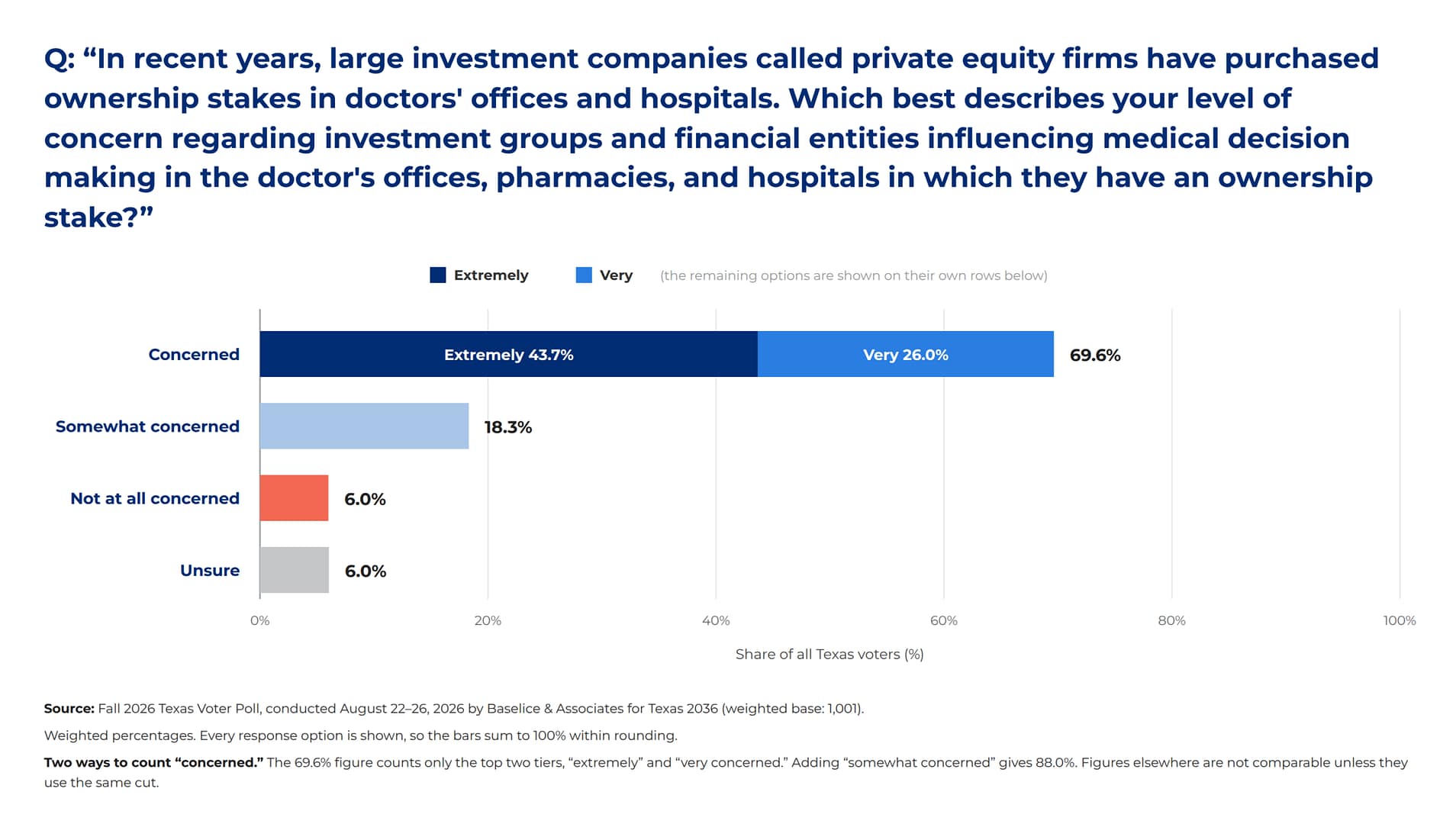
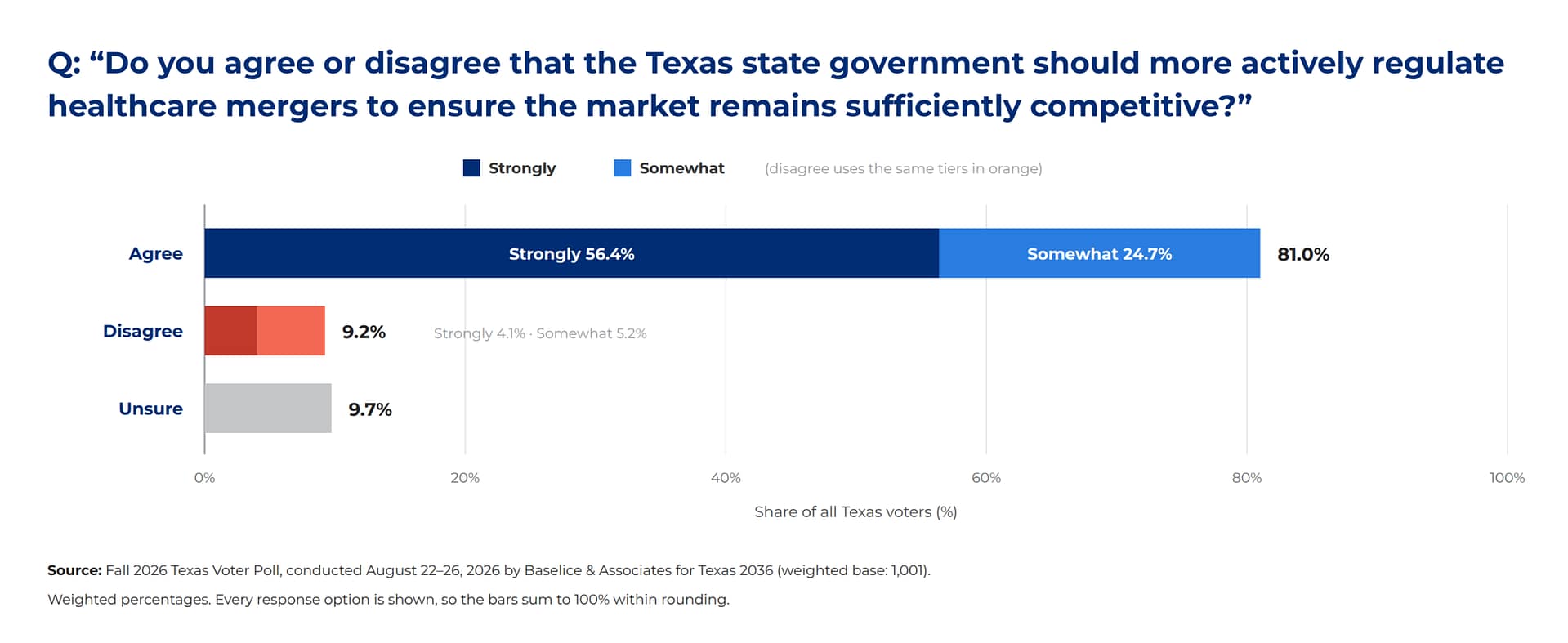
Consolidation and private equity ownership worry voters, and they want the state watching more closely: 88% express at least some concern about investment groups and financial entities influencing medical decisions, and 81% agree Texas should more actively regulate health care mergers to keep the market competitive.
Texas voters reject the status quo on healthcare: just 17.5% favor doing nothing about healthcare affordability, against 61.3% opposed, the lowest score of any approach tested.
Healthcare prices are a powerful electoral issue: 83.2% of voters say a candidate’s position on reducing healthcare prices would make them more likely to earn their vote, including 59.6% who say much more likely.
A System Patients Can’t See Into
No complete, publicly available data source tracks who owns a healthcare practice in Texas. Against that backdrop, 89.5% of Texas voters agree Texas should have a right to know who owns their hospitals, doctor’s offices, and health insurers, with just 5.2% disagreeing.
What stands out is the intensity, not just the majority. Of the 89.5% who agree, 78% agree strongly rather than only somewhat, a far more lopsided ratio than other items in the poll. When this question was tested alongside nine other approaches to healthcare prices and consolidation, it posted the widest net favorability margin of any item polled, at 84+ points.
Concerns Over Private Equity Runs Deep
As private equity firms have taken ownership stakes in doctors’ offices and hospitals, Texas voters register real unease about the medical decisions being made in practices they own. Asked about their level of concern, 69.6% of voters say they are extremely or very concerned, and 88% express at least some concern, with just 6% being not concerned at all.
Voters Want the State Watching Mergers to Keep Texas’ Healthcare Market More Competitive
That concern translates directly into support for more active oversight from the state. Presented with the issue that consolidation among hospitals and medical practices lead to higher prices and fewer choices, 81% of voters agree Texas should more actively regulate healthcare mergers to keep the market competitive, including 56.4% who agree strongly. Only 9.2% disagree, one of the widest margins in the entire poll, with a net favorability of ~72.
Texans Reject the Status Quo
We also asked voters to weigh in on 10 specific approaches to healthcare prices and consolidation, and whatever their disagreements over the specific fix, Texas voters agree on one thing: doing nothing is not acceptable. Maintaining the current healthcare status quo is the only approach that fails to win majority support, with just 17.5% in favor against 61.3% opposed, a net favorability of -43.8 and the lowest score of any option tested. More Texas voters reject inaction than reject any specific reform proposal, however contested that proposal might otherwise be.
A Powerful Electoral Signal
This attitude is not abstract, it is something Texas voters are considering when determining which candidate to vote for. A sizable majority, or 83.2%, of Texas voters say a candidate’s position on reducing healthcare prices would make them more likely to support them, including 59.6% who say much more likely, one of the strongest results of any position we polled.
The Takeaway
Across every measure, Texas voters send a consistent signal: they want to know who owns their care, and they want the state watching consolidation more closely. Nearly nine in 10 want basic ownership information made public, four in five want the state watching mergers more closely, and reducing healthcare prices ranks among the most powerful positions a candidate can hold.
The 10th Texas Voter Poll was conducted Aug. 22–26, 2026, by Baselice & Associates for Texas 2036, consisting of 1,369 completed interviews with registered Texas voters. Results weighted to represent registered Texas voters statewide with an effective sample size after weighting of 1,001. Margin of sampling error is ±3.1 percentage points.
In his policy advisor role, Alec supports the development and execution of Texas 2036's healthcare policy strategy, driving efforts that foster market reforms and ensure Texans have access to high-quality, affordable care.