

Texas families with employer-sponsored coverage now pay nearly $27,000 a year in premiums, and 63% have delayed or skipped care in the past year because of cost. In a June 2026 Texas Politics Project poll, nearly 9 in 10 Texans are concerned about healthcare affordability. Today, Texas 2036 releases Symptoms of an Unhealthy Market, a four-report series examining what’s driving healthcare prices higher in Texas and what policymakers can do about it.
Taken together, the reports find that prices, not how much care patients use, remain the primary driver of healthcare spending. The analysis also identifies reforms that could strengthen competition, improve transparency and increase accountability in the market.
“Families and employers know healthcare is becoming less affordable, but the reasons aren’t always obvious,” said Alec Mendoza, policy advisor for health and economic mobility at Texas 2036 and report author. “Many of the biggest drivers of higher prices happen through market dynamics that patients rarely see.”
Among the reports’ key findings:
Prices Versus Utilization: It’s Still the Prices finds that billing changes, not greater use of care, explain much of what patients pay.
- U.S. healthcare spending reached $5.3 trillion in 2024, nearly 18% of the national economy.
- The share of office and emergency room visits billed at the highest complexity level rose from 31% to 43% between 2012 and 2023, without a corresponding rise in patients getting sicker.
Understanding Facility Fees documents how a billing practice is weakening transparency, raising the prices of everyday care, and leaving Texans with unexpected charges.
- A primary care visit averaging $116 in a physician’s office costs $217 in a hospital outpatient department.
- One Texas family saw a routine pediatric visit rise from $90 to nearly $600 after a hospital system acquired their child’s clinic.
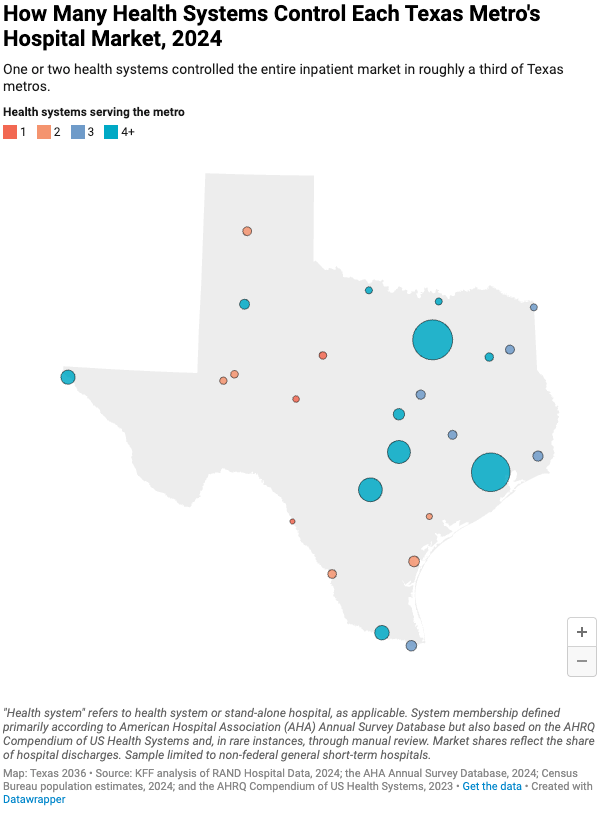
Hospital Consolidation in Texas finds an association between shrinking competition among hospitals and higher prices.
- 69% of hospitals now belong to a larger health system, up from 56% in 2010.
- In nearly half (47%) of all U.S. metro areas, just one or two health systems controlled the entire market of inpatient care.
- Nine Texas metro areas, including Amarillo, Corpus Christi and Laredo, are now served by only one or two health systems.
The True Cost of Dispute Resolution examines the rising cost of the national and state arbitration systems created to resolve surprise medical billing disputes.
- Arbitration and mediation requests to the Texas Department of Insurance grew more than tenfold, from about 49,000 in 2020 to more than 519,000 in 2023.
- Health plans and providers have paid more than $121 million in arbitrator and mediator fees since 2020, and average provider-billed amounts in arbitration cases rose sixfold, to $18,577.
Why Texas 2036 is focused on this work
“We are seeing rising healthcare prices impact family, business, local and state budgets alike,” Mendoza said. “These reports show the Legislature has options to make markets more informed, competitive and accountable, and help address healthcare affordability for Texas families, employers, and taxpayers.”
The full report series is available at texas2036.org/symptoms-of-an-unhealthy-market.