

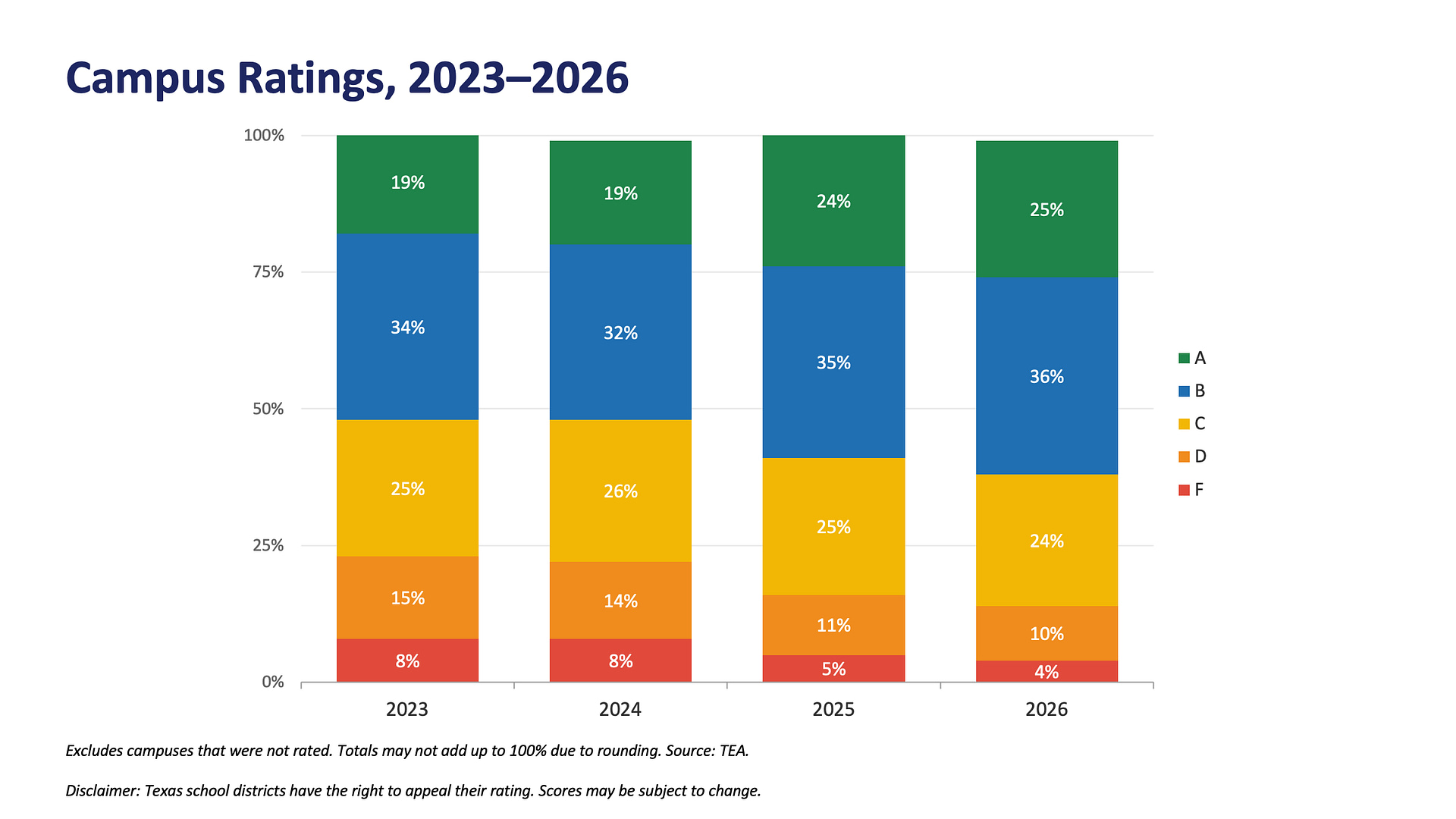
The Texas Education Agency today released 2026 A-F accountability ratings showing 61% of the state’s roughly 9,000 public school campuses earned an A or B rating, up from 59% last year; 396 high-poverty campuses received an A rating this school year.
The statewide results remain relatively stable compared with 2025, without the large year-over-year shifts seen in some previous rating cycles. But beneath the statewide numbers are several important trends: a larger share of economically disadvantaged campuses achieved an A rating, an increasing share of campuses earned an A or B rating, and many campuses were able to improve from below an A in 2025 to an A in 2026.
Texas 2036 has more information and analysis of the 2026 ratings, along with resources explaining how the A-F accountability system works, at texas2036.org/texas-a-f-school-ratings.
“From Perryton to Port Aransas, every student in Texas deserves access to a great public education. Without an accountability system, Texas would have no consistent and fair way to ensure that,” said Mary Lynn Pruneda, director for education and workforce policy at Texas 2036. “Today’s ratings are a critical signal to Texas parents on how well their student’s school is performing. They tell us if students are able to read and do math, and whether or not they’re prepared for life after high school.”
What the 2026 Ratings Show
Texas’ A-F accountability system evaluates public school campuses, districts and charter systems across three areas: student achievement, school progress and how well schools close achievement gaps. High schools, districts and charter systems also are measured on how well they prepare graduates for college, a career or the military.
The ratings provide parents and communities with comparable information about school performance and give state and local leaders a way to identify both areas of success and places where students need greater support.
Among the notable trends in this year’s results:
- Overall, 396 campuses with 80%+ economically disadvantaged students earned an A in 2026, including Dovalina Elementary (Laredo ISD, 100% economically disadvantaged), Goodrich High School (Goodrich ISD, 100%), Tool Elementary (Malakoff ISD, 80.4%), and Valley View South Elementary (Valley View ISD, 96.9%), among many others across the state.
- The share of “A” and “B” campuses grew from 59% to 61% (+2 percentage points).
- 585 Campuses moved from below an A in 2025 to A in 2026.
“Tracking school performance over time is one of the strongest tools Texas has for improving public education,” said Carlo Castillo, senior research analyst at Texas 2036. “The state’s accountability system gives school system leaders the information they need to identify what’s working and what isn’t inside their own schools, and enables policymakers to identify areas of excellence and those of improvement. When we see those trends clearly, we can act on them and improve outcomes for all Texas students.”
Where Texas still has work to do
While the percentage of campuses receiving an F decreased from 5% in 2025 to 4% in 2026, and Texas schools are improving overall, some of the state’s lowest-performing campuses continue to struggle year after year.
The Texas Legislature passed House Bill 2, a comprehensive public school finance and education reform package providing an $8.5 billion investment, including those aimed at helping more students and schools improve. These include changes to Resource Campuses, which direct funding to chronically struggling campuses; funding for private tutoring for struggling students; and intervention programs designed to equip educators with strategies to help students who repeatedly fall behind academically.
Texas now has the information to identify where students are succeeding and where they are not. The next challenge is using it to help more schools improve, with the ultimate goal that no Texas student attends a failing campus.
Learn more about the 2026 ratings and Texas’ A-F accountability system at texas2036.org/texas-a-f-school-ratings.