
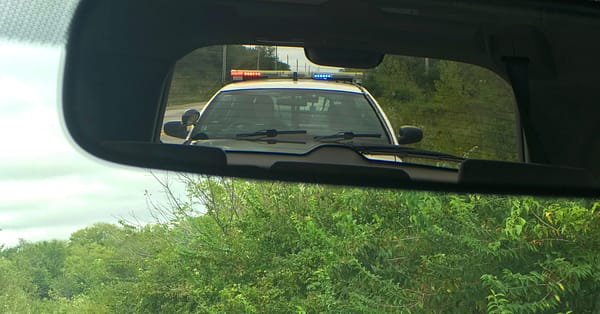
In the world of Texas justice and safety data, 2026 is off to a strong start. There are promising signs for improved motor vehicle stop data from Texas law enforcement, but the road to get here has been a long one.
Texas 2036 has been working to improve the regulation of law enforcement in Texas through enhancing the Texas Commission on Law Enforcement (TCOLE). In 2022, Texas 2036 released the Texas Law Enforcement Data Landscape, taking a wide view of the informational landscape in which TCOLE operates. One area of focus for the report was problems with the way Texas collects motor vehicle stop data.
Every year, all 2,786 law enforcement agencies in Texas are required to report whether they conduct any motor vehicle stops, and, if so, to provide data on who was stopped, why they were stopped, and what happened during the stop. This is one of the more complete statewide pictures that Texas gets on officer-civilian interactions, but, unfortunately, it suffers from some drawbacks. Among the problems are a lack of consistent standards and definitions on the front end and a lack of data validations on the back end.
What counts as a “stop”
There are basic questions like what counts as a “stop” in the first place and how to account for common occurrences that don’t neatly fall into the typical getting-pulled-over scenario. Another kind of problem is how current reporting accounts for stops of vehicles with multiple passengers, where data on the resulting actions (searches, arrests, force, etc.) fails to distinguish between the driver and someone else in the car.
Data quality problems exist that proper data validation could address. For example, in 2024 one West Texas sheriff’s office reported 2,307 total stops for the year. It also reported that of those, 2,307 stops involved physical force resulting in bodily injury, and zero stops involved no physical force. It should go without saying, but a 100% physical force rate is impossible. Errors resulting in improbable or logically impossible figures like these are unfortunately common.
These and other problems have led to sustained academic critiques and legislative scrutiny. In 2023, the Texas House Committee on Criminal Justice Reform found that “[c]urrent data quality issues arise from both lack of clear instructions to agencies and lack of proactive checking to ensure accuracy.” The Institute for Predictive Analytics in Criminal Justice at Tarleton State University annually analyzes this statewide data and recommended in its most recent report that a “standardized reporting process, which requires all data to be accurate, valid, and in balance should be required.”
A hearing to start 2026
Following more legislative attention on the issue in 2025, TCOLE decided late last year to proactively create the Motor Vehicle Stop Data Advisory Committee. The committee includes a cross-section of licensed peace officers, crime analysts and experts with representation from large and small law enforcement agencies from across the state. The panel has a charge of “recommending improvements for the collection and reporting of motor vehicle stop data… with the intent of establishing better quality data standards to produce more usable data for analysis.”
The committee held its first meeting on Jan. 6 and, following introductions and opening remarks, it began discussing substantive issues and establishing subcommittees. The committee plans to meet monthly and submit their proposed findings and recommendations by May 11 for consideration by the TCOLE Commissioners in June. With this expedited timeline, TCOLE hopes to implement some of the recommendations in time for the 2027 data collection effort.
This advisory committee is an important opportunity to think big about ways to both increase data quality and decrease administrative burdens on agencies. Hopefully, the committee will move beyond putting Band-Aids on the current data collection effort and do its work with the end-goal in mind, focusing on data-use cases that are most important for stakeholders, researchers and the public.
The public’s trust in law enforcement is a bedrock of public safety, and that requires oversight and regulation which prioritizes professionalism, transparency and accountability. As Texas 2036 said in 2022, “an effective regulatory structure that oversees law enforcement and serves Texans requires a strong foundation based in data.” If the advisory committee takes that as a starting point, and if TCOLE listens to its findings and recommendations, the agency will be driving in the right direction.