
Who are Texas’ Potential Completers? A closer look at the numbers
Note: This is Part 2 of a series on Texas 2036’s Earned but Not Awarded report.
In the first post in this series, we introduced Texas’ Potential Completers and identified why recognizing their progress matters for the state’s attainment goals. To understand the opportunity they represent, it helps to take a closer look at how these students moved through higher education.
Most Potential Completers Stayed at One Institution
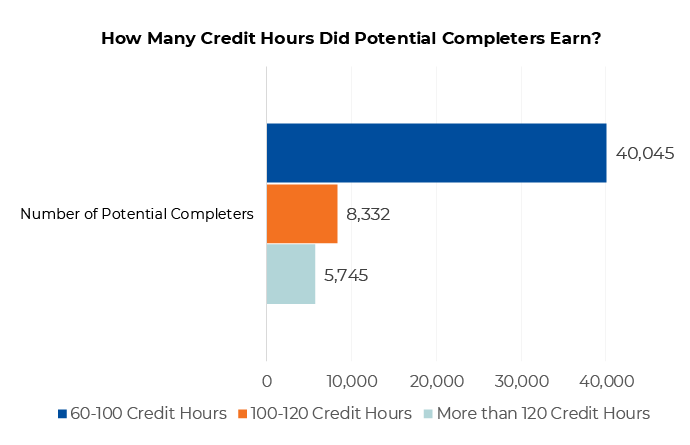
Over 70% of Potential Completers earned all of their college credits at the same four-year university where they first enrolled. Many advanced well beyond the 60-credit threshold, with more than one in 10 earning over 120 credits, enough to meet the requirements for most bachelor’s degrees.
This matters because near-completion is not only about transfer challenges. For many students, it reflects how progress is tracked and recognized within a single institution.
Others Navigated Multiple Institutions and Transfer Barriers
Some Potential Completers attended multiple institutions, often moving between two-year and four-year colleges. These students face longer timelines and greater risk of stopping out.
Students who remain at one institution graduate in about 5.3 years on average, while transfer students take closer to 7.5 years. Credit loss plays a key role. Among transfer students, 14.4% earned 120 or more credits, compared to 10.7% of students who stayed at one university, yet many saw fewer of those credits apply toward degree requirements.
Deep Progress Within Majors
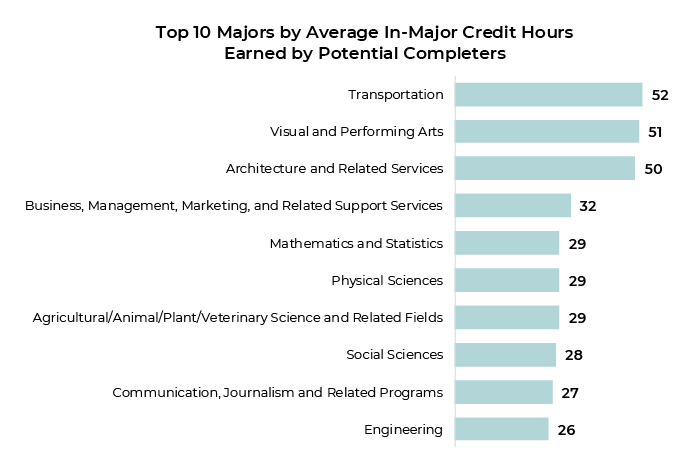
Across pathways, many Potential Completers moved deep into their programs. Students in fields such as architecture, transportation, and visual and performing arts averaged more than 50 credits within their major alone. Others built substantial coursework in demanding areas like engineering, business and biological sciences.
Academic performance reinforces this picture. Potential Completers maintained average GPAs between 2.7 and 2.8, showing consistent capacity to succeed.
Financial Context for Potential Completers
Financial pressure often intersects with these pathways. Students facing financial need may qualify for Pell Grants, which are federal awards based on demonstrated financial need. Potential Completers are more likely to receive Pell Grants and receive about $3,500 more in Pell funding on average.
For students who transfer, those pressures can intensify. Mixed-enrollment Potential Completers rely more heavily on Pell Grants but receive $500 to $800 less in total financial aid, increasing the cost of staying enrolled after years of progress.
Demographic Patterns
Men are more likely than women to become Potential Completers, with about 6% of men reaching 60 or more credits without earning a credential, compared to 4.6% of women.
Differences also appear across racial and ethnic groups. About 7% of Black students become Potential Completers, compared to 5% of Hispanic students, 4.5% of Asian students, and 4% of white students.
Achievement Without Recognition
Taken together, the picture is clear.
They persisted for years, advanced through challenging coursework, and demonstrated the ability to succeed academically. Whether they stayed at one institution or navigated multiple campuses, their records show progress that is substantial and real.
In the final post in this series, we will examine what happens next. In the next post in this series, we examine what happens after these students leave college and how outcomes differ when progress goes unrecognized.