
After college: Outcomes and opportunities for Potential Completers
Note: This is Part 3 of a series on Texas 2036’s Earned but Not Awarded report.
The first two posts in this series focused on who Texas’ Potential Completers are and how close many came to earning a credential. This final post examines what happens after these students leave college and outlines policy approaches that respond to the outcomes observed in the data.
Read more:
Part 1: EBNA report: Recognizing credits students have already earned
Part 2: Who are Texas’ Potential Completers? A closer look at the numbers
Earnings and Employment Over Time
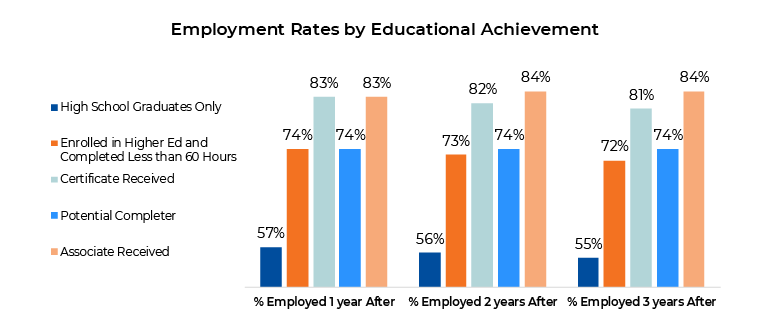
In the first few years after leaving college, Potential Completers and associate degree holders show similar earnings.
Potential Completers earn median annual wages of about $30,000 in the first year after leaving school. By the third year, their median earnings rise to nearly $46,000. Associate degree holders show a similar pattern, with median wages increasing from about $26,000 in the first year to roughly $42,500 by the third.
Over time, however, growth rates differ. Wages for associate degree holders increase by about 63% over three years, compared to 55% for Potential Completers.
Employment rates also differ. Three years after leaving college, about 74% of Potential Completers are employed, compared to 83% of associate degree holders.
Differences Across Fields of Study
Outcomes for Potential Completers vary substantially by field.
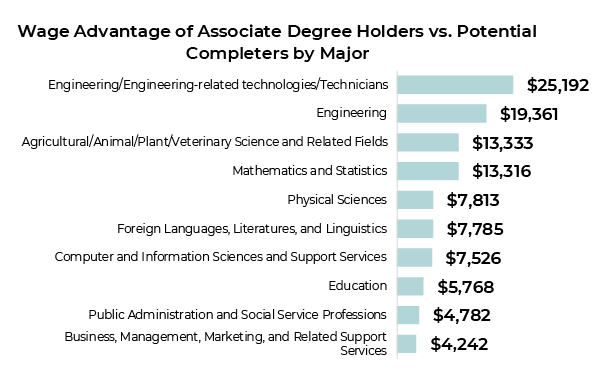 In technical and applied disciplines, differences between Potential Completers and associate degree holders are larger. In engineering technologies, Potential Completers earn about $25,000 less per year than associate degree holders in the same field. Employment rates in the engineering technologies field are also lower for Potential Completers. In mathematics-related fields, wage differences exceed $13,000 annually.
Looking at other fields, differences are smaller. In majors such as visual and performing arts, social sciences, and biological and biomedical sciences, wage differences between Potential Completers and associate degree holders are generally less than $5,000 per year.
These patterns indicate that labor market outcomes associated with partial completion vary depending on field of study.
Differences Across Demographic Groups
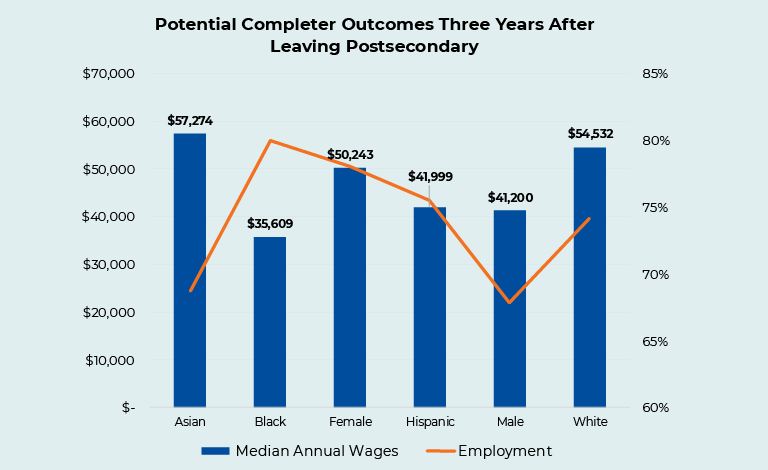
Labor market outcomes for Potential Completers vary most notably by gender. Three years after leaving college, female Potential Completers have a median wage of $50,243 and an employment rate of 78%, compared to $41,200 and 68% for men. Men also face the steepest drop relative to credentialed peers, with an employment rate 15 percentage points below associate degree holders.
Taken together, these patterns show that college progress carries labor market value, but that outcomes differ depending on field of study, time, and whether progress is formally recognized through a credential. These findings provide context for understanding differences in employment and earnings among students who leave college without a credential.
Policy Approaches to Recognize Progress
The outcomes described above point to opportunities to better align postsecondary systems with how students progress through college and into the workforce. The Earned but Not Awarded report identifies several policy approaches that would formally recognize learning that has already occurred and reduce the likelihood that students leave college without a credential.
-
Retroactive credentialing
Allows four-year universities to award associate degrees to former students who already met requirements, ensuring progress completed at a single institution is formally recognized.
-
Embedded credentials
Awards associate degrees or certificates automatically as students progress through bachelor’s pathways, capturing milestones before students stop out.
-
Reverse transfer
Strengthens processes that allow students who begin at community colleges to receive associate degrees after transferring, addressing outcomes for mixed-enrollment pathways.
-
Credit portability
Reduces credit loss during transfer so accumulated coursework applies consistently toward degree requirements.
-
Competency-based education
Provides additional pathways for students to earn credit based on demonstrated skills, particularly in technical fields where outcomes diverge most sharply.
Across this series, the data show that thousands of Texans made substantial progress toward a credential, left college without formal recognition, and experienced varied workforce outcomes as a result. By strengthening systems that recognize earned progress, Texas can better align postsecondary pathways with labor market expectations and ensure that credits completed translate more consistently into credentials.