

One of the clearest findings from our 10th Texas Voter Poll is that Texans share broad agreement on many of the challenges facing the state. Looking at the results by partisanship also shows where different groups place greater emphasis.
For Republican voters, the results point to a mix of longstanding priorities and broad interest in issues ranging from education and affordability to infrastructure and workforce outcomes.
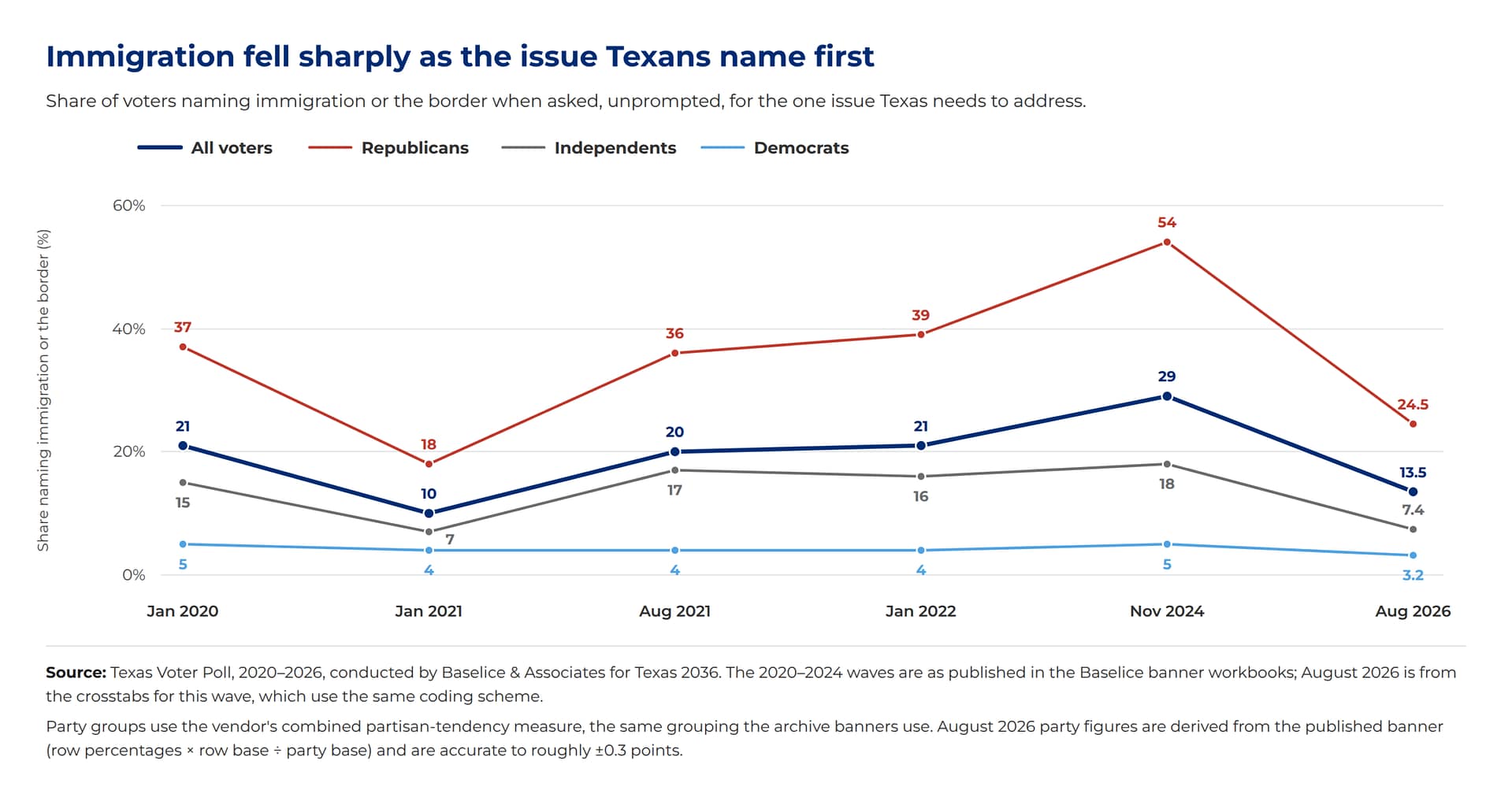
Border security remains important, but fewer Republicans name it first
Border security remains a clear Republican priority, but it is no longer consuming the same share of the party’s attention. When asked how specific policy positions would affect their support for a candidate, 86.3% said prioritizing border security would make them more likely to support that candidate.
But the poll’s open-ended question adds another dimension.
When Republicans were asked, without being given a list, to name the one issue Texas most needs to address to be successful in the future, about 24.5% named immigration and the border. That is less than half the 54% who volunteered the issue in November 2024.
The difference between the prompted and open-ended responses suggests that border security remains important to Republican voters, but the sharp decline in Republicans indicates considerably more room in their issue agenda for education, affordability, infrastructure and other concerns.
Republican voters place strong emphasis on education outcomes
Education also produces some of the strongest responses among Republican voters.
85.6% say they would be more likely to support a candidate committed to ensuring Texas students can read and do math at grade level. Meanwhile, increasing public education funding receives a positive response from 55.3%.
That emphasis on outcomes extends beyond K-12 classrooms. 86.1% of Republicans support requiring Texas to track and publicly report whether its education and job-training spending leads to good-paying jobs.
For Republican voters, the distinction between spending more and getting better results is significant. They respond much more strongly to improving reading, math and college and career readiness than to increasing public education funding. Coupled with 86.1% support for reporting whether education and workforce spending leads to good-paying jobs, the results suggest Republicans place greater emphasis on what Texas gets for its education investments than on increasing those investments alone. Texas 2036’s broader analysis of the poll similarly found statewide support for tying education and workforce investments to measurable results.

Affordability and core services broaden the picture
Republican voters’ views on health care are more nuanced than a simple preference for less state involvement. Nearly two-thirds support the state negotiating lower hospital prices for teachers even when presented with the tradeoff that hospitals would earn less. The finding suggests targeted government action can draw Republican support when it is tied to a specific affordability problem and a clearly defined result.
Water and electricity also draw broad interest. Nearly eight in 10 Republicans say prioritizing water projects that deliver specific benefits is extremely or very important. And when voters are asked how Texas should weigh reliability, affordability and emissions in considering grid reforms, every partisan group places reliability first.
Taken together, the findings show a Republican electorate that continues to place substantial emphasis on border security while also prioritizing student outcomes, affordability, workforce results and the infrastructure Texas relies on to grow.
Those priorities provide a broader picture of the policy issues Republican voters bring to the conversation about Texas’ future.