

Last year, approximately 25% of Texas students attended a campus that earned the state’s top A rating, and nearly 37% attended a B-rated campus. While an A or B rating is indicative of a high-performing campus, it does not mean that all students in those schools are on grade level.
The grade reflects three things, not one
A campus’ overall rating takes into consideration Student Achievement (raw performance on STAAR and other measures), School Progress (year-over-year academic growth or how a campus performs relative to its peers), and Closing the Gaps (how well a campus serves its lowest-performing student groups). A campus can earn an A rating through strong absolute performance or through strong progress, which is why two A-rated campuses can look different on paper but still earn the same grade.
An “A” rating does not mean every student is on grade level
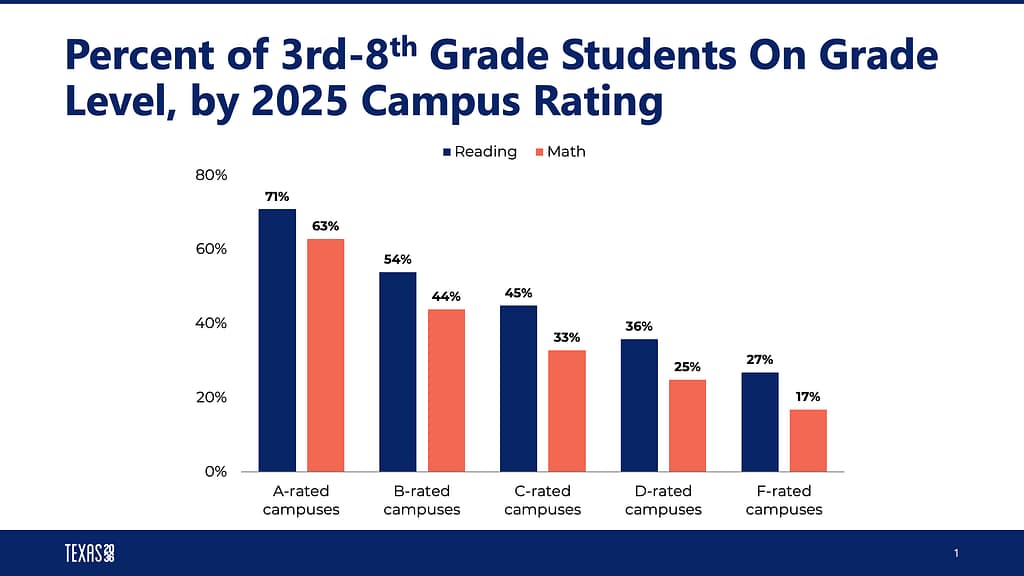
Looking at 2025 STAAR results for grades 3-8 across the state, 71% of students at A-rated campuses met grade level expectations in reading and 63% did in math. These numbers are well above the state average, but roughly three in 10 students at an A campus are behind in reading, and close to four in 10 are struggling in math.
At B-rated campuses, proficiency falls to 54% (reading) and 44% (math). At F-rated campuses, only 27% of students meet grade level in reading and just 17% in math. Put another way, students at A-rated campuses are 2.6 times as likely to be on grade level in reading as students at F-rated campuses, and 3.7 times as likely to be on grade level on math.
What this means
Texas doesn’t need to import a fix from somewhere else. It already has hundreds of working examples of what a high-performing campus looks like across the state. A-rated campuses are an opportunity to study and scale those practices.
What are these schools doing differently in staffing, instructional time, curriculum and use of data that’s producing stronger results, and how quickly can those practices reach the campuses still working to close gaps in learning?