
No energy resource in Texas is growing faster than battery energy storage systems (BESS). VC-funded startups are surging here, there, and everywhere to build the industry. A search for “battery storage” returns thousands of recent headlines. But quantifying the actual utility-scale power available from batteries right now takes a bit more legwork.
To quantify utility-scale energy storage’s contribution to grid capacity, this post analyzes data from the U.S. Energy Information Administration’s (EIA) annual Form 860. It reports each generator’s nameplate capacity, which is the maximum instantaneous power output in megawatts (MW). We pulled facilities with prime mover code “BA” (for battery), aggregated by state and year to total the battery storage capacity available on the grid.
Nameplate capacity is not the same as power actually delivered. EIA’s Form 923 reports battery discharge minus electricity consumed, a net-negative figure that reads more as an accounting measure than a gauge of market value or reliability. Batteries are increasingly vital to ERCOT’s grid reliability: they store power at off-peak times, when demand and prices are low, then release it when the grid needs it most — smoothing the volatile hours after sunset before the wind picks up and before dawn when the sun returns.
This installment in our series on Texas’ “all of the above and below” energy leadership focuses on utility-scale batteries and where Texas stands nationally. Nameplate capacity is only a starting point: EIA’s Form 860 doesn’t capture annual discharge cleanly, nor does it include residential batteries, a growing phenomenon in Texas. Still, it gives us a window into this fast-moving sector.
Texas has grown its battery capacity by over one million percent in 15 years
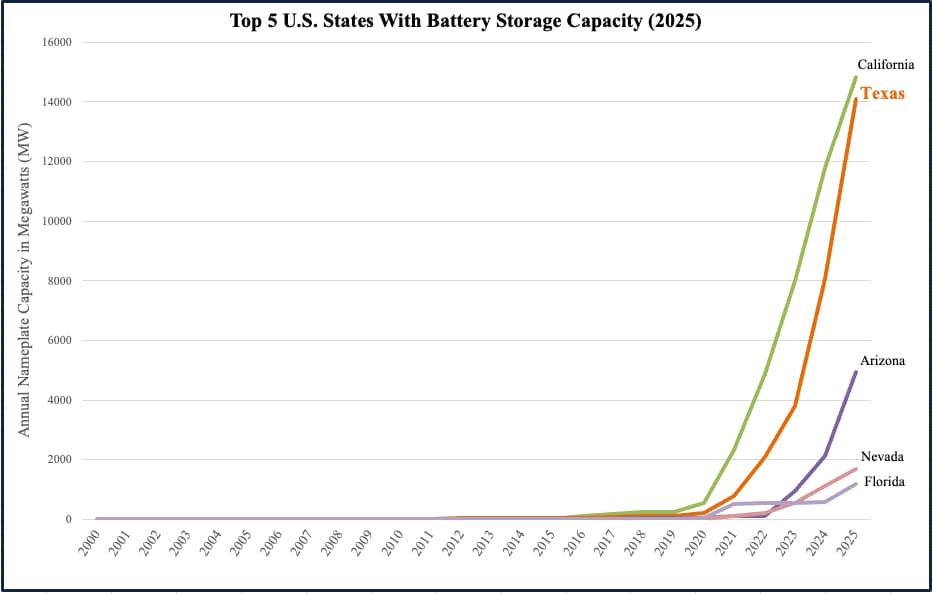
Texas ranks second in the U.S. for utility-scale battery storage based on early 2025 data, clocking 14,109 MW of nameplate capacity – just shy of California’s 14,853 MW. This growth is illustrated in the chart Top 5 U.S. States with Battery Storage Capacity (2025). Texas’ rate of growth since 2010 is astonishing; in 15 years, the state has grown its battery capacity by 1,410,800%. This percentage increase far surpasses any other form of energy studied in this series, dwarfing even the rapid rise of solar and wind over the same time period.
Battery storage capacity has risen dramatically in the last 15 years
Unlike nuclear or natural gas, utility-scale battery storage emerged around 2010, and EIA’s reporting is still catching up; Form 860 didn’t have a dedicated “Energy Storage” tabulation until 2016.
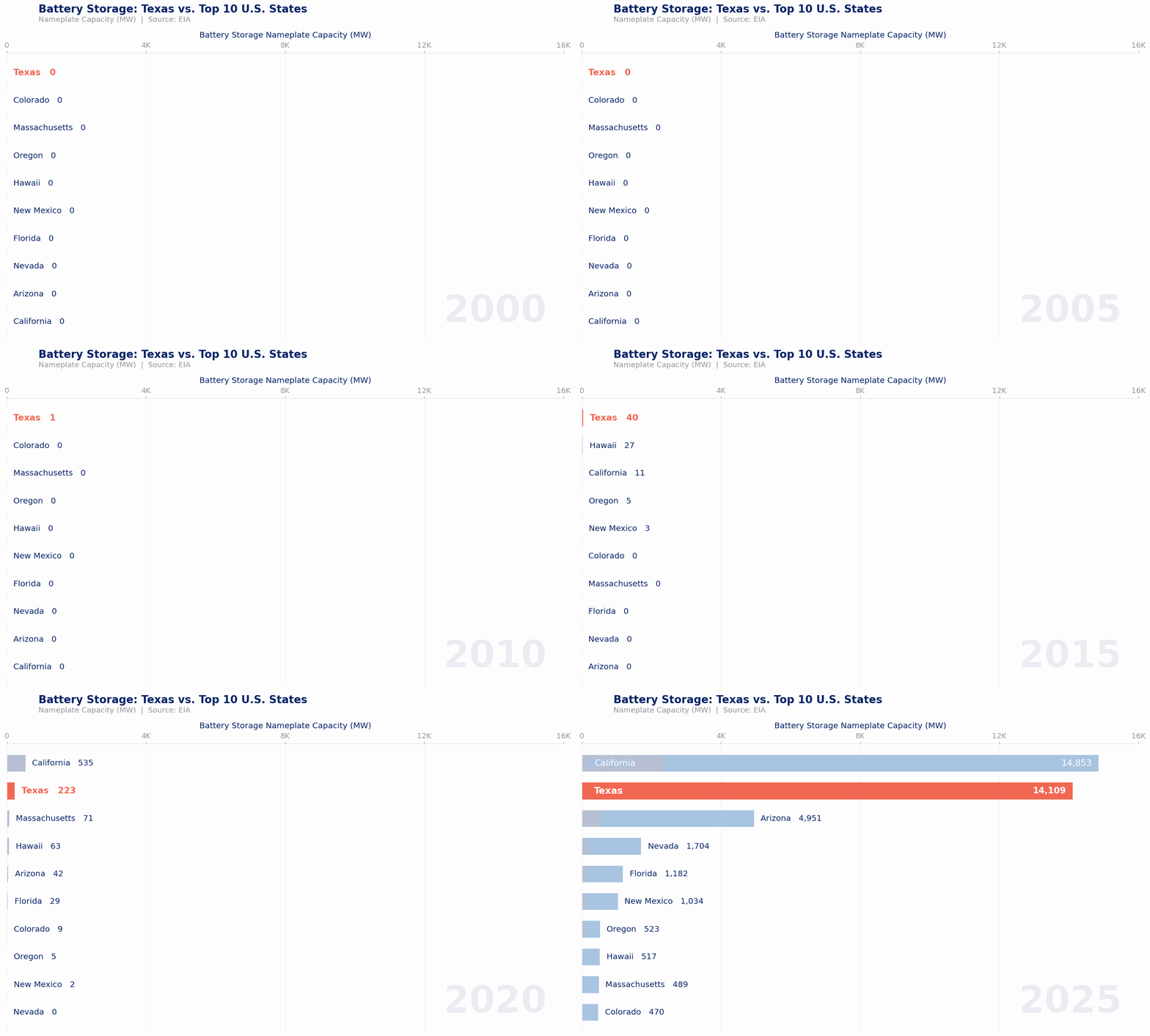
Illustrated in Battery Storage: Texas vs. Top 10 U.S. States, 2000-2025, Texas was first out of the gate in 2010, but California took the lead by 2016. As of 2024, the states were once again neck and neck. Texas and California together are the clear leaders, accounting for two-thirds of the entire U.S. battery storage fleet. However, Texas is projected to surpass California in 2026.
Batteries could help solve some of Texas’ grid issues
Distributed energy resources (DERs) involve the use of batteries in a decentralized way, often entirely “behind the meter,” that is, separate from the electricity grid. DERs couple power generation with BESS to create a “microgrid.” When a facility operates separately from the larger electricity grid, it is referred to as being on its own “island.”
EIA captures small-scale “behind the meter” generation in a different form (EIA Form 861). However, the reporting is initiated at the utility level and is typically limited to microgrids of less than 1 MW. This data likely does not capture larger commercial facilities operating entirely off the grid, outside utility or state purview.
Texas policymakers could consider asking commercial and industrial users to disclose any behind-the-meter power generation to give the state the full picture of both power usage and potential grid capacity. Many newcomers are choosing to build their own generation on their own island due to a long wait for grid interconnection. Folded into a broader large-load data transparency effort, this disclosure could help legislators understand how much new generation is being built across Texas. Armed with this information, the state can make crucial decisions to streamline future interconnectivity of these microgrids to boost overall grid strength and reliability.
The technology is advancing
Battery technology is advancing swiftly alongside adoption. Co-location of BESS with other forms of power generation is becoming standard practice. Also, longer durations and larger capacities are on the horizon. To unleash growth and innovation in the battery sector, markets must reward long-term thinking. ERCOT’s ancillary services currently favor shorter-duration batteries, which could stymie that progress.
California’s utility-scale batteries average four hours of duration compared with Texas’ two. By encouraging investment in the longest-duration, highest-capacity systems possible, we can continue to build a Texas-sized energy grid.