
This is a preview of our Texas 2036 newsletter discussing the forces shaping Texas’ next decade. To receive this weekly look at our work, sign up here.
The Decade That Will Shape Texas At 200
Texas has begun the 10-year countdown to its bicentennial with strong momentum. From 2000 to 2025, its economy has nearly quadrupled to $2.9 trillion. By 2036, about 35.7 million people are projected to call Texas home — 4 million more than today.
Whether Texans benefit from that growth will depend in part on our ability to prepare the next generation for an evolving economy.
This edition examines three forces shaping the decade ahead: changing population trends, the state’s economic momentum and the education and workforce pipeline.
Texas Is Growing, But Not At Same Pace or Place
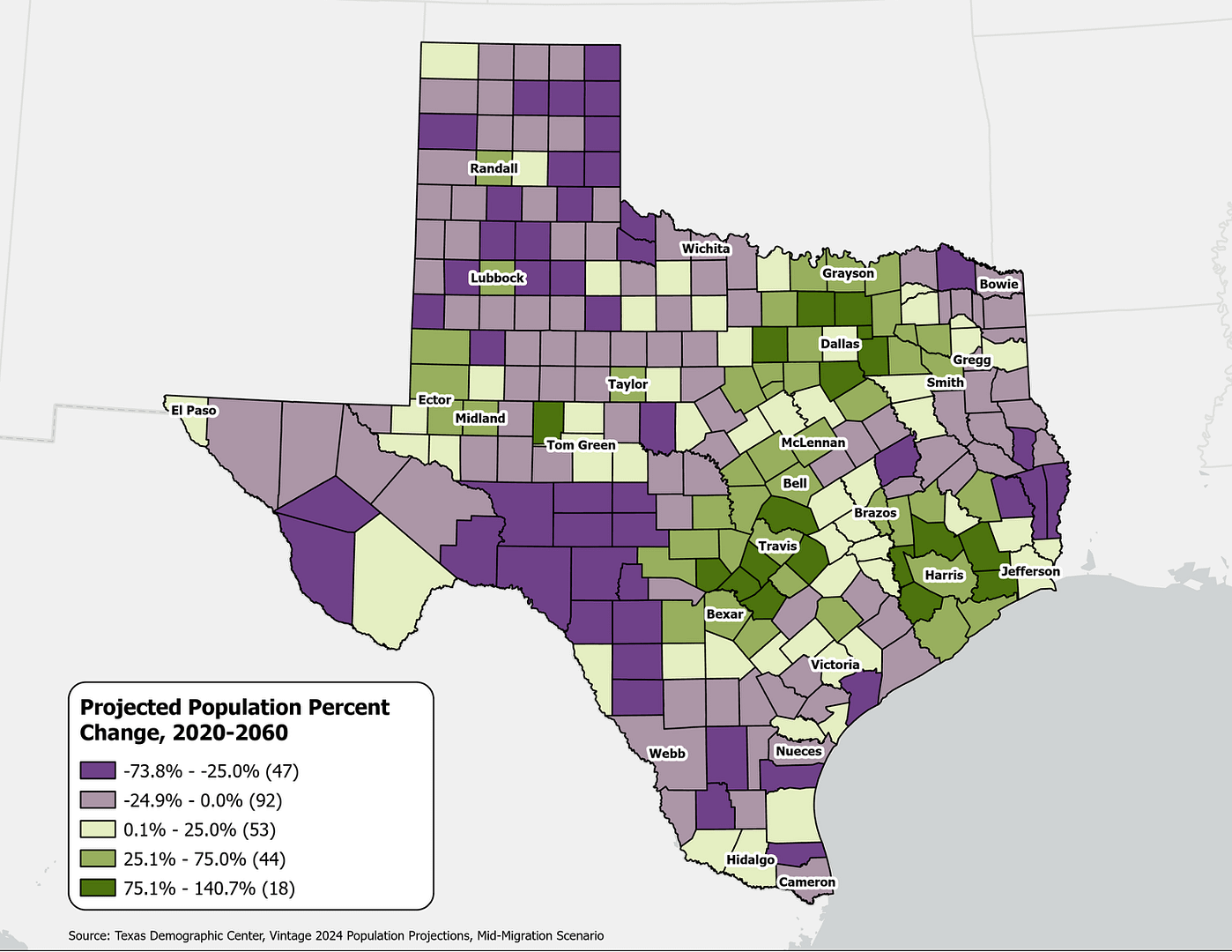
Texas continues to add people faster than any other state. It added more than 391,000 residents between July 2024 and July 2025, bringing the state’s population to 31.7 million. Its 1.2% growth rate remained more than twice the national rate of 0.5%. However, that growth is slowing, concentrating in a few regions as the state overall grows older.
What the data shows:
- Migration to Texas is slowing. A drop in international migration was the biggest driver of slower population growth. Net migration from other states also fell to about 184 people per day in 2024-25, down from more than 500 per day two years earlier.
- Nearly all net growth is projected to occur in the Texas Triangle. The Dallas-Fort Worth, Austin, San Antonio and Houston regions are expected to account for 99% of the state’s net growth through 2036.
- Rural counties are aging fastest. In 2025, 134 counties recorded more deaths than births. Meanwhile, the share of Texans 65 and older is projected to rise from 13.5% in 2020 to 21.7% by 2060.
Source: Texas 2036 analysis of U.S. Census Bureau Vintage 2025 Population Estimates & Texas Demographic Center projections. Published May 26, 2026. Read the full analysis
The opportunity ahead 🌟
Texas can use the next decade to prepare for different regional futures. That means expanding capacity where demand is rising while helping aging and slower-growing communities sustain their workforces, economies and essential services.
Texas Accounts For A Larger Share Of U.S. Economy

As Texas added millions of residents, it also gained economic ground nationally.
What the data shows:
- The Texas economy grew from $742 billion in 2000 to $2.9 trillion in 2025, moving from the nation’s third-largest state economy to its second largest.
- Texas’ gross domestic product grew 291%, faster than every other top-10 state economy.
- The state’s share of U.S. gross domestic product increased from 7.2% to 9.4%, the largest gain of any state.
Source: Texas 2036 analysis of U.S. Bureau of Economic Analysis data, 2000–2025. Published June 4, 2026. The Texas Economic Miracle
The opportunity ahead 🌟
Texas enters the next decade with the economic strength to expand opportunity for more people. The work now is to build stronger connections among education, workforce training and careers that provide economic security so that more Texans can participate in the state’s continued growth.
Expanding Pathways to Opportunity for TX Students
Every Texas student should leave school prepared to choose what comes next, whether that is college, a credential or a good career.
Recent data offer reasons for encouragement, alongside clear reminders of how much work remains. While the state has made progress in reading, campus performance and career-connected education, too many students remain below grade level, math recovery is incomplete and enrollment trends are reshaping schools statewide.
What the data shows:
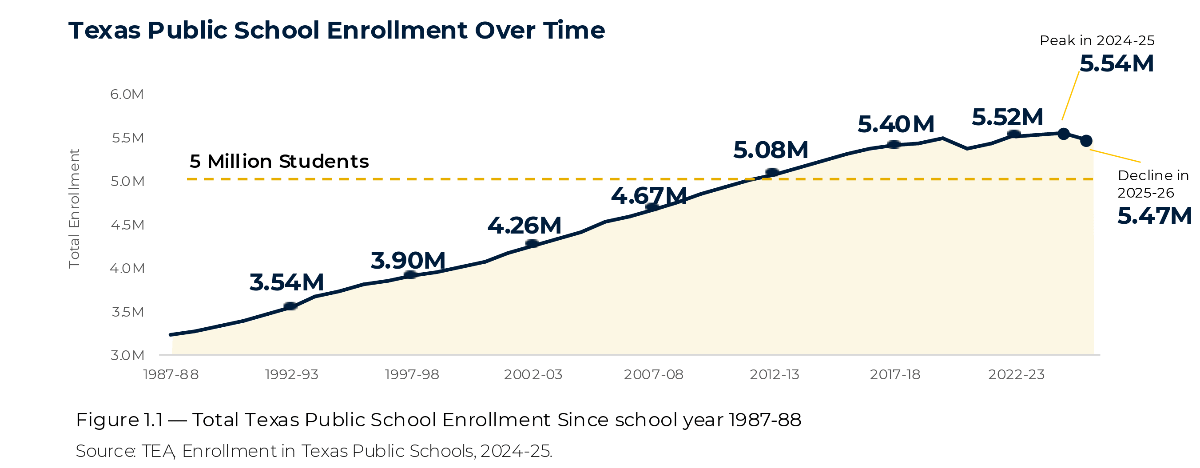
- Enrollment is falling, particularly in the early grades. Public schools lost about 76,000 students in 2025-26, the largest non-pandemic decline in decades. Nearly 60% of that decline occurred in kindergarten through fifth grade. Student populations are projected to begin rebounding by the end of the decade, making these shifts important for how districts plan for the years ahead.
- More campuses are earning higher ratings, but improvement is not universal. From 2023 to 2026, the share of campuses receiving an A or B increased from 59% to 61%, while 24% improved their rating. Among campuses where at least 80% of students are economically disadvantaged, 49% earned an A or B in 2026, up from 47% in 2025.
- Reading has improved, but substantial gaps remain, especially in math. Reading performance now exceeds pre-pandemic levels across every tested grade. Eighth-grade reading increased from 53% at grade level in 2019 to 59% in 2026. That progress matters, but it also means more than four in 10 eighth graders are still not reading at grade level. Math recovery has further to go, with seventh-grade math performance still 12 percentage points below its 2019 result.
- More students are completing career-connected pathways. Postsecondary credentials earned in high school have increased 532% since 2018, while credentials of value earned in community college have increased 22.3% since 2023. For rural students, completing blended education and workforce pathways is associated with earnings that are $17,170 higher six years later.
The opportunity ahead 🌟
Texas has made progress, but the job is far from finished. The next decade will require sustaining gains in reading, accelerating math improvement and expanding access to education and workforce pathways that prepare students for what comes after high school.
At the same time, changing enrollment patterns will require schools and policymakers to plan carefully for where students are and what they need to succeed.
Turning Momentum Into Lasting Prosperity
Texas approaches its bicentennial with considerable strengths: a growing population, a powerful economy and progress across key areas of education and workforce preparation. But demographic shifts, uneven student outcomes and other long-term pressures mean the state cannot rely on growth alone.
The choices Texas makes now will determine whether that momentum creates greater opportunity for the next generation.
Next week: How affordable healthcare, reliable energy and water supplies can help Texas sustain its momentum.
What Gives You Hope About Texas’ Future?
Texas faces important challenges, but it also has tremendous strengths. Tell us what gives you confidence about the decade ahead.