

This is the second part of a series exploring Texas 2036’s new report, The Next Generation of the Texas Miracle.
Preparing more students for success after high school is only one part of building a stronger education-to-workforce pipeline. Students also need postsecondary institutions that help them complete credentials with real value in the workforce.
For decades, community colleges were largely funded based on how many students walked through their doors. But enrollment alone doesn’t tell us whether students complete a credential, transfer to a university, or earn wages that support themselves and their families.
In 2023, lawmakers fundamentally changed community college finance through House Bill 8. It created one of the nation’s most ambitious outcomes-based funding systems. Rather than rewarding enrollment, the state now rewards colleges for helping students achieve milestones that lead to long-term success.
Rewarding outcomes that matter
Under the new funding model, community colleges receive funding for three key student outcomes:
- successful transfer to a four-year institution
- completion of meaningful dual credit coursework
- earning a Credential of Value
These outcomes reflect the state’s broader goal of connecting education to workforce opportunity rather than simply measuring participation.
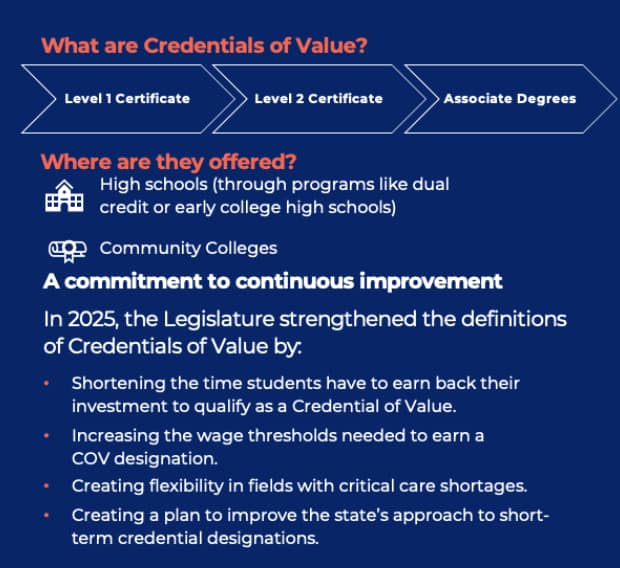
Credentials of Value are central to the new model. These credentials must demonstrate workforce value by leading graduates to earnings that exceed both the cost of the credentials with demonstrated economic returns. By tying funding to credentials with demonstrated value for students, Texas is aligning public investment with student success.
The Legislature continued strengthening this approach in 2025 through Senate Bill 1786. It refined how Credentials of Value are evaluated by:
- increasing wage expectations
- accelerating the timeframe for measuring return on investment
directing additional work to improve the framework for short-term credentials
These reforms are already taking shape across the state. In 2024, Texas community colleges awarded approximately 140,000 Credentials of Value. That reflected the scale of the state’s investment in outcomes-based funding and workforce-aligned credentials.
Looking Ahead
Texas’ shift to outcomes-based funding represents an important step toward ensuring students earn credentials that provide long-term value. But rewarding outcomes also requires understanding which programs are producing the strongest results.
Texas is continuing to strengthen the education and workforce data systems needed to connect postsecondary credentials to employment outcomes, regional workforce needs, and economic mobility. Better workforce data can help policymakers identify which programs are creating opportunity for students, adjust Credentials of Value to better reflect regional labor market needs, and ensure state investments continue supporting pathways that deliver meaningful returns for Texans.
The final part of this series explores how Texas can integrate better across education and workforce agencies, expanding career-connected learning, and building the data infrastructure needed to continually improve outcomes for students and employers alike.
Read the full report, The Next Generation of the Texas Miracle, to learn how Texas is aligning higher education funding and workforce opportunity.