
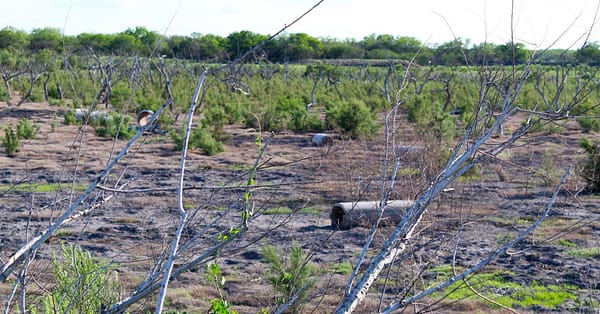
A new Texas 2036 report finds that across 25 years and five planning cycles, Texas’ state and regional water planning process never projected the water shortage that pushed Corpus Christi and other Coastal Bend communities into crisis earlier this year.
By April 2026, combined storage in the reservoir system serving the region had fallen to less than 8%, below the reserve set aside for a worst-case drought, triggering local drought disaster proclamations, significant water-use restrictions and a credit downgrade for Corpus Christi.
The report, The State Water Plan & The Coastal Bend Water Crisis, examines every state and regional water plan produced since the Legislature passed Senate Bill 1 (SB 1) in 1997, creating the bottom-up planning process in which regional planning groups identify when potential water shortages could occur and recommend water supply projects to meet those needs. These data and recommendations are incorporated into the state water plan prepared by the Texas Water Development Board (TWDB).
Neither the state water plan nor the Coastal Bend regional plan ever projected a shortage for Corpus Christi, Alice, Rockport, Aransas Pass, Port Aransas, Ingleside, Mathis, Portland or Beeville — the communities at the center of the crisis.
The report finds the failure was not the fault of any single plan or planner. The TWDB and the Coastal Bend planning group followed the state’s rules and used the drought assumptions those rules required. But the laws, data and assumptions underlying the process did not provide consistent warning that the region needed major drought-resilient supplies before the 2020s.
Texas 2036’s full report is available at Your Guide to Texas’ Water Future.
“Texas created the state and regional water planning process to give communities signals about future water needs and enough time to act,” said Jeremy Mazur, Director of Infrastructure and Natural Resources Policy at Texas 2036. “In the Coastal Bend, that signal was inconsistent. That’s not a reason to abandon the process. But it is a reason to strengthen the laws, data and accountability mechanisms behind it as Texas moves forward with a new era of water infrastructure investment.”
Among the report’s findings:
- The signal reversed direction from cycle to cycle. Projections shifted across planning cycles — from no regional water shortage, to a projected deficit, back to a surplus, and then to a larger shortfall just before the crisis. Consequently, the data from the reports from each planning cycle did not point to a regional water crisis like that seen earlier this year.
- “No shortage projected” for Corpus Christi and other cities at the heart of the water crisis. Plans from each planning cycle consistently concluded that Corpus Christi and neighboring cities would not have water shortages during the 2020s.
- Recommended projects did not consistently translate into completed water supplies. Of the strategies recommended for the 2020s in the final planning cycle before the crisis, only one — a brackish groundwater desalination plant in Alice — had been built by 2025.
“A community reading these plans in sequence had no stable warning to act on,” Mazur said. “The plans followed the laws and rules they were given. The rules just weren’t up to catching a crisis like this one.”
Texas Has Increased Its Commitment to Water
The Coastal Bend’s water crisis came after Texas substantially expanded its commitment to water infrastructure and new water supplies.
Over the past several legislative sessions, lawmakers and voters have created and expanded major financing tools tied to the state water plan. Those include the State Water Implementation Fund for Texas (SWIFT); the New Water Supply for Texas Fund, created to support projects such as desalination, produced-water treatment, aquifer storage and recovery, and conveyance infrastructure; and the Texas Water Fund.
In 2023, the Legislature and Texas voters approved the creation of the Texas Water Fund to help address the state’s long-term water infrastructure needs. In 2025, voters approved a dedicated revenue stream of up to $1 billion per year for the fund for the next 20 years.
“Texas’ new financial strategy for water infrastructure development presents an opportunity to strengthen the planning process so public dollars translate more reliably into completed projects, new water supplies and greater drought resilience,” Mazur said. “As Texas commits billions more to water infrastructure, a renewed focus should be on how those investments deliver measurable improvement in water security consistent with an actionable state water plan.”
Strengthening the Planning Process
The report recommends the Legislature and the Texas Water Development Board strengthen the planning process in six ways:
- Verify the data before planning begins. Add a dedicated data and model readiness phase — completed before the first legislative session after each planning cycle — to review hydrologic models, groundwater availability models, and drought-of-record assumptions, and to flag gaps before regional planning starts.
- Turn plans into an actionable blueprint. Classify recommended strategies by purpose and urgency, map shortage-driven projects directly to the communities they serve with start dates and milestones, and require project sponsors to formally commit before a project is listed as a recommended strategy.
- Track implementation across planning cycles. Require plans to show how projections and recommendations changed from cycle to cycle and why. Incorporate stronger metrics on actual construction progress and water delivered or conserved.
- Stress-test for worse droughts. Require sensitivity analyses showing how supplies, shortages and strategy needs would change under drought conditions worse than the official drought of record, and revisit whether the five-year planning cycle and long-term horizon give planners enough time to update data and guide implementation.
- Distinguish shortages from vulnerability. Require plans to flag communities that are vulnerable to drought — because they depend on a single water source, a common wholesale provider, or lack emergency interconnections — even when no shortage is formally projected.
- Formally notify at-risk communities. Create a process requiring water providers and project sponsors to be formally notified of a projected shortage and to acknowledge whether they accept it, dispute it, or intend to address it. Require future plans to explain whether voluntary transfers or water markets could help move supply to needed areas.
A bottom-up planning model
The report notes that Texas must have a state water plan informed by the bottom-up planning model established by SB 1. Regional planning groups bring local knowledge and priorities that meaningfully inform the state water plan. The Coastal Bend experience, however, demonstrates the need for clearer statewide standards, stronger data and more transparent implementation measures so policymakers, communities and project sponsors can distinguish between projects that are optional, precautionary or urgently needed.
The Coastal Bend is paying the cost for these gaps in the planning process. The rest of Texas should use this moment to fix those gaps before the next region finds itself caught up in crisis.
Read the full report at Your Guide to Texas’ Water Future.