
Every year, Texas assigns every public school campus, district and charter a letter grade meant to answer one basic question: how well is this school serving its students? Here’s a primer on what that grade actually measures and how Texas got here.
What the system measures
The A-F Accountability Rating System evaluates every district, campus and open-enrollment charter school across three domains:
- Domain 1: Student Achievement — STAAR performance, graduation rates, and College, Career, and Military Readiness;
- Domain 2: School Progress, measured two ways:
- Academic Growth, which tracks year-over-year academic growth on the STAAR test
- Relative Performance, which includes campus-level performance on STAAR and College, Career, and Military Readiness relative to campuses serving similar levels of economically disadvantaged students; and
- Domain 3: Closing the Gaps, which shows how well a school serves its lowest-performing student groups, tracked across multiple categories.
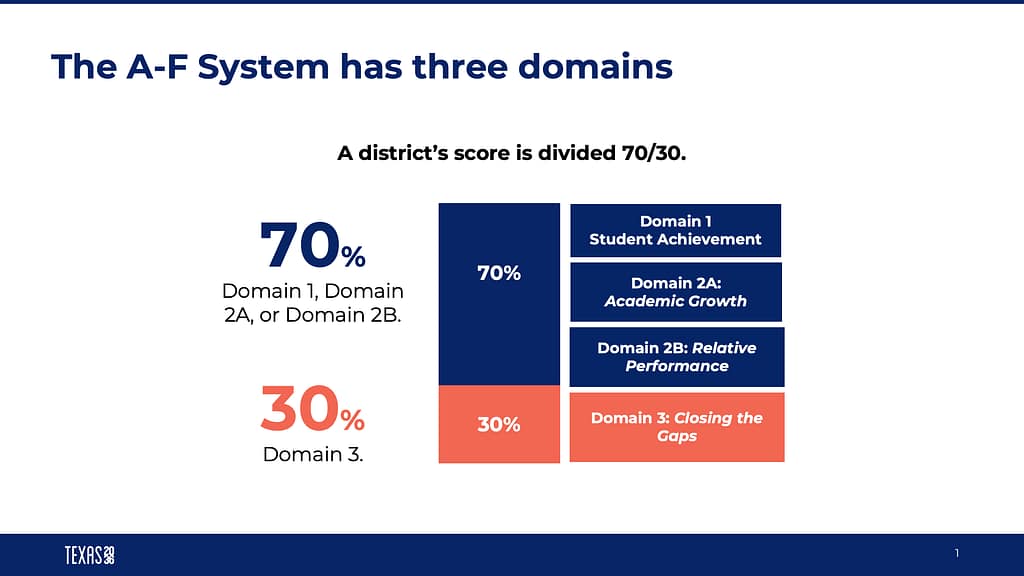
The overall rating combines the better of a school’s Achievement or Progress score (70% of the total score) with its Closing the Gaps performance (30% of the total score), then converts that numerical score into a rating on a 0-100 scale.
The Origins of Texas’ School Accountability System
Texas has evaluated school performance in some form for decades, but the current A-F framework dates to 2017, when the 85th Texas Legislature unanimously passed House Bill 22, replacing the Met Standard/Improvement Required system in place since 2013.
Under HB 22, districts began receiving A-F letter grades in August 2018; campuses received a transitional “Met Standard” or “Improvement Required” rating that first year, then moved to full A-F grades in August 2019. The system paused entirely for the 2020 and 2021 cycles because of COVID-19 disruptions to instruction and assessment, then the ratings resumed in 2022.
TEA also committed to hold methodology and cut scores steady for five-year stretches so schools can be compared consistently over time. The first refresh took effect with the 2023 ratings, and the next is scheduled for 2028.
The accountability system also changed under state law in 2025. HB 8, passed during a called session of the 89th Legislature, codified the five-year refresh schedule and directed TEA to raise the rigor of performance standards. The law sets a 15-year goal of ranking Texas among the Top 5 states nationally on both the National Assessment of Educational Progress and postsecondary readiness.
Why it matters
Today, Texas is home to more than 9,000 campuses. Ensuring parents at every campus have access to transparent and comparable information on how their school is performing is critical. The state’s A-F accountability system helps identify areas of improvement so policymakers at the state and local level can work with communities to improve student outcomes.