

This is a preview of our Texas 2036 newsletter discussing the effects of the current midterm elections through 2030 and beyond. To receive this weekly look at our work, sign up here.
The Texas of 2030 Is On Your Ballot
It’s 2026, but this election will help shape Texas through 2030. The governor elected in November will serve through that year, while the next Legislature will write a state budget extending through fiscal 2029.
Those leaders will make decisions about accommodating millions more residents, meeting growing water and electricity demand and preparing a changing workforce. What kind of Texas will those decisions create, and what do voters want leaders to prioritize?
🗳️ Early voting is happening now. If you haven’t voted yet, early voting continues through Friday, Oct. 30. Election Day is Tuesday, Nov. 3.
19 million registered voters: According to the Texas Secretary of State, the number of registered voters has passed the 19 million mark for the first time.
Since 2022, Harris County has added 177,714 registered voters, the most of any county. Following behind are Bexar (95,118), Collin (94,976), Denton (81,757) and Montgomery (77,564) counties.
Tarrant County, meanwhile, lost 32,503 registered voters, the only county to register a large numeric decline.

Source: Texas Secretary of State
Three Ways Texas Will Change By 2030
1. A Larger, Older Texas
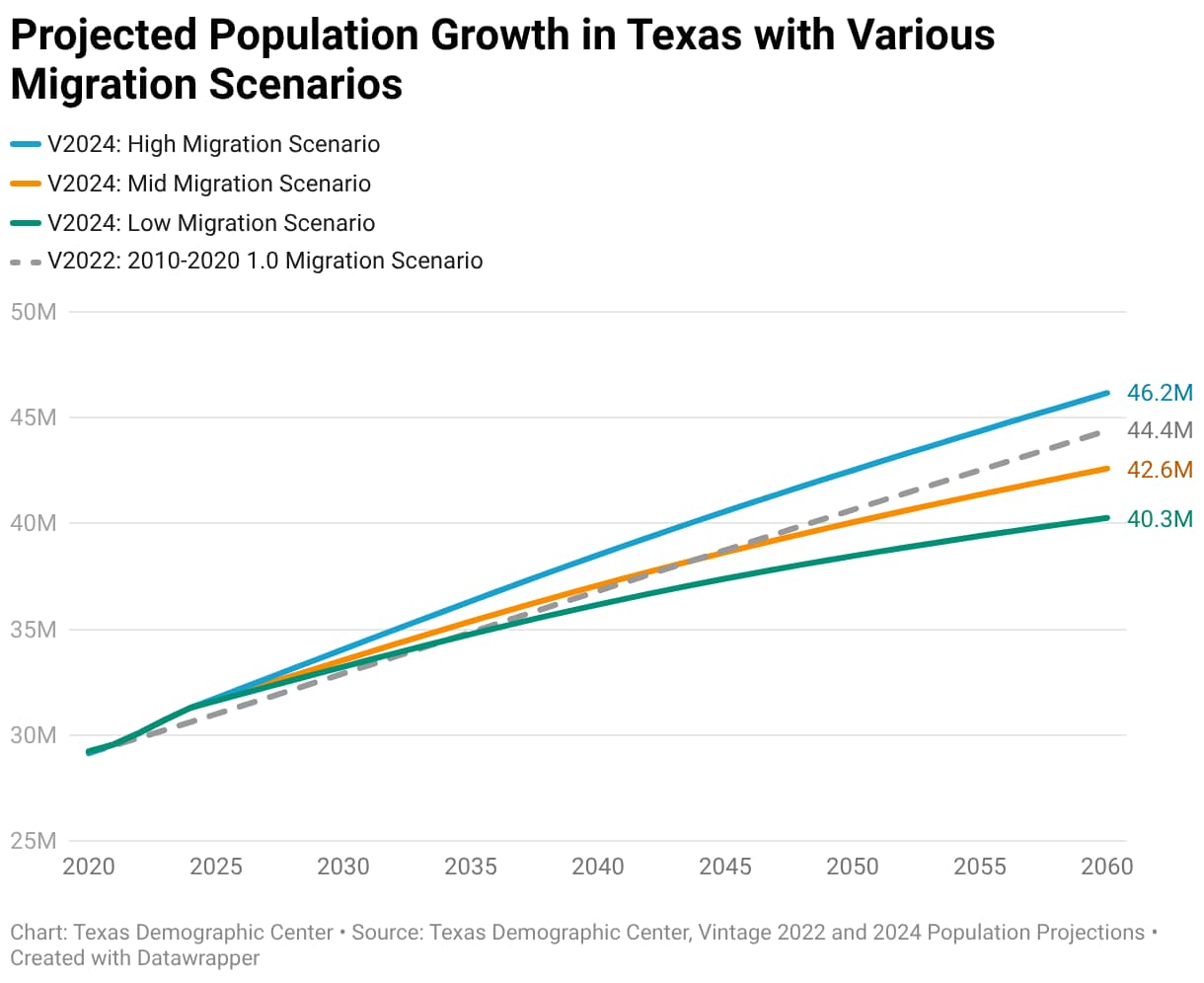
State planners expect 33.5 million people in Texas by 2030, up from about 32 million today. By the 2036 bicentennial, the state could have about 35 to 37 million residents (as many as 4.5 million more than today).
That growth will span generations. This fall’s kindergartners will graduate from high school in 2039. At the other end of the age spectrum, Texans 65 and older are the state’s fastest-growing broad age group, projected to grow about 76% between 2023 and 2050, while those 85 and older are projected to roughly triple.
The Big Q: Where will a growing population live, work and go to school? Who will care for more older Texans and fill the jobs they leave behind?
Older Texans Vote
(And Feel Better About the Future)
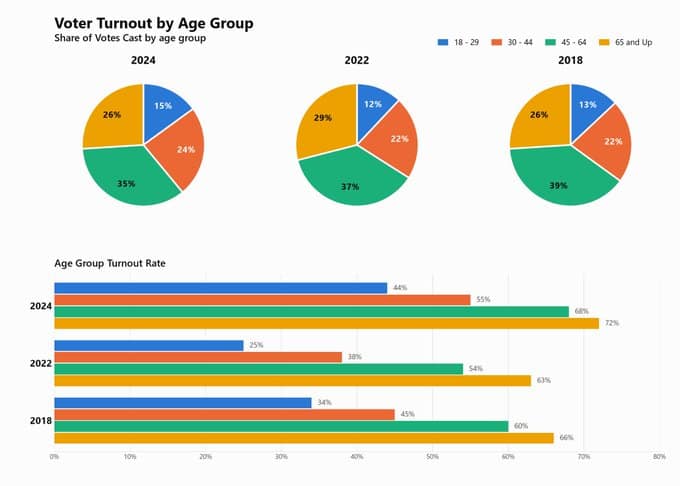
Texas pollster Derek Ryan of Ryan Data & Research reports that voters 45 and older consistently turn out in greater numbers than younger voters. Voters 65 and older accounted for 26% of turnout in 2018, 29% in 2022 and 26% of turnout in 2024. What will it be this year?
Furthermore, our Texas Voter Poll finds that older voters view Texas’ prospects more favorably.
In August 2026, 66.9% of voters 55 and older said Texas is a better place to raise a family than the rest of the country, compared with 46.6% of voters 18 to 34. Older voters were also more likely to expect Texas to have a stronger economy than the rest of the U.S. over the next four years (62.5% vs. 42.4%).

2. More Demand For Water and Power

Population growth, industrial expansion and data centers are increasing demand for both water and electricity. Meeting that demand will require significant investment in both systems.
ERCOT’s preliminary forecast projects that peak electricity demand in 2032 could reach about four times the 2026 record (following this press release, demand peaked at 91,134 megawatts in July). ERCOT has cautioned that the figure likely overstates growth and is developing a revised forecast.
The state’s water needs are also substantial. Voters approved up to $1 billion a year over 20 years for water projects starting in 2027, but the Texas Water Development Board estimates that projects in the state water plan will require $174 billion.
The Big Q: Can Texas invest quickly enough to keep its water and electricity systems reliable and affordable as demand grows?
3. More Influence in Washington

The next census will take place in 2030 and determine how seats in the U.S. House are divided among the states. After the 2020 census, Texas gained two seats, more than any other state.
Independent projections suggest Texas could gain four additional seats following the 2030 count.
The Big Q: Will Texas’ growing population translate into a larger voice in Washington?
The Races Shaping Your Business and Community
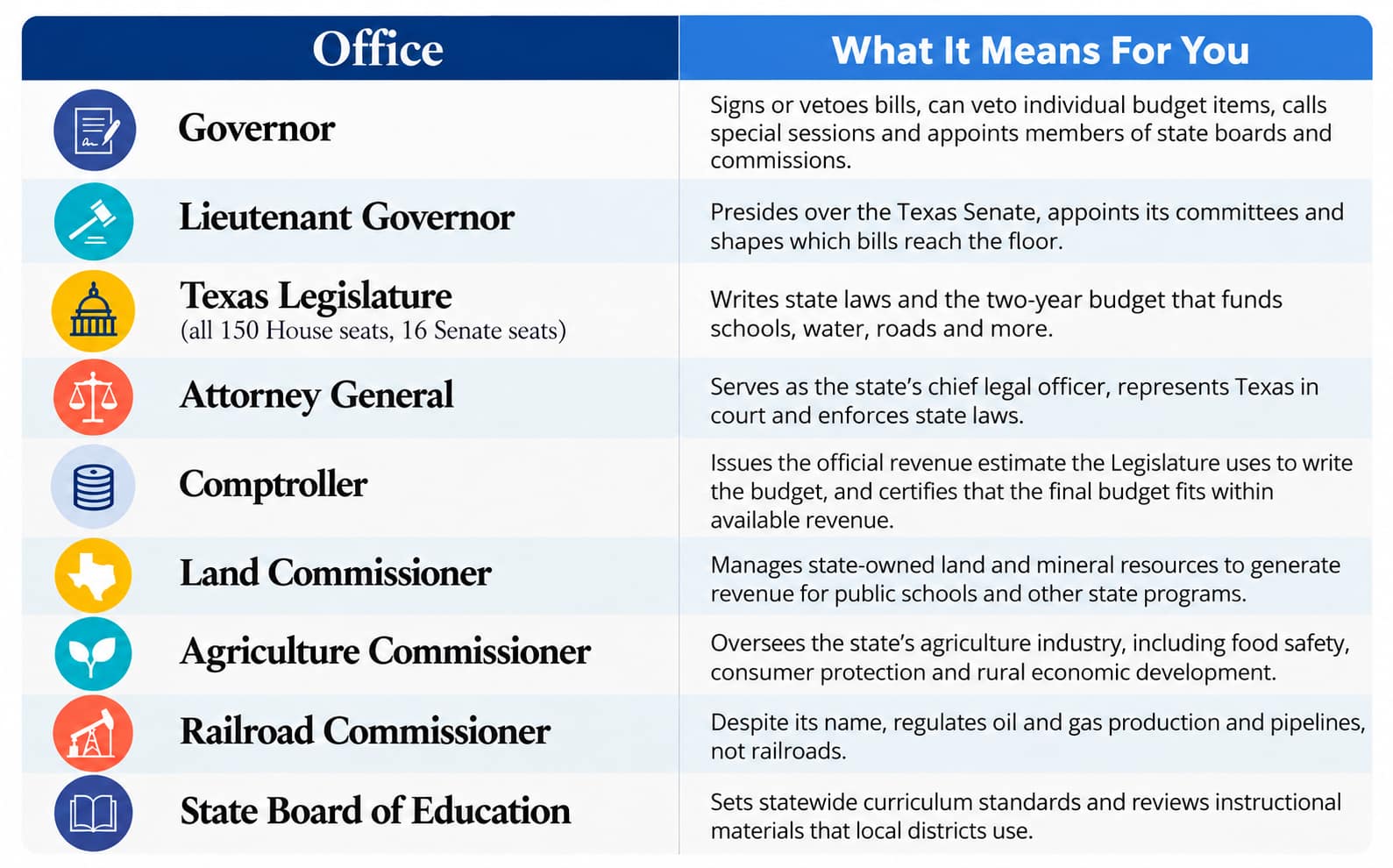
The race for U.S. Senate gets the headlines, but some of the decisions affecting schools, infrastructure and the state budget sit further down the ballot.
✅ Also on the Texas ballot: All 38 U.S. House seats, statewide and local judges as well as county offices. See your full sample ballot at VoteTexas.gov.
2030 May Be Uncertain, But What Voters Want Isn’t
In late August, Texas 2036 asked Texas voters how a candidate’s position on 13 issues would affect their vote. The survey named no candidates.
More than 80% of voters said they would be more likely to support a candidate who favored:
- improving student reading and math,
- reducing healthcare prices,
- preparing high school graduates for college or careers,
- lowering electricity bills and
- building water infrastructure.

Improving student reading and math drew the strongest response. Sixty-four percent said that position would make them much more likely to support a candidate.
Evaluating data center growth, a hot topic in boardrooms and at the Capitol, drew the weakest response: 51% said it would make them more likely to support a candidate, and just 29% much more likely to support a candidate on that issue.

“Even in a polarized political environment, this poll confirms something we hear from Texans in every part of the state: there is real common ground on the challenges that will define our future.”
– David W. Leebron, President and CEO of Texas 2036
👉 Those shared priorities are the starting point for our 2027 session agenda.
TXLege Election: What Happens Next?
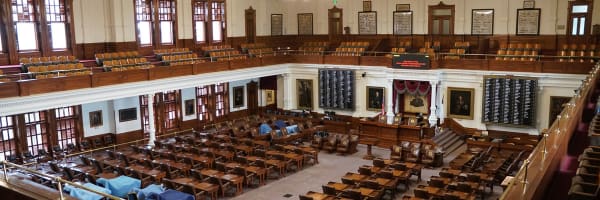
Most of the Legislature is up for election. All 150 Texas House seats and 16 of 31 Senate seats are on the ballot. The members chosen will write the 2028-29 state budget.
A fast start. Bill pre-filing opens Nov. 9. The comptroller’s revenue estimate, which determines how much money is available to legislators for the next budget, lands in January. The 90th Legislature convenes Jan. 12, 2027.
New maps in 2031. Census Day is April 1, 2030. Based on the new count, the Legislature is expected to redraw congressional and legislative districts in its 2031 session.
When seats were reapportioned in 2020, Texas narrowly missed a third new House seat; one analysis estimates it fell about 190,000 people short.
Vote Texas, Then Tell Us What Comes Next

The Texas of 2030 is already taking shape. Our research shows that voters have found common ground on priorities including education, healthcare, electricity and water. This election will help determine whether that agreement becomes action.
Early voting continues through Friday, Oct. 30. Election Day is Tuesday, Nov. 3. Before heading to the polls, get up to speed on what’s on the ballot, key election dates and a few other things on the voting process Texans should know beforehand. Find voting locations, sample ballots, identification requirements and mail-ballot information at VoteTexas.gov.
📣 After you vote, tell us: What is the one long-term challenge you most want the 2027 Legislature to address? We’ll share what we hear in an upcoming issue, alongside findings from our voter research.