

This is a preview of our Texas 2036 newsletter discussing what Texas needs to sustain its momentum in the next decade. To receive this weekly look at our work, sign up here.
Making Texas’ Growth Work for More People
Texas enters the decade before its bicentennial with strong economic and population growth. But growth alone does not guarantee greater opportunity or a better quality of life.
The systems Texans rely on must be able to support a larger and changing state. This edition examines three areas where action today can make a meaningful difference: affordable healthcare, reliable water supplies and dependable energy resources.
Texans Are Paying More For Healthcare
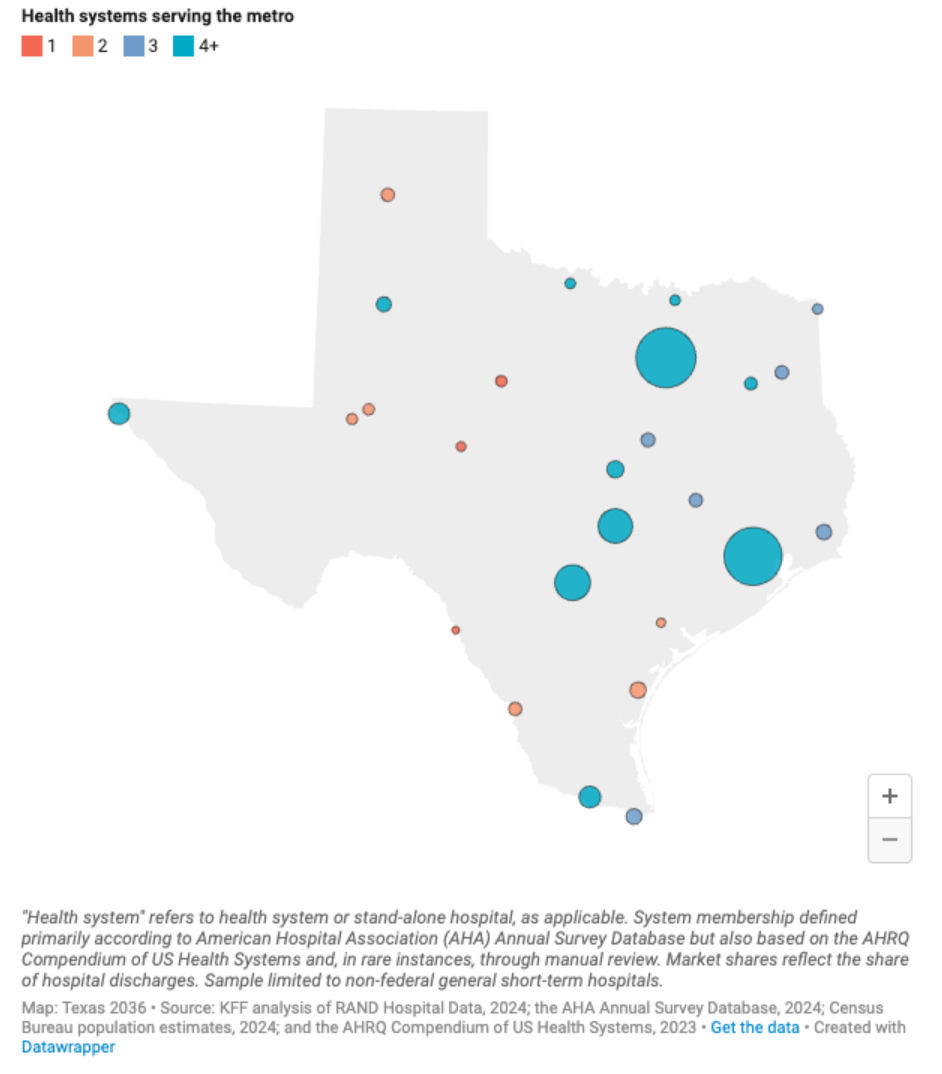
How Many Health Systems Control Each Texas Metro’s Hospital Market, 2024
One or two health systems controlled the entire inpatient market in roughly a third of Texas metros.
Strong communities depend on families and employers being able to afford the care they need. Yet the price of healthcare continues to rise, driven in part by where care is delivered, how services are billed and reduced competition among providers.
These trends are making it harder for Texans to get good value for their healthcare dollars.
What the data shows:
- A physician visit that costs $116 in an office costs $217 in a hospital outpatient department in 2022.
- The share of visits billed at the highest level of complexity rose from 31% in 2012 to 43% in 2023, without a corresponding increase in how sick patients were.
- In 2024, 69% of hospitals were affiliated with larger health systems, up from 56% in 2010. Nine Texas metropolitan areas are served by only one or two health systems.
- Texas Department of Insurance arbitration and mediation requests increased from about 49,000 in 2020 to more than 519,000 in 2023.
Source: Symptoms of an Unhealthy Market, 4-report Texas 2036 series. Published July 21, 2026.
The opportunity ahead 🌟
Texas can make healthcare more affordable by promoting competition, increasing price transparency and holding billing practices accountable. These changes can help families and employers get better value for their healthcare dollars without compromising access or quality.
How We Prepare For Texas’ Future Water Needs
Affordability is only one part of sustaining a growing state. Communities also need the infrastructure to support more residents and businesses, beginning with a reliable water supply.
State and regional water plans are intended to anticipate future shortages and identify the projects needed to address them. Texas 2036 examined how that process worked in the Coastal Bend, where water supplies fell to critical levels in 2026.
What the data shows:
- Across 25 years and five planning cycles, no state or regional plan consistently projected the Coastal Bend’s current water shortage.
- By April 2026, combined reservoir storage had fallen below 8% — beneath the region’s worst-case drought reserve.
- Of the 50 water strategies recommended in the region’s 2021–22 plan, only one had been completed by 2025.
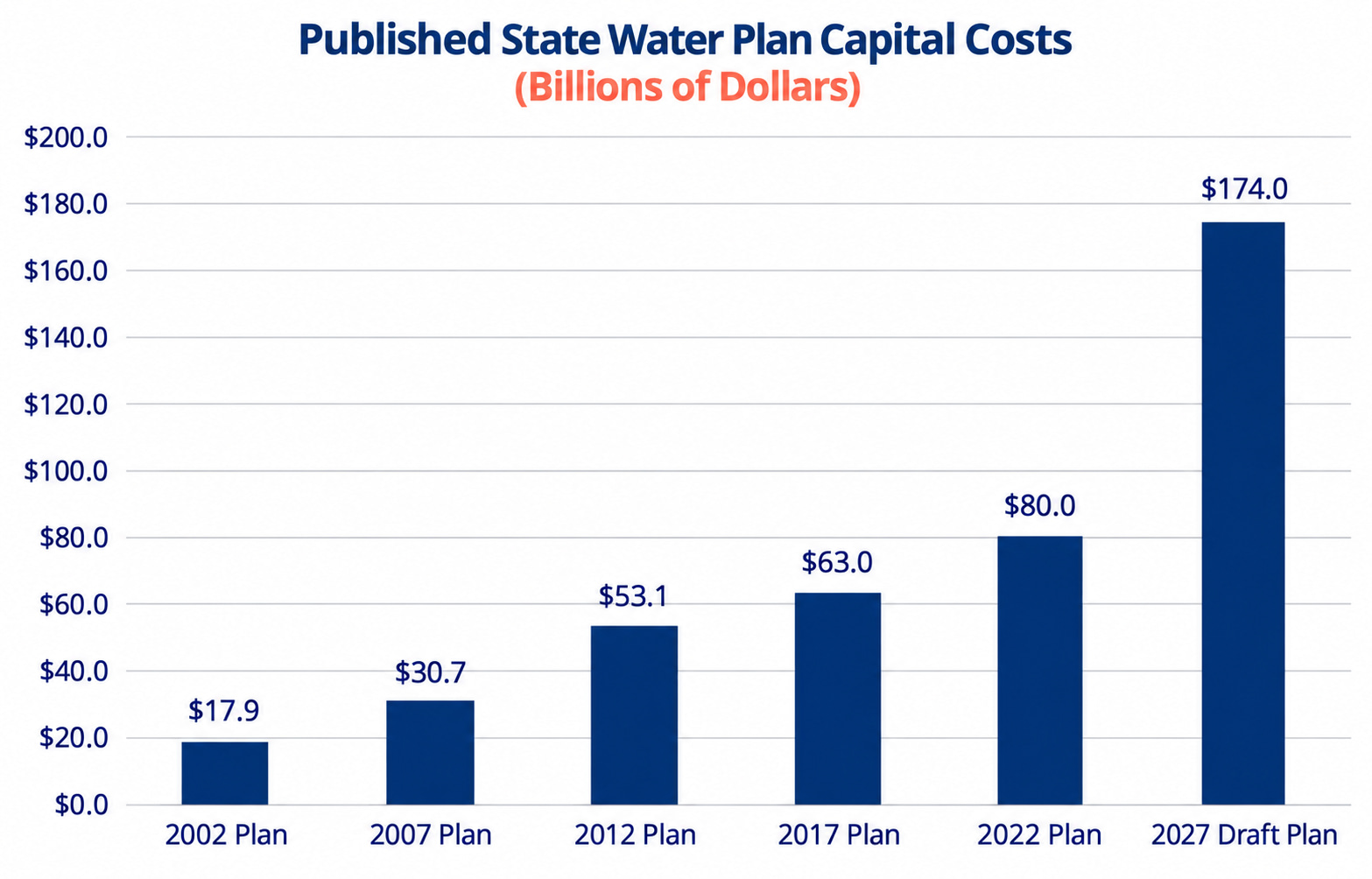
- The state will need to invest over $200 billion over the next 50 years on water infrastructure, including water supplies, system upgrades, and flood protection.
Source: The State Water Plan & The Coastal Bend Water Crisis. Published Aug. 19, 2026.
The opportunity ahead 🌟
Texas can use the lessons from the Coastal Bend to improve water planning statewide. More accurate projections, clearer priorities and stronger follow-through can help communities develop reliable supplies before shortages become emergencies.
Powering Texas’ Continued Growth
Texas leads the nation in energy production, helping power homes, businesses and economic growth. But electricity demand is rising quickly, and meeting it will require more generation and grid capacity without sacrificing reliability or affordability.

Electricity demand is growing in Texas:
- ERCOT’s base electricity load rose 55.8% between 2016 and 2026, growing from 29,079 MW in 2016 to 45,305 MW by 2026.
- Peak load served rose as well, but more slowly than base load by 28.2% between 2016 and 2026, moving from 71,093 MW in 2016 to 91,134 MW in 2026. However, ERCOT projects peak electricity demand could reach 367,790 megawatts by 2032, quadrupling the record peak of 91,134 megawatts set in July 2026.
Sources: Texas 2036 analysis of ERCOT hourly load data, 2016-2026; 2026 values are preliminary, pulled from ERCOT on Sept. 29, 2026 and may change before final settlements occur.
The opportunity ahead 🌟
Texas’ diversified “all of the above” energy portfolio that includes a mix of gas, solar, wind, coal, nuclear and battery storage carried the state through record-breaking electricity demand in Summer 2026 without conservation calls or blackouts.
Texas can build on its energy leadership by adding all forms of power generation — including exploring underutilized and unique energy resources like advanced nuclear, produced water and geothermal — while expanding grid capacity and strengthening resilience.
Doing so can help Texas meet the challenges of extreme weather and rapid load growth while maintaining the reliable, affordable electricity that households and families depend on.
Texas’ Next Decade Starts Now
Across both parts of this series, the data tell a clear story: Texas enters its next decade with tremendous strengths, but continued success is not guaranteed.
Population growth and economic momentum create opportunity, while our education, healthcare, water and energy systems will determine how broadly that success is shared.
With sustained focus and action, Texas can reach 2036 more prosperous, more resilient and full of opportunity for generations to come.
What Will Shape Texas’ Next Decade?
We’ve shared what the data tell us. Now we want to hear from you.
Which challenges will matter most to Texas over the next 10 years, and how confident are you about the state’s ability to address them?