
Political labels can make elections sound simpler than they actually are.
Republicans vote Republican. Democrats vote Democratic. Independents sit somewhere in between.
But Texas voters do not always fit neatly into those categories.
In our 10th Texas Voter Poll, Texas 2036 identified a group we call Unaffiliated and Undecided Voters. They make up 16.7% of the poll sample, roughly one in six voters, and understanding who they are requires looking beyond a traditional party label.
First, who counts as Unaffiliated and Undecided?
Our definition has two parts.
- First, these voters are unaffiliated, meaning they are not committed partisans based on their past voting behavior and views of the two major parties. That does not mean they all call themselves independents.
- Second, they are undecided. When interviewed in late August, they described their choices in the November election as mostly or fully undecided.
Their past voting histories show just how varied this group is.
Two in five, or 40%, say they have tended to vote independent of party in previous November elections. Another 29% have tended to vote Republican, 15% Democratic and 15% are unsure.
Their plans for 2026 are similarly unsettled. About seven in 10 describe themselves as mostly undecided and three in 10 as fully undecided. Only 14.7% plan to vote a straight ticket, while 37.9% expect to choose a mix of candidates from different parties and another 23.7% cannot yet say how they will vote.

There are some demographic differences, too. These voters skew younger than the electorate overall: 26.6% are under 35, compared with 19.1% statewide. They are also somewhat more likely to be parents of children under 18 and less likely to own a home. Their gender, education and income, however, track the broader electorate relatively closely.
Undecided on candidates does not mean undecided on issues
For all the uncertainty about candidates and parties, these voters do not have a dramatically different policy agenda from everyone else.
Healthcare prices, electricity bills and getting students to read and do math at grade level are among their leading candidate positions, largely mirroring the priorities of the electorate overall.
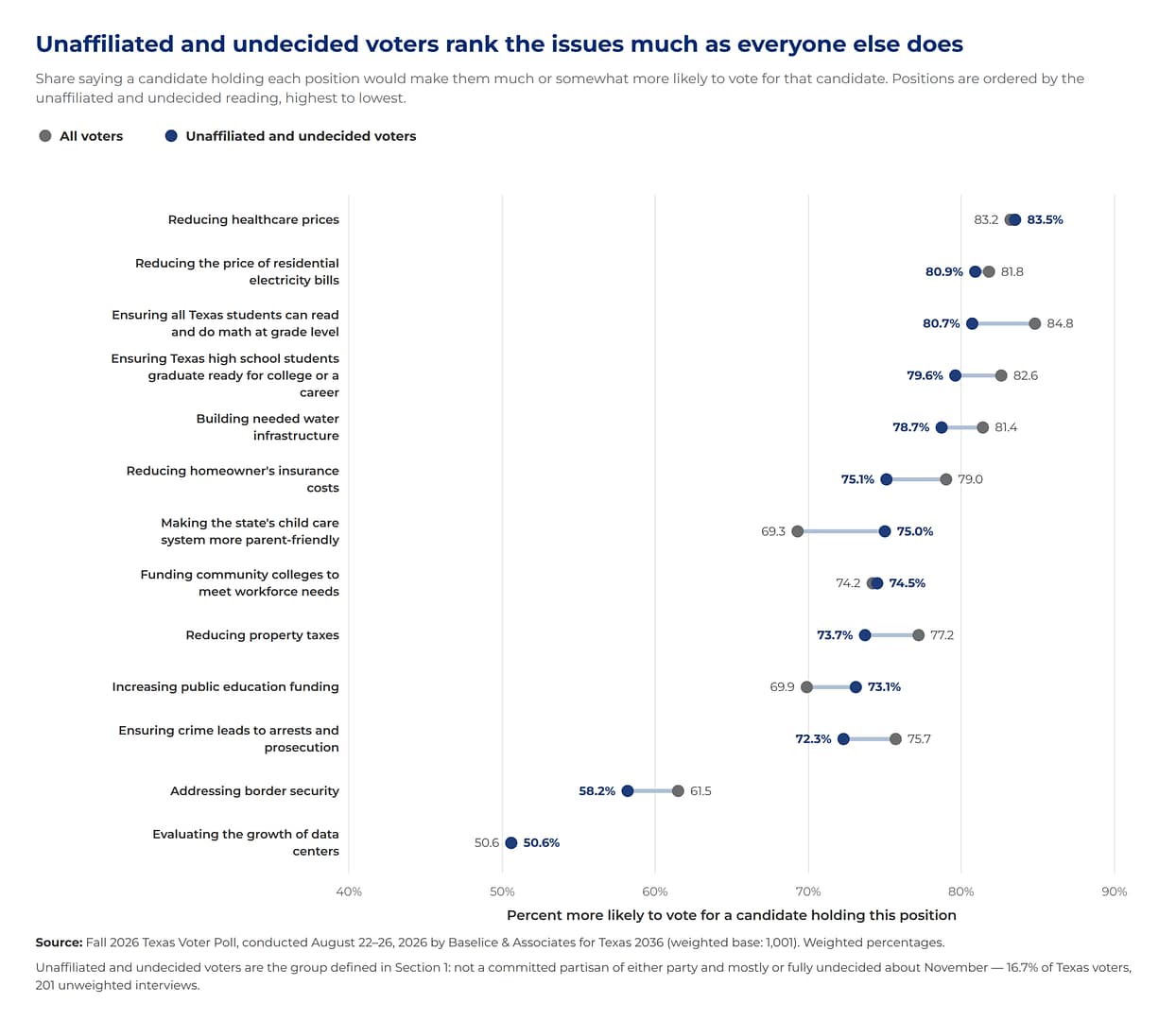
That distinction matters. These voters may not have settled on whom they will support, but many have clear reactions to the issues candidates are discussing.
There are also a few areas where their responses run somewhat ahead of the statewide numbers. Three-quarters say a candidate committed to making Texas’ childcare system more parent-friendly would make them more likely to offer support, compared with 69.3% of all voters. Increasing public education funding also receives a somewhat higher response, 73.1% compared with 69.9% overall.
Those differences should be treated cautiously. The Unaffiliated and Undecided group includes 201 interviews and carries a margin of error of roughly ±7 percentage points, so differences smaller than that are directional rather than definitive.
Politically uncommitted, but not without priorities
It can be tempting to think of undecided voters as a single bloc sitting halfway between Republicans and Democrats. Our poll paints a more complicated picture: Texas’ Unaffiliated and Undecided Voters come from different political histories. Some have previously leaned Republican or Democratic. Many have voted independent of party. Most have not yet settled on their November choices, and relatively few expect to vote one party’s ticket from top to bottom.
But on policy, their priorities look surprisingly familiar.
Their defining characteristic is not a unique set of issues. It is that they have not attached those priorities firmly to a party or a candidate.
That makes the distinction between being undecided about an election and uncertain about what matters an important one. For many of these Texas voters, the first is true. The second is not.