
Out of roughly 1,834 high schools in Texas, only 17 earned an F in 2025, about 1% of the state’s high schools. While it’s a relatively small number of F-rated campuses, the outcomes at these high school campuses are worth paying special attention to.
The numbers behind the letter
At high schools that received an “F” rating in 2025, the average Student Achievement score was just 59 out of 100, and the Closing the Gaps score, which measures how well a school serves its lowest-performing student groups, averaged only 41. The average School Progress score among these schools was 61, and the Relative Performance average was 58.
Looking directly at 2025 STAAR end-of-course results makes the picture even clearer. At F-rated high schools, only 33% of students were on grade level on the English I and II exams and just 14% did in Algebra I. Compare that to A-rated high schools, where 75% met grade level in English I and II and 54% in Algebra I. Even in Biology and U.S. History, F-rated campuses land at 37% and 46%, far below the 77% and 79% seen at A-rated schools.
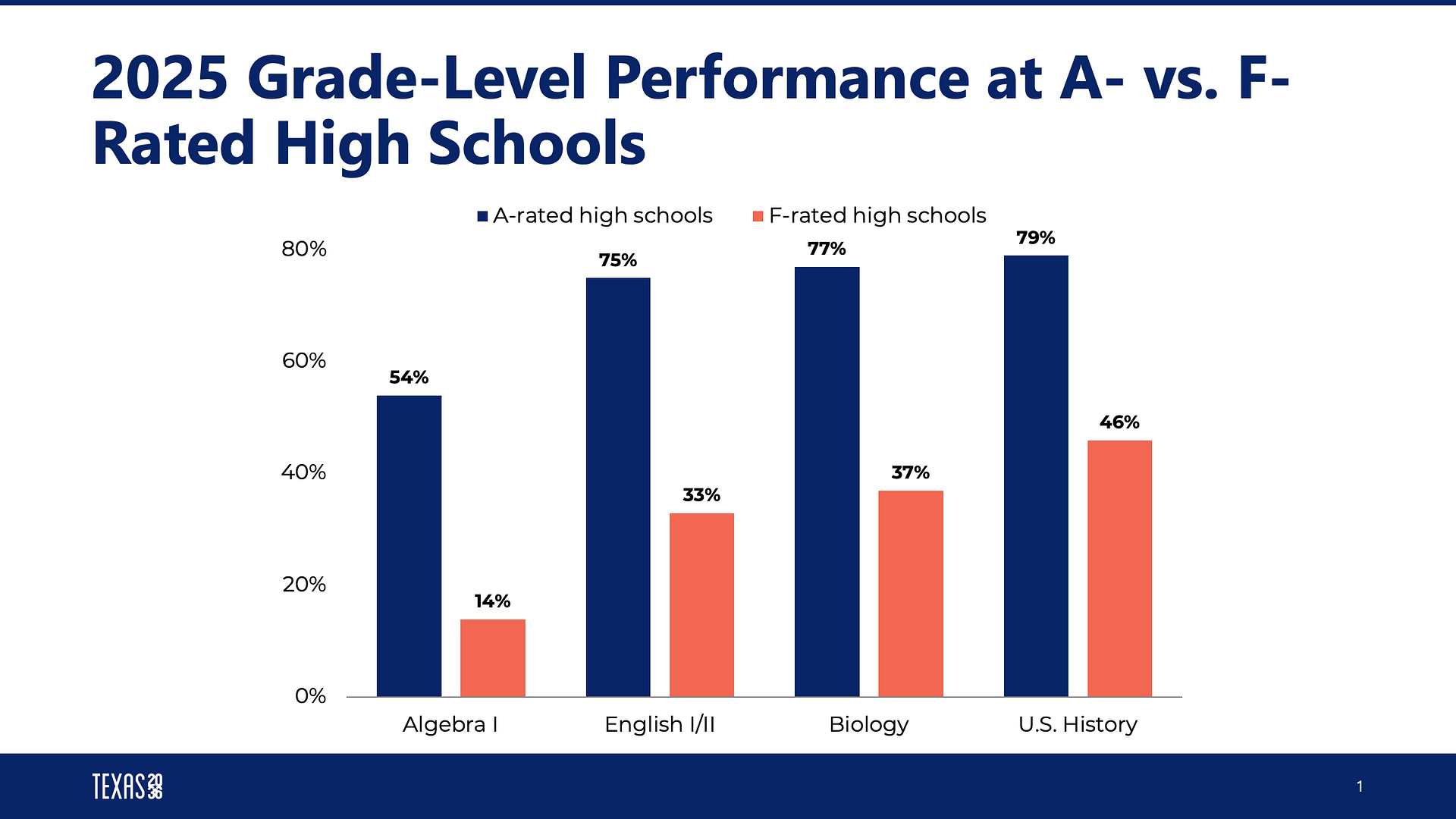
In practical terms: at the average F-rated high school, roughly seven in 10 students are not on grade level in reading, and more than eight in 10 are not on grade level in Algebra I. For a graduating class, that translates into far fewer students prepared for life after high school — and that gap has lasting consequences.
Why this matters
Texas has a commitment to creating one of the best public education systems in the country. High schools with a significant amount of students not on grade level keeps that reality from being the case for every Texas family. These 17 campuses are where the most urgent, most consequential improvement work in Texas education needs to happen.