

This is a preview of our Texas 2036 newsletter discussing the state of childcare in Texas. To receive this weekly look at our work, sign up here.
Texas Spends Billions on Childcare.
Who’s Accountable for the Results?
Texas invests billions of dollars a year in childcare and early childhood programs.
But ask which state agency is responsible for whether that system actually works, and the honest answer is: none of them, exactly.
In our new report, The State of Childcare in Texas, we find oversight split across at least five state agencies, plus the federal Head Start program.
No single entity is accountable for whether the pieces add up to a system that works for Texas families.
Many Authorities, No Owner

Each agency executes against its own mission. But none is responsible for whether the system as a whole works for the families of the roughly 2.4 million Texas children under age 6. For example:
- A provider can pass one agency’s licensing inspection and get cited by another for the same practice.
- A childcare center can sit at just 65% capacity while a working parent nearby cannot easily find available care with necessary hours.
- And the state still can’t answer a basic question: do the subsidies it pays for actually help kids arrive at kindergarten ready to learn?
That fragmentation isn’t just an inefficient government problem. It has real consequences: families face rising costs, employers lose workers and providers struggle to stay open. The state, meanwhile, can’t determine which of its investments are delivering results.
The report finds these aren’t separate problems. They’re symptoms of a system with no single entity responsible for its overall performance.

“Texas already spends billions on early childhood programs, but no one is responsible for the system as a whole. That’s not a criticism of any one agency. It’s the result of a structure that split responsibility several ways without assigning accountability for the outcome.”
— Charles Miller
Director of Health and Economic Mobility, Texas 2036
By the Numbers: Early Childhood
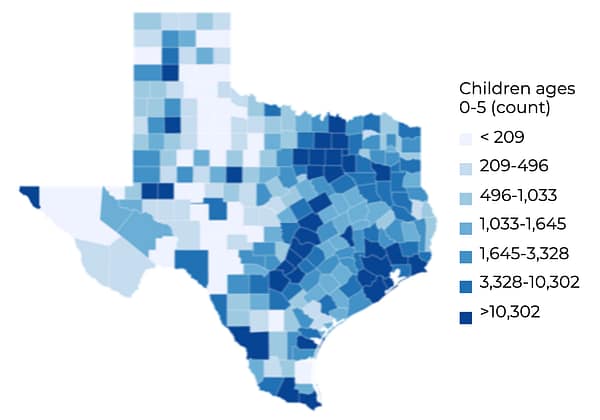
Fig 1. Data Source: U.S. Census Bureau, Population Estimates Program, Vintage 2025 County Population Estimates by Age, July 1, 2025. Ages 0–5 estimated as ages 0–4 plus one-fifth of ages 5–9.
- Only one in six Texas children under age 6 is reached by a public early childhood program — Pre-K, Head Start, or a childcare subsidy. The other five in six rely on private pay, family care, or a parent staying home.
- At least 95,000 children were on childcare subsidy waiting lists as of late 2024. Texas can’t determine whether children who receive subsidies have better long-term educational outcomes than those who do not.
- Families earning under $35,000 a year spend about 19% of their income on childcare.
- Childcare tuition crowd out: 56.7% of Texas parents say the cost of childcare has affected their decisions about whether to have more children.
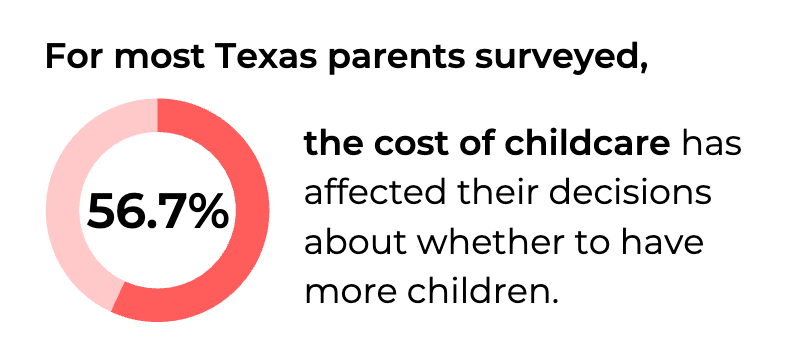
Source: Texas 2036 statewide survey of 975 parents, fielded in winter 2026
What Families, Employers and Providers Are Up Against
The strain shows up everywhere the system touches. Parents describe tradeoffs no family should have to make.
Employers feel it too, particularly in areas where childcare supply is thinnest. From our report:

Providers are struggling as well: statewide, providers report only about 65% of licensed childcare seats are actually in use, even as center owners describe forgoing salaries and drawing down savings just to stay open.

“Childcare costs are honestly a huge strain. We’re paying out of our pocket, which has meant making some tough tradeoffs in our budget.” — Parent focus group participant
“I’m losing dairy workers because there is no childcare here. I can pay them, but I can’t make care exist for them.” — Amarillo employer
A Window to Act
The report calls for consolidating oversight of the childcare system under a single accountable entity — one with a mandate to coordinate regulation, funding and outcome measurement around what Texas parents actually need.
Policymakers have a window of opportunity to start this work. The Governor’s Task Force on Early Childhood Care and Education is already meeting.
And the Texas Workforce Commission and Health and Human Services Commission are currently both under Sunset review, with the 90th Legislature set to address policy recommendations in 2027.

Reasons for optimism that the state can meet the childcare challenge are many. Here are a few:
- Policymakers have a parent-first framework to build on; a safety baseline for every provider; and education-anchored quality standards for programs that receive public funds.
- Data like what we lay out in our report shows what it would take to finally show whether public investments are actually delivering better outcomes for children.
- Select regional employer partnerships are already closing local childcare gaps; reforms can build on what’s working rather than complicate it.

“Texas can now see this system’s challenges from all angles — what families pay, what providers are up against, what employers lose, and how the state’s own programs fit together. Having the full picture is what turns a long-standing challenge into one Texas can actually work on.”
— Dr. Tracy Ayrhart
Vice President of Data and Research, Texas 2036
Texas Voters Say: Childcare Matters

Parents are not the only Texans with a stake in childcare. Because the system includes public funding, the broader electorate has an interest in what those dollars are meant to buy.
In our February 2026 poll, 89% of likely voters told us that publicly supported early childhood programs are important, including 84% of Republicans and 97% of Democrats.
Likely voters also told us that they value educational outcomes over workforce enablement when prioritizing public investments in early childhood programs, by a 56%-38% margin, according to the February 2026 poll.
Tell Us Your Childcare Story
From parents to employers to childcare workers to taxpayers, Texans come at the state’s childcare challenge from many different points of view. Share your perspective with us.