
Around the turn of this century, a small solar array sat to the side of the Decker Creek Power Plant in northeast Austin with the capacity to generate 0.3 megawatts (MW) of solar power. This capacity represented a fraction of the nearly two million megawatt-hours (MWh) generated annually with natural gas across the property. And even in 2002, 0.3 MW was not a meaningful amount of solar power generation, accounting for less than 0.0006% of the total utility-scale solar production in the United States that year.
And then the Decker Creek solar array eventually went completely dark.
Nearly a decade went by before Texas produced solar power at utility scale – projects of at least one MW. Meanwhile, throughout the early 2000s, California was slowly and steadily building up their solar generation in the Mojave Desert, modest numbers that hovered around half a million annual MWh, accounting for nearly 100% of the total utility-scale solar generated in the U.S at the time.
Texas remained at zero.
Soon, starting in 2010, something started happening in the Lone Star State that nobody expected. Nearly 10,000 MWh from solar generation came online. That generation figure tripled the following year. One year later it went up by a factor of four. By 2025, Texas surpassed California for utility-scale solar power generation.
In a state traditionally associated with oil and gas, Texas’ “all of the above and below” approach to energy production has resulted in massive, unexpected growth in utility-scale solar power.
Utility-scale solar in Texas grew more than 730,000% between 2001 and 2025
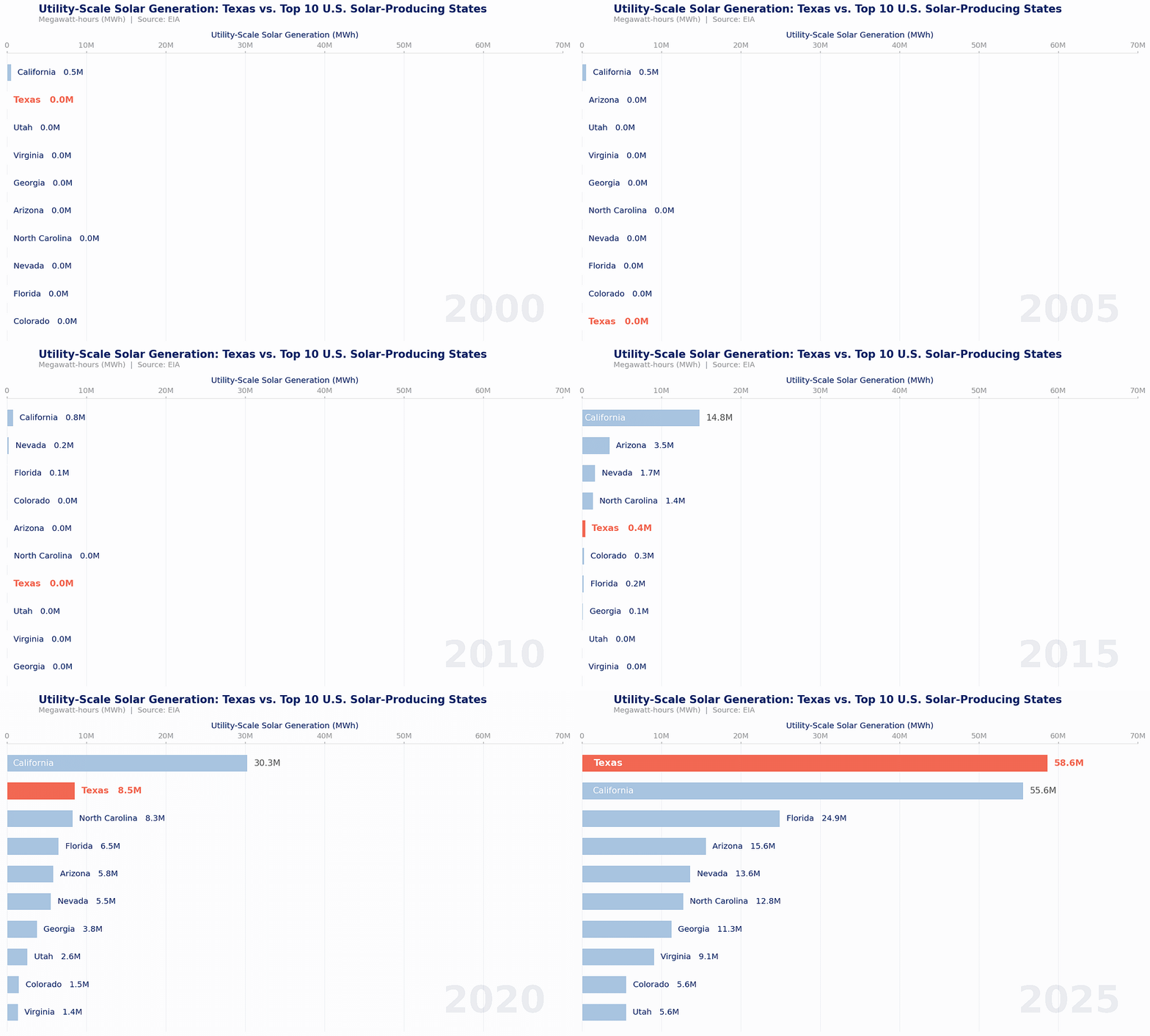
The story above is positively explosive in animated form, depicted in Utility-Scale Solar Generation: Texas vs. Top 10 U.S. Solar-Producing States. There wasn’t much action on the board until 2010. But in a dramatic twist, Texas climbed exponentially in a few short years, ultimately surpassing California in 2025. The visual is indeed dizzying because between 2010 and 2025, Texas grew its solar by 732,825%. California, a worthy opponent (who started the race ahead) grew by 7,126.8% in the same time period.
Source: EIA Electricity Browser, Utility-Scale Solar
Texas now produces more solar than three of the top five states combined
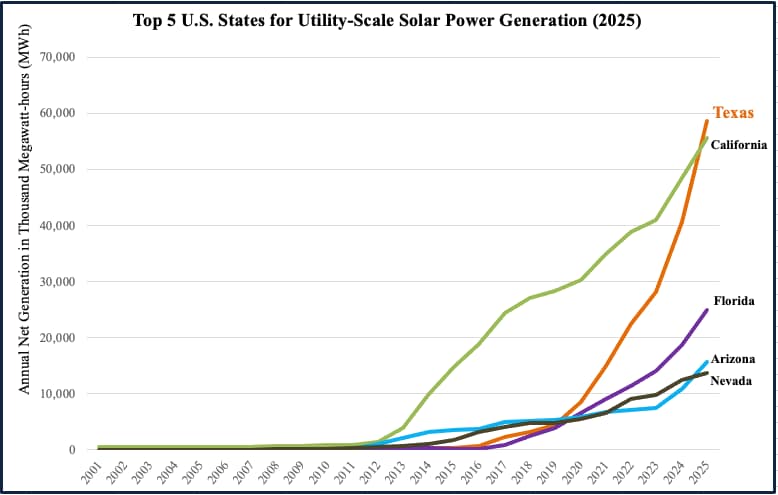
Solar power generation has grown across the U.S. by nearly 54,351.4% since 2001, in large part due to federal subsidies and scale that have made the cost per MWh more competitive for solar over the past decade. Owing to its vast land and abundant sunshine, Texas now accounts for 19.8% of the total U.S. utility-scale solar power generation, and generates more utility-scale solar power than three of the top five states combined (the sun-baked states of Florida, Arizona and Nevada).
Texas is also leading because it is faster to bring solar power to the market here from a permitting and interconnection perspective than other states. Texas’ primary electricity market — ERCOT — is an “energy-only” market designed to favor the cheapest form of power available on the grid. Resources like solar and wind, which have no fuel costs, get sold first within Texas’ energy marketplace.
Source: EIA Electricity Browser, Utility-Scale Solar
Massive solar growth in Texas has not peaked
In 2025, solar contributed 14% to ERCOT’s fuel mix, edging one percentage point higher than coal last year for the first time ever. Austin Energy now operates 966 MW of solar power generation, up from their early 0.3 MW array at Decker Creek in 2002, including record numbers of solar investments for the utility in 2025.
It’s worth noting that California still leads on smaller-scale solar generation (solar panels on residential rooftops and small commercial projects). However, EIA expects 40% of total U.S. solar additions in 2026 to come from Texas.
The forthcoming growth in 2026 could generate an additional 14 million MWh in electricity, with another 11.8 million projected to come online by 2027. That means the equivalent of nearly half of what’s come online in the past 15 years is projected to come online in the span of only two years. This massive and surprising growth in solar is not slowing down — and in fact, it appears to be accelerating.