
Texas reached 31.7 million residents in July 2025, adding more than 391,000 people in a single year. We rank in the top four states for percent growth and lead the nation in numeric change. By headline measures, Texas is still very much a growth story.
Yet, the shape of that growth is changing.
The U.S. Census Bureau’s newly released Vintage 2025 Population Estimates, paired with the Texas Demographic Center’s (TDC) projections through 2060, point to three trends that will define Texas’s policy environment for decades:
- Growth is slowing
- The population is aging
- Growth is moving to the metro edges, not the urban cores
The implications cut across nearly every policy area we work on.
Why this work matters
The Texas Demographic Center, housed within the Institute for Demographic and Socioeconomic Research at UT San Antonio, is the state’s official source for population estimates and projections. TDC translates federal Census products into Texas-specific analysis, produces independent long-range population projections for the state (available through their Population Projections Data Tool), and convenes researchers and policymakers each year at the Texas Demographic Conference.
TDC is a critical partner: Their population projections inform our research, and as the state’s official data center, they offer authoritative Texas-specific analysis of federal Census data that we engage with across our policy areas. Accurate counts matter: TDC’s role in Census 2030 preparation will help shape the projections and funding formulas that follow. The findings below come from presentations at the 2026 conference by TDC Associate Director, Dr. Helen You and researcher, Dr. Jeongsoo Kim.
Trend 1: Growth is slowing
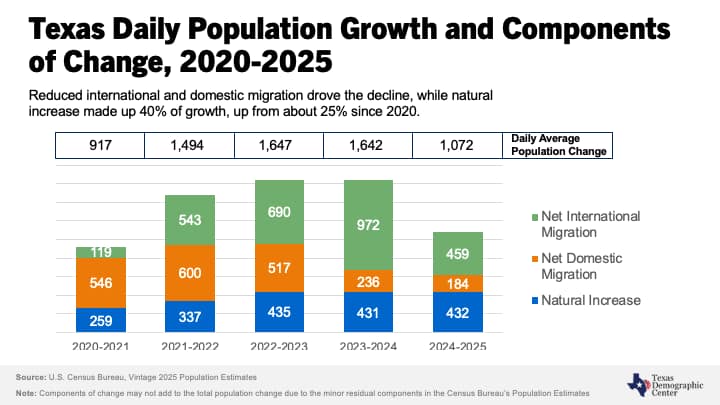
Even with the headline numbers, the trend line is bending. Texas’s 1.2% growth rate is more than double the national rate of 0.5%, but growth has decelerated meaningfully — and the composition of that growth is shifting:
- Reduced migration — both international and domestic — drove the slowdown. Net domestic migration to Texas fell to its lowest level in over a decade, at about 184 new Texans per day in 2024–2025, down from over 500 per day just two years earlier.
- Net international migration peaked sharply in 2023–2024 and then dropped by more than half. Texas gained 972 new residents per day from international migration in 2023–2024 — and 459 per day in 2024–2025.
- Natural increase has held steady at roughly 430 Texans per day since 2022. Its share of total growth has risen — from about 25% earlier in the decade to about 40% — not because births are accelerating, but because migration has slowed.
Source: Texas Demographic Center, State of the State Presentation, 2026 Texas Demographic Conference
Trend 2: Texas is aging quickly
TDC projects Texas will transition from an “aging” society (13.5% age 65+ in 2020) to an “ultra-aged” society (21.7% by 2060). The median age is projected to rise from 35.6 to between 43.0 and 44.2.
- The aging is geographically uneven. Rural counties are aging fastest. In 2025, 134 Texas counties already experienced more deaths than births.
- It is reshaping the labor force. As the population ages, a growing share of Texans will be 65+ — a group with lower workforce participation. The labor force will still grow, but at a slower pace.
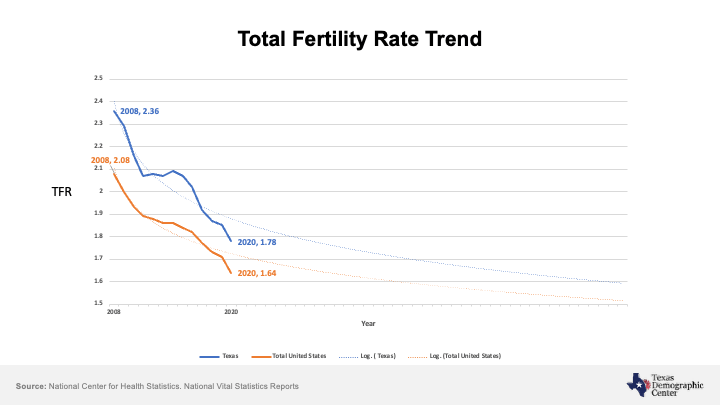
- Fertility is declining and now below the replacement rate. Texas’s total fertility rate dropped from 2.36 in 2008 to 1.78 in 2020 — falling below the 2.1 replacement rate for the first time. Peak childbearing age has shifted from 20–24 to 25–29.
Source: Texas Demographic Center, Texas’ Future in Numbers Presentation, 2026 Texas Demographic Conference
Trend 3: Growth is moving to the metro edges
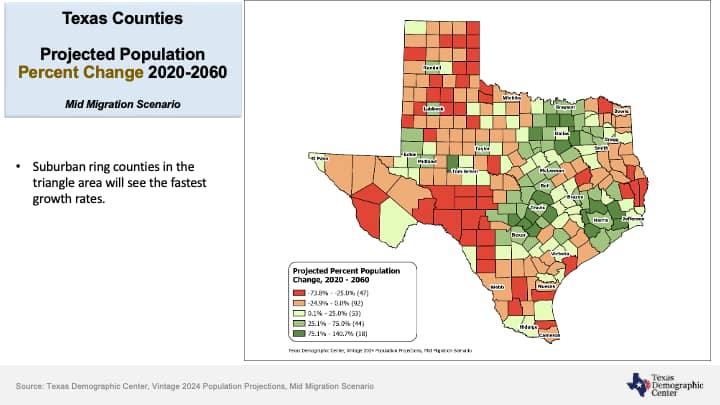
Texas’s population is concentrating geographically — and within that concentration, growth is happening at the suburban and exurban ring, not in the urban cores:
- 87% of Texans now live east of the I-35 corridor — the metropolitan triangle anchored by Dallas–Fort Worth, Austin, San Antonio, and Houston.
- Major urban centers grew more slowly than their surrounding rings in 2024–2025. The fastest-growing places in Texas are small and midsized cities at the edges of the Triangle metros.
- Under TDC’s mid-migration scenario, the four Triangle metros will grow from 67% to 74% of the state’s total population by 2060, accounting for 99% of net statewide growth.
Source: Texas Demographic Center, Texas’ Future in Numbers Presentation, 2026 Texas Demographic Conference
What this means
Slower growth, an aging population, and growth shifting to the metro edges each create distinct pressures. Together, they compound:
- Rural counties face declining tax bases, aging populations, and shrinking workforces — at the same time.
- Suburban and exurban counties face accelerating demand for housing, transportation, water, and schools.
- Urban cores face affordability pressures and slower growth, even as they remain economic engines.
- The state as a whole faces a workforce composition shift that will reshape labor supply, public benefit utilization, and revenue patterns.
These dynamics cut across nearly every policy domain we work on — from education and workforce to health, infrastructure, natural resources, justice and government performance. We’ll continue partnering with Texas Demographic Center and others to keep our work grounded in how Texas is changing.