

This is a preview of our Texas 2036 newsletter launching the fourth episode of our Future of Texas podcast with our guest, Henry Cisneros, on the future of the city in Texas and the growth of megaregions. To receive this weekly look at our work, sign up here.
Episode 4: Megaregions and Texas’ Next Decade

(Left to right) Host Brad Swail talks with Henry Cisneros and A.J. Rodriguez in episode four of the “Future of Texas” podcast series.
Texas’ dynamic growth isn’t confined to a single city. Rather, the state’s biggest cities are growing at a rate to eventually erase the boundaries among them. The opportunity now is to build the systems to support that growth.
The Future of Texas series continues with the future of Texas’ megaregions.
This Week’s Podcast Guest: Henry Cisneros

Henry Cisneros, former U.S. Secretary of Housing and Urban Development and former mayor of San Antonio, joins Texas 2036’s A.J. Rodriguez to explore the next era of urban growth in Texas.
They discuss how megaregions are redefining opportunity, and the bold coordination needed for Texans to thrive in a rapidly changing workforce.
📺 Watch the full episode on YouTube
🎙️Listen on Spotify or Apple Podcast
Did you know? Cisneros is the co-author of The Texas Triangle and the 2025 book The Austin–San Antonio Megaregion.
What’s a Megaregion and Why Do They Matter?
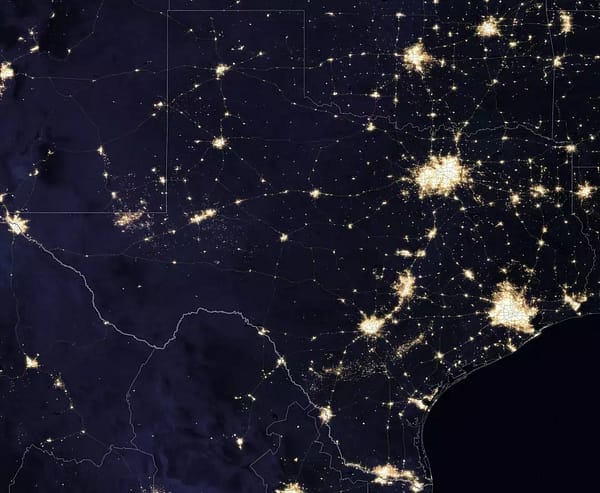
Source: Texas at night in 2017, NASA
A megaregion isn’t just about cities getting bigger. It’s what happens when multiple metros begin to function as one connected system sharing jobs, infrastructure, housing and opportunity.
This concentration of interconnected large urban areas is changing how Texans live, work and move through their daily lives. For Texans, megaregions mean:
- More opportunity across regions → Talent and jobs are no longer confined to one city
- Greater flexibility for families → More choices in where to live, work and learn
- Stronger business environments → Deeper talent pools and larger markets
- More resilience → Diverse industries supporting long-term growth
Texas Triangle: Shaping America’s Next Decade
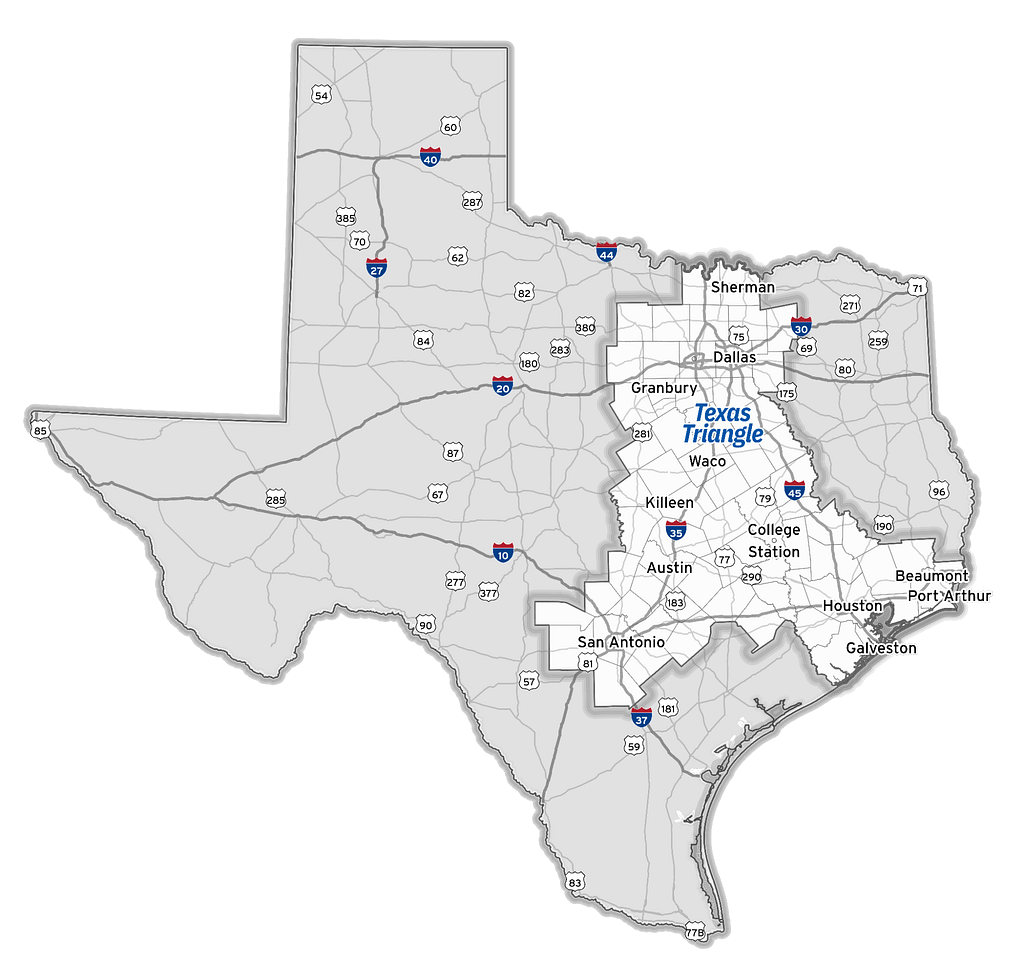
Source: Texas Department of Transportation
Odds are that you’re already living and working in one of the nation’s biggest megaregions: the Texas Triangle, anchored by Dallas-Fort Worth in the north, Houston in the southeast and Austin-San Antonio in the southwest.
Consider the scale of this booming megaregion:
- Roughly 35 counties in the Texas Triangle are home to about 68% of the state’s population.
- It produces ~$2.2 trillion in economic output, or about 80% of the state’s GDP.
- From July 2024 to July 2025, the Houston area added 127,000 residents — the most of any U.S. metro — followed by Dallas with 124,000; Austin and San Antonio combined added 92,000 residents, which would rank third nationally.
 Did you know? Growth is most pronounced in the suburban counties outside the biggest cities (think Collin, Montgomery, Waller or Williamson counties) rather than the urban core counties.
Photo: Georgetown, the county seat of Williamson County in Central Texas.
What Sets the Triangle Apart? Speed and Growth
From 2010 to 2023, the region has captured nearly 87% of Texas’ population growth, adding millions of new residents in just over a decade.
And over the next 30-40 years, 10-plus million more people are expected to live in Texas, with over 90% of the growth through 2060 located in the Triangle.
How does it work? The triangle is a powerful mix of specialized, complementary economies:
- Houston-Galveston → global energy capital and trade gateway
- Dallas-Fort Worth → corporate headquarters, logistics, finance
- Austin-San Antonio → technology and innovation engine; manufacturing, military, biosciences, workforce growth
And critically, Texas still has something few places do: room to grow.
Beyond the Triangle: Regions Powering Texas
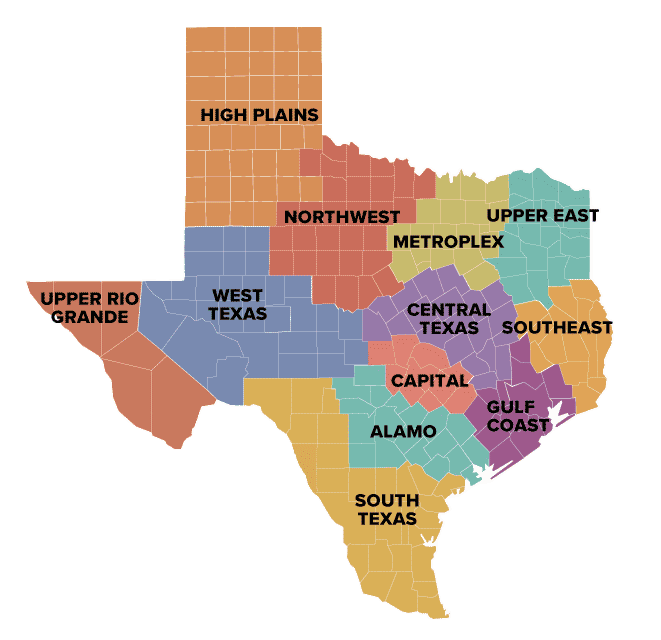
Source: Texas Comptroller of Public Accounts
The Triangle drives growth, but a network of regions across the state supplies the energy, goods and infrastructure that make it possible.
- Gulf Coast + Beaumont and Corpus Christi: Its ports move hundreds of millions of tons of cargo each year, connecting Texas to global markets and supplying industries statewide.
- West Texas: It produces more oil than most countries, anchoring U.S. energy security and powering a growing digital economy.
- Upper Rio Grande: El Paso–Juárez–Las Cruces is one of the world’s largest cross-border industrial regions, integrating supply chains, labor and trade.
- South Texas: Expanding ports and growing aerospace activity make it a key link between global supply chains and Texas’ inland markets.
- High Plains: From wind energy to agriculture, the Panhandle and South Plains provide the inputs that stabilize the grid and support growth across Texas.
Three Big Questions: Future of Texas’ Growth
1. Will Texas plan and govern at the scale its economy now operates?
To sustain the Texas Miracle, we must bridge the gaps between our local boundaries. By embracing regional coordination, we empower our communities to solve big challenges, like water and transportation, together.
It’s about modernizing how we collaborate to ensure no community is left behind by the speed of our state’s progress.
2. Will Texas’ megaregion make the transportation systems of the future a reality?
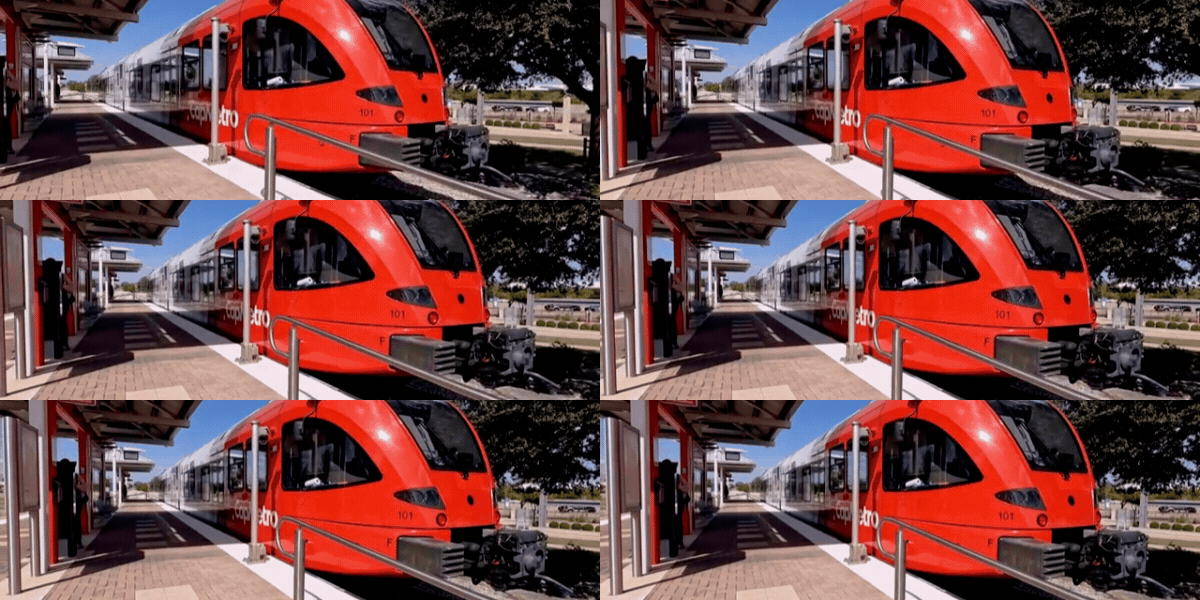
With millions moving into the Triangle in the decades to come, transportation systems must adapt to ensure residents can get from Point A to Point B.
That includes transportation systems of the future like autonomous freight corridors and air taxi pilot programs launching across the Triangle.
What’s the next innovation we might witness? Boring tunnels to enhance mobility in urban areas, perhaps? Or maybe rail service from Austin to San Antonio?
3. Can Texas build fast enough to keep up with its own growth?
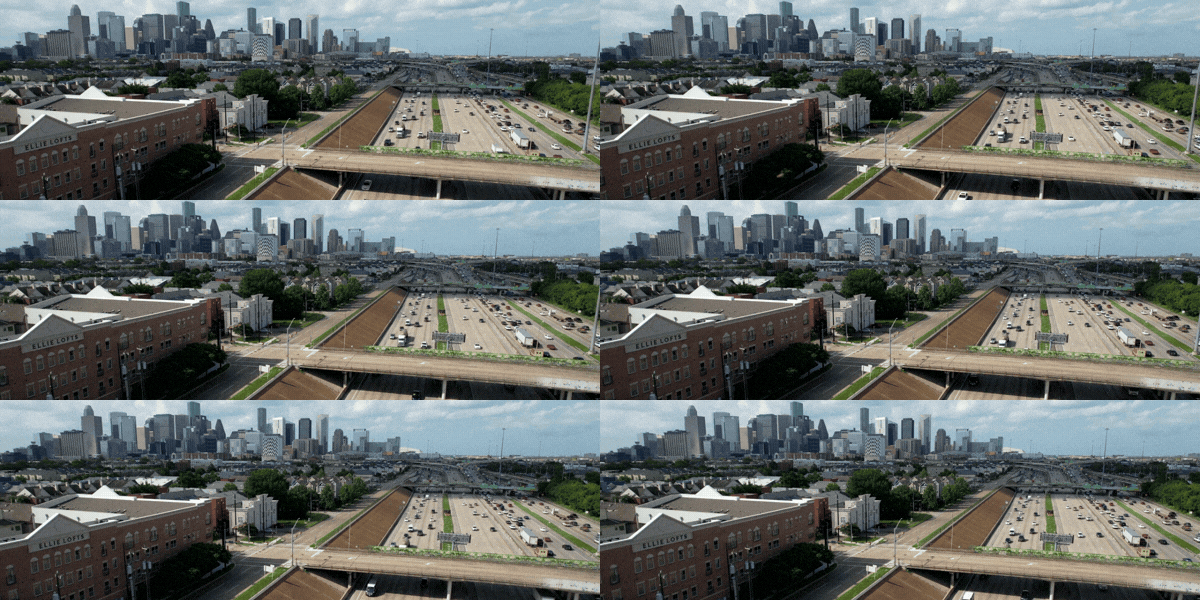
Texas does not have a demand problem. It has a build-speed problem.
Success in the next decade will depend on how fast the state can scale energy, water, housing and transportation.
Regions that build this basic infrastructure faster than demand will capture investment. Those that cannot will be constrained.
Texas Can Be The Standard For Smart Growth

“Texas could be a national exemplar of how you do quality growth and development. Bring people along economically, create a strong middle class, great quality of life with open space and parks and lakes. And that’s what Texas could look like. That’s what the Triangle could look like.”
– Henry Cisneros
What Texas 2036 Is Working On

At Texas 2036, we are focused on ensuring megaregional growth translates into long-term statewide opportunity.
- Workforce Alignment: We are advancing strategies to better align education and training with employer demand.
- Infrastructure – especially water: We are tracking implementation of long-term water solutions, including the investment of $22-plus billion into water supply and infrastructure over the next two decades.
- Regional Competitiveness: Housing, health care and childcare costs are shaping where businesses invest and where Texans can live and work.
- Better Data for Better Decisions: Modernizing workforce and education data systems is essential to planning at megaregional scale.
What Do You Think?
Did we miss anything? Reply or tag us. Your insights help shape the conversation for Texas’ next decade. Tell us your thoughts.
Through the Future of Texas podcast series, Texas 2036 brings together diverse perspectives as we explore the opportunities and challenges facing our state over the next ten years. The views expressed in this program are those of the individual speakers and do not necessarily reflect the views of Texas 2036, its staff or its Board of Directors.