
Seven New Colleges Approved for Texas Prison Programs
A new report from Texas 2036 finds that Texas is already seeing significant expansion in higher education opportunities for incarcerated Texans following passage of Senate Bill 2405 by Sen. Tan Parker and Rep. Terry Canales during the 89th Texas Legislature.
The report, Opening More Doors: Data, Progress, and Opportunities for Higher Education in Texas Prisons, examines the state of postsecondary education in Texas prisons and documents early progress resulting from reforms that transferred administration of prison higher education programs to Windham School District.
Research consistently shows that postsecondary education in prison settings reduces recidivism, improves employment outcomes after release, and generates returns for taxpayers through reduced criminal justice costs. The report notes that a 2023 meta-analysis found prison college programs reduced the likelihood of recidivism by more than 40 percent.
Among the report’s key findings:
- Seven new colleges and universities have been approved to launch programs in Texas prisons since implementation of SB 2405 began.
- Nine institutions have been approved to offer new programming across 11 prison units, including seven units that previously had no higher education provider.
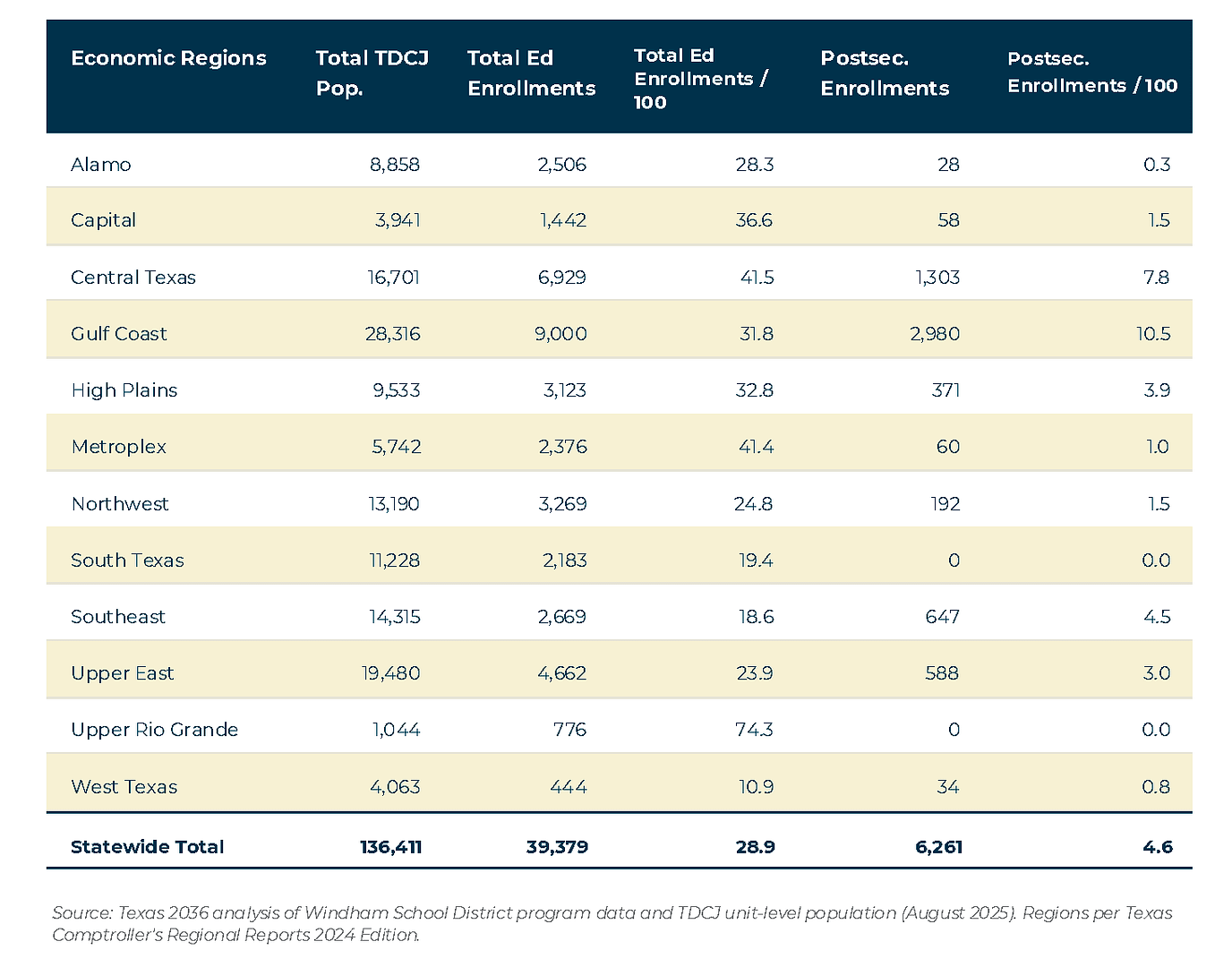
- More than 6,200 postsecondary enrollments were recorded in Fall 2025 across 15 higher education institutions operating in Texas prisons.
- While expansion is underway, approximately 60 percent of incarcerated Texans remain housed at units without access to postsecondary programs offered by institutions of higher education.
The seven new institutional partners approved to begin programming are Frank Phillips College, Lamar State College–Orange, Sam Houston State University, Southwest Texas College, Texas State Technical College, Victoria College, and West Texas A&M University.
Figure D: Mapping Postsecondary Education Programming in Texas Prisons

“Research consistently shows that higher education in prison settings reduces recidivism, improves employment prospects after release, and ultimately lowers costs for taxpayers,” said Luis Soberon, Senior Policy Advisor and In House Counsel at Texas 2036 and author of the report. “A 2023 meta-analysis found that prison college programs reduced the likelihood of recidivism by more than 40 percent, making these programs one of the most effective tools available to support successful reentry.”
SB 2405 implemented recommendations from the Sunset Advisory Commission and established a new framework for administering postsecondary education programs in Texas prisons. Among other reforms, the legislation transferred day-to-day administration of prison higher education programs to Windham School District while maintaining oversight through the Texas Department of Criminal Justice.
“Windham School District is proud of the ongoing advancements and new partnerships with institutions of higher education supporting students in the Texas Department of Criminal Justice,” Windham Superintendent Kristina J. Hartman said. “Collectively, we are increasing opportunities for high-quality, credit-bearing certificate and degree programs aligned with in-demand careers and remain committed to building momentum that supports student success during incarceration and positive outcomes upon reentry.”
The report credits Windham School District’s outreach efforts and engagement with colleges and universities across Texas for helping accelerate expansion. As of April 2026, additional institutions were already exploring opportunities to establish prison education programs.
“Texas has an opportunity to connect more Texans in prison with the education and workforce skills they need to successfully reenter society,” said Soberon. “The early results following SB 2405 show what can happen when institutions work together to expand access. While significant gaps remain, Texas is already making meaningful progress in bringing higher education opportunities to more prisons and more students.”
Table 1: IHE Postsecondary Enrollment by Economic Region
“The data show encouraging momentum across Texas, with new institutions and prison units gaining access to higher education opportunities following the passage of SB 2405,” said Carlo Castillo, Senior Research Analyst at Texas 2036. “Our interactive map helps Texans see where that progress is occurring and where additional opportunities remain to expand access.”
The full report and interactive statewide map are available at www.texas2036.org/texas-prison-higher-ed/