
This is a preview of our Texas 2036 newsletter launching the eighth episode of our Future of Texas podcast with our guest, Glenn Hegar, on the future of higher ed in Texas. To receive this weekly look at our work, sign up here.
Episode 8: The Future of Higher Education
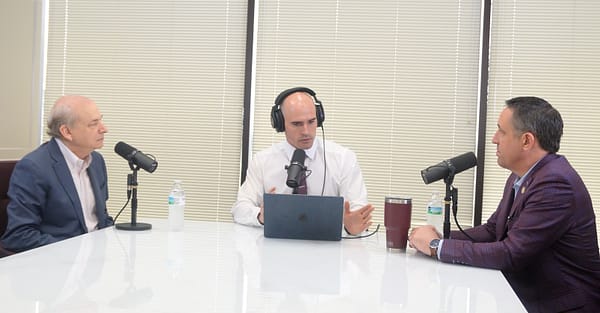
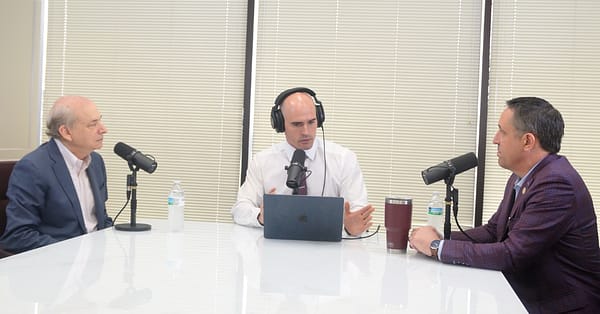
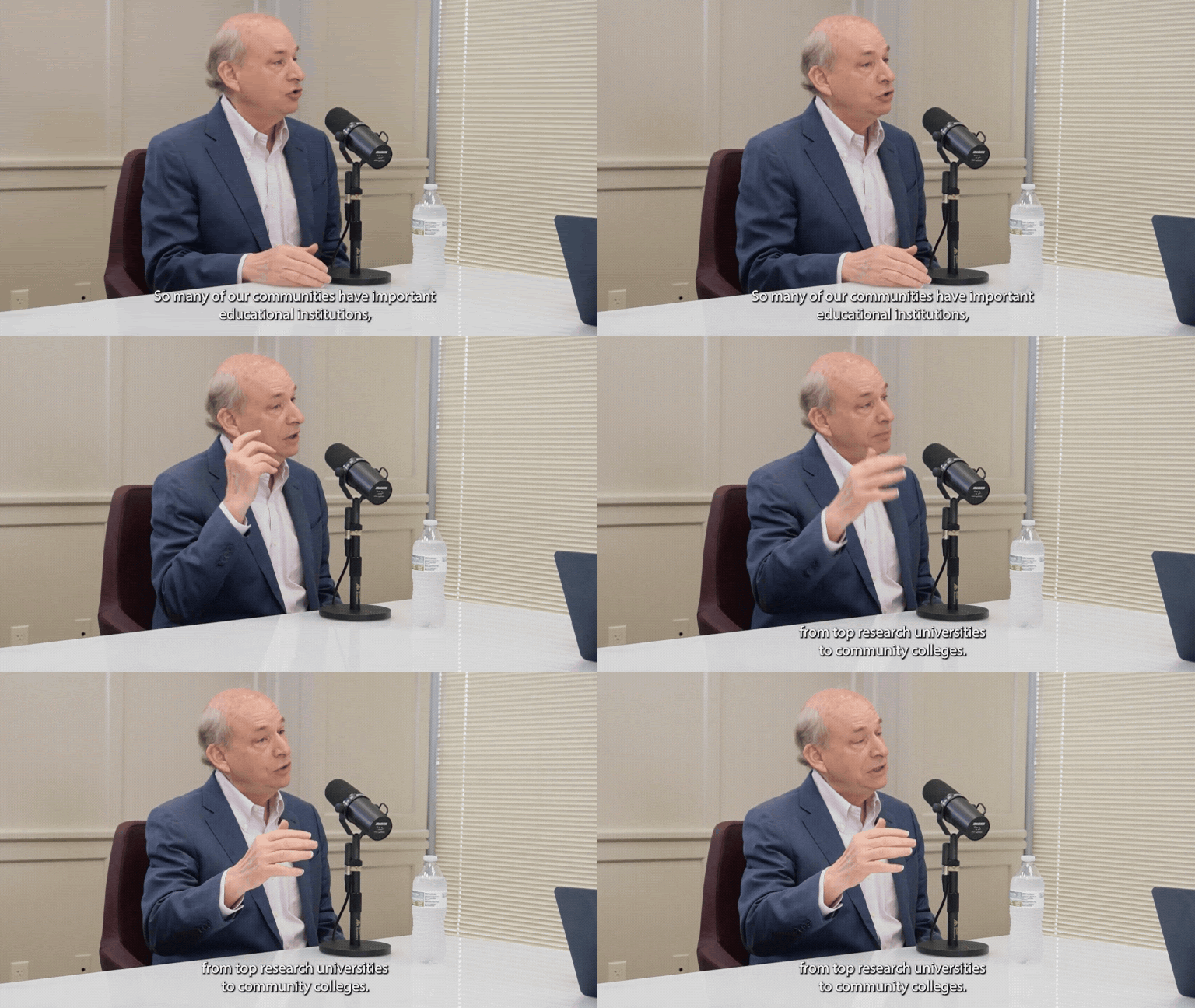
(Left to right) Host Brad Swail talks with Texas A&M Chancellor Glenn Hegar and Texas 2036 President David Leebron in episode eight of the “Future of Texas” podcast series.
Texas is building one of the most powerful higher education systems in the world. We have more top-tier research universities than any state, record enrollment and billions in innovation across the state’s campuses.
This isn’t just about degrees. It’s about talent, innovation and whether Texas can meet the demands of a rapidly growing economy.
The Future of Texas series continues with a look at higher education.
Our Podcast Guest: Chancellor Glenn Hegar
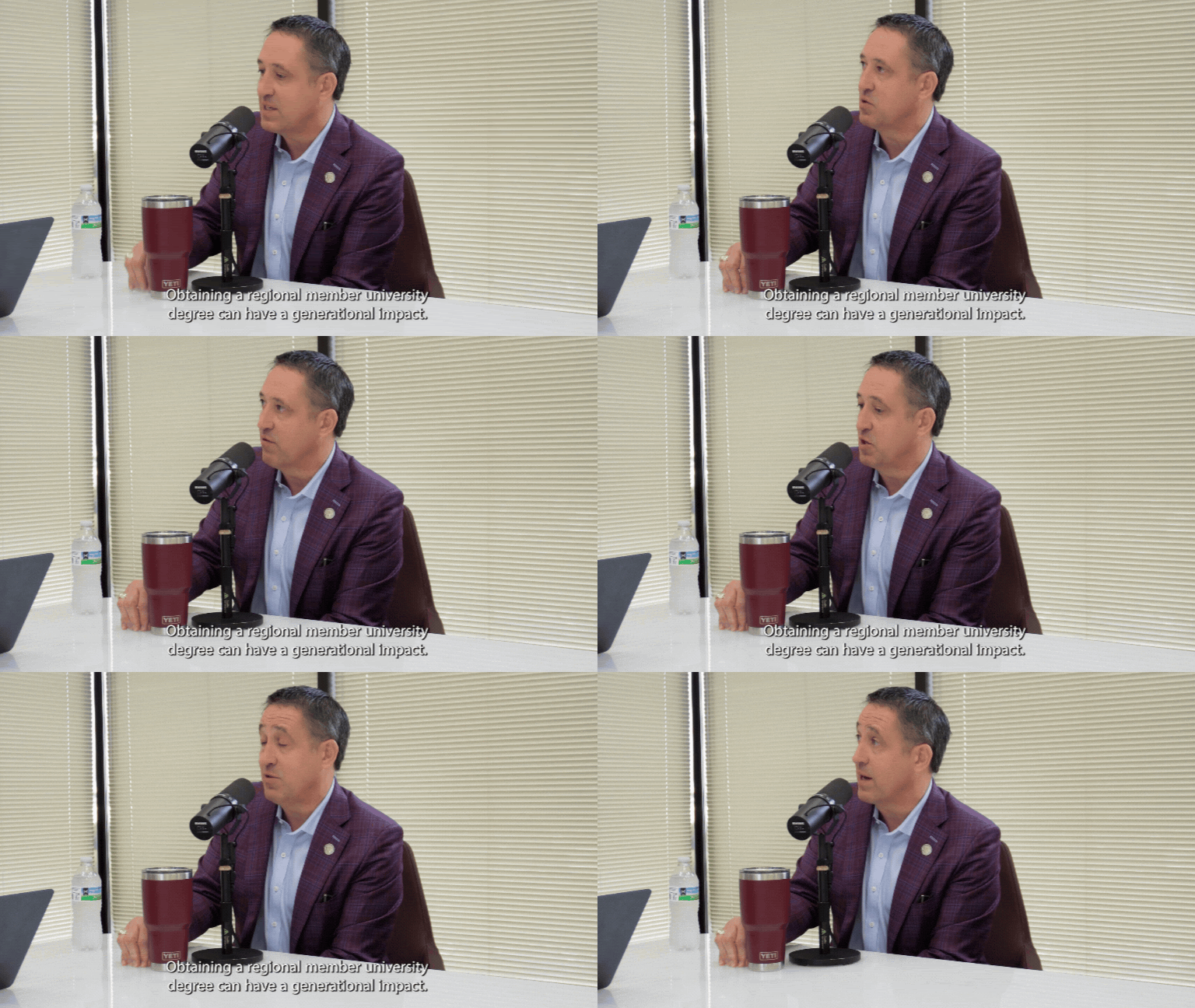
Texas A&M University System Chancellor Glenn Hegar joins Texas 2036 President and CEO David Leebron to explore how higher education is powering Texas’ future from training the workforce to driving breakthroughs in energy, space, semiconductors and beyond.
They discuss the growing role of universities in shaping our future, the challenge of preparing talent in a rapidly changing economy and what it will take for Texas to stay competitive in the decade ahead.
📺 Watch the full episode on YouTube
🎙️Listen on Spotify or Apple Podcast
Texas Is the Nation’s Research Capital
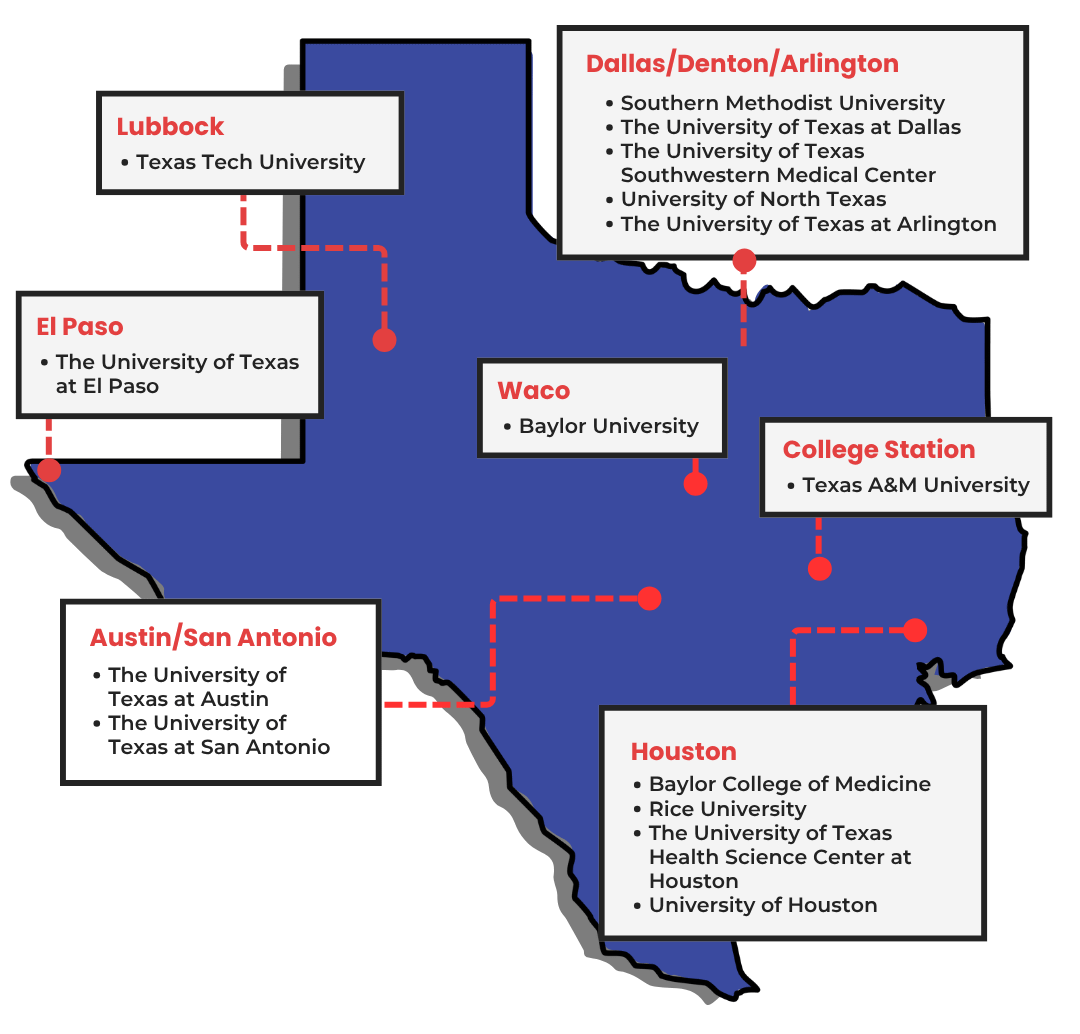
Texas’ Top-Tier Research Universities
Source: Texas Higher Education Coordinating Board
Texas now has 15 R1 research universities*, more than any other state. In 2015, Texas had four R1 research universities.
What is R1? It’s shorthand for a university doing serious research: at least $50 million in annual research spending and 70 research doctorates awarded a year.
Why it matters
📈 Economic firepower. A deeper research base keeps Texas competitive with every other state chasing the same industries.
🎓 A magnet for top talent. A bigger research ecosystem draws world-class faculty and graduate students to Texas, and gives them reason to stay.
🛠️ Workforce for what’s next. R1s produce the advanced-degree graduates that power tech, biotech, energy and other high-skill industries.
🏠 Homegrown innovation. More research universities mean more Texas-born startups and innovation hubs across the state.
*NOTE: The University of Texas at San Antonio and the University of Texas Health Science Center at San Antonio merged in September, 2025, dropping the number of Carnegie classified R1 research universities to 15.
Did you know? Texas’ research surge didn’t happen by accident. It’s the payoff from a strategy of deliberate legislative investment dating back to the 19th century.
The Texas Legislature established the Permanent University Fund in 1876, eventually setting aside 2.1 million acres of West Texas public land to generate investment income supporting the University of Texas and, later, Texas A&M University systems.
More recently, voters in 2023 approved an amendment to the state constitution establishing the Texas University Fund — backed by a $3.9 billion endowment — to help more Texas universities achieve top-tier research status.
Texas Higher Ed Enrollment Climbs
Source: Texas A&M Data Science
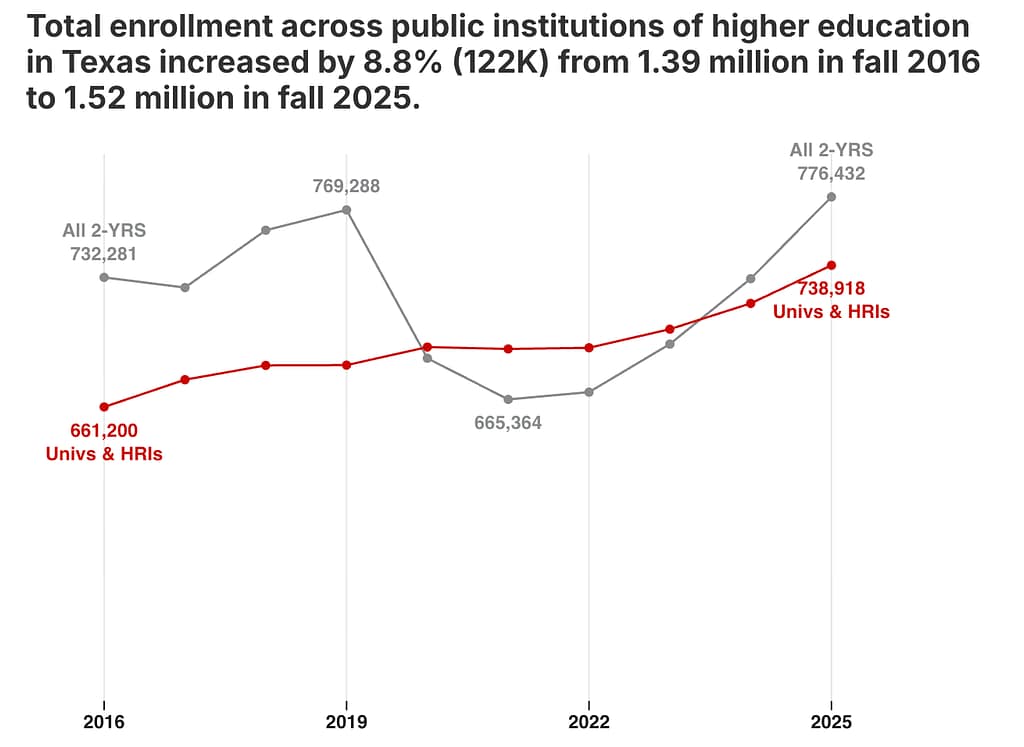
Texas higher ed just hit an all-time record: 1.52 million students in public institutions enrolled in fall 2025, up 4.7% in a single year.
- UT Austin crossed 55,000 students and received 90,000 applications, a 51% jump from 2022.
- The Texas State University System passed 100,000 for the first time.
- Texas A&M University System as of 2024 served more than 160,000 students statewide.
Undergraduate enrollment nationwide peaked in 2010 and fell nearly 15% through 2022 before rebounding. By 2024, undergraduate enrollment had nearly recovered to pre-pandemic levels.
Two forces explain the gap. Population growth is the engine. But Texas enrollment is growing slower than its population, and direct college-going rates remain below where they were a decade ago — a signal that affordability and value-perception concerns are still constraining the state’s higher ed pipeline.
Also, the post-2007 birth rate decline reaches college age in the next one to two years, which leaves Texas a narrow window to build capacity while demand is still climbing.
💰 Did you know? Sixty-three percent of Texas A&M University’s 2024-25 graduates finished debt-free, compared with 45% nationally.
Every UT System campus now offers free tuition for Texas residents from families with an adjusted gross income under $100,000, with Texas A&M (College Station) and the University of North Texas joining them in Fall 2026.
College Still Pays, but Not Equally

Recent college graduates earn a median $60,000 a year, compared with $40,000 for recent high school graduates.
The non-financial case is just as strong: on 50 of 52 life-outcome measures, college graduates come out ahead, from health to civic engagement to career satisfaction.
Is a college degree worth it? Researchers at the Federal Reserve Bank of New York concluded that investing in a college education, even a high-cost one, yields a good return for the typical graduate.
Not all college grads, though, end up with high-paying jobs. In fact, they noted, as many as a quarter of college grads may not see college pay off.
Choice of college major, they added, can affect the economic payoff for a graduate and is a factor over which students can control.
2 Things the Data Reveals That Headlines Miss
1. An issue to watch – Transfers between institutions
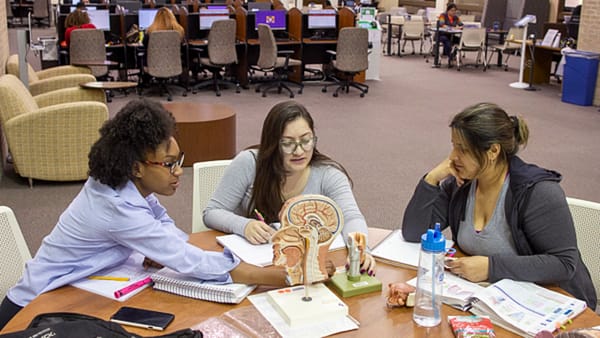
Only 45% of Texas community college students who transfer to a four-year university actually earn a bachelor’s degree. For adults over 24, that number drops to 37%. In 2023, the Legislature overhauled community college funding to reward transfers.
2. AI is reshaping what a degree is worth, and universities are racing to keep up
PwC’s 2025 AI Jobs Barometer analyzed nearly a billion job postings and found that employer demand for college degrees is falling faster in AI-exposed jobs than in the broader jobs market. Meanwhile, 47% of current college students say they’ve considered switching majors because of AI. The universities that figure this out will define higher education for the next generation.
A Closer Look At Research Powerhouses
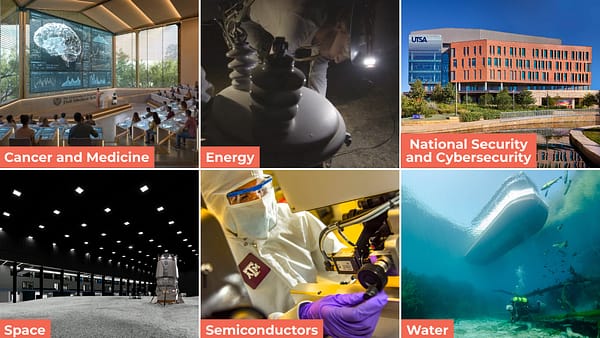
Texas’ research institutions aren’t just training the workforce for tomorrow’s economy. They are inventing it. Here are some examples of what that looks like right now:
🧬 Cancer & Medicine | UT Austin: The UT Austin + MD Anderson Collaborative pairs TACC supercomputing with the nation’s top-ranked cancer hospital, supporting five joint research teams of up to $4 million each. MD Anderson will be co-located at the New UT Dell Medical Center in Austin, and this week Michael and Susan Dell announced a $750 million gift to fund a new UT medical center.
⚡ Energy | Texas A&M-RELLIS: Four companies are building small modular reactors on 2,400 acres near Bryan. A separate pilot from Last Energy targets reactor testing in 2026.
🛡️ National Security & Cybersecurity | UT San Antonio: UTSA is one of only ~10 U.S. universities designated by the NSA as a Center of Academic Excellence in all three cybersecurity focus areas — defense, operations, and research. Its National Security Collaboration Center convenes government, industry, and academia on national security challenges.
🚀 Space | Texas A&M: The Texas A&M Space Institute is a $200 million facility opening Fall 2026 at Exploration Park, next to NASA Johnson Space Center, home to the world’s largest indoor lunar and Martian simulation space.
🔬 Semiconductors | Texas A&M-RELLIS: The Texas A&M Semiconductor Institute is a $226 million facility that broke ground in April 2026 with full-scale clean-room production capacity. Texas has already led the U.S. in semiconductor exports for 14 consecutive years.
💧 Water | Texas State University: The Meadows Center for Water and the Environment conducts research, education and policy work aimed at protecting freshwater ecosystems — with a focus on the spring-fed rivers and aquifers of Texas.
How This Research Is Funded
Texas’ public universities generate nearly $7.8 billion in research and development each year. Nationally, about 55 cents of every dollar comes from the federal government.
Looking Ahead: Federal research funding is in transition. New grants from major agencies are running well below recent averages in FY 2026. What it means for Texas labs, students and research depends on decisions ahead in Washington and Austin.
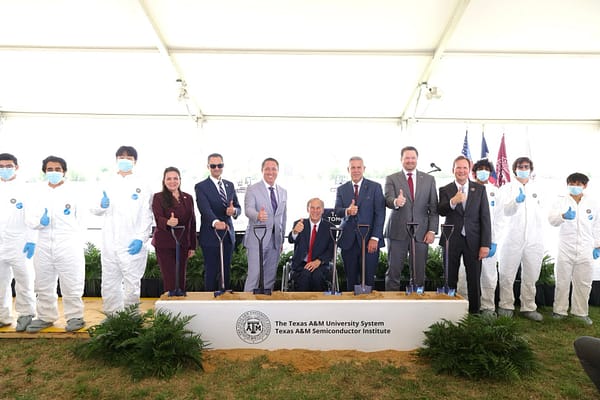
On April 9, Texas A&M University System broke ground on the Texas A&M Semiconductor Institute. This facility will be located at the RELLIS Campus and represents one of the largest investments in A&M System history. Source: Texas A&M University System
What Texas 2036 Is Watching
Texas continues to aim high in setting ambitious higher education goals, but meeting them will require more than enrollment growth. We must rethink how progress is measured and ensure that every student who invests in their education receives recognition for what they’ve earned.
Texas 2036 is working to leverage partnerships and advance policy, such as:
- Turn credits into credentials: More than 54,000 Texans earned 60-plus credit hours between 2012 and 2022 but left without a credential. Tools we’re advancing include retroactive credentialing, reverse transfer and credit portability.
- Build on community college finance reforms: We continue to monitor how a performance-based funding model is delivering better outcomes for community colleges and what the next Legislature can do to make further improvements.
- Make it easier to enter, persist, and complete: We are pushing to reduce wasted credits, better align dual credit to workforce pathways, and help more students (especially from lower-income households) move efficiently from enrollment to a credential that opens doors.