
Early voting has begun: Texas primaries 101
This is a preview of our Texas 2036 newsletter with a look at the primaries — what is on the ballot, who is voting and why these elections matter. To receive this weekly look at our work, sign up here.
How Texas Primaries Shape the State

In Texas, many of the most decisive elections happen in March, not November.
Those elections are party primaries. They draw far fewer voters than the general election, even though many March winners often face limited opposition in November.
In a state of 31.7 million people and a $2.8 trillion economy, those early decisions matter. Early voting for the March 3 primaries is underway, and we take a closer look at who participates and why it counts.
Why March Matters: What’s on the Ballot
Texas primaries determine which candidates advance to the November ballot. Because the state does not register voters by party, eligible voters choose which primary to participate in each cycle.
The March 3 ballot includes U.S. Senate and congressional races, statewide offices, legislative seats, judges, State Board of Education members and local offices across Texas.
Many of these leaders will shape the state’s government, budget, schools and courts through 2030 and beyond.
 Source: March Matters
In the last comparable primary cycle in 2022, only four Texas House races were genuinely competitive in November. In many districts, party alignment makes the general election outcome largely predictable. In those districts, March is the decisive contest.
Want to learn more about how Texas primaries work? Check out this blog by Texas 2036 Government Affairs Director Jordan Wat, Texas Primaries 101: How They Work and What to Expect in 2026
Who’s Registered to Vote?
Texas’ voter rolls have grown significantly over the past three decades.
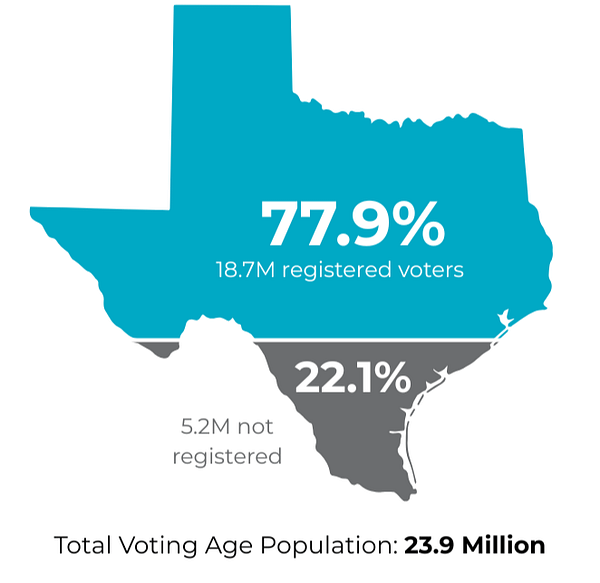
In 1991, about 7.8 million Texans were registered to vote. In 2026, the state reports roughly 18.7 million registered voters. That’s more than twice as many registered voters as in 1991.
Texas is now home to an estimated 23.9 million adults. That means about 78% of voting-age Texans are registered, leaving roughly 5.3 million adults unregistered. That’s a population larger than more than half of U.S. states.
Texas Voter Registration Snapshot (2026)
Are you registered to vote? Check your registration status.
Three Million Primary Voters. Who Are They?

In 2022, the last non-presidential primary, approximately 3.1 million Texans cast a ballot. That represents fewer than one in five registered voters and a much smaller share of the overall adult population.
The 3.1 Million Voters By Age
 Source: Ryan Data & Research
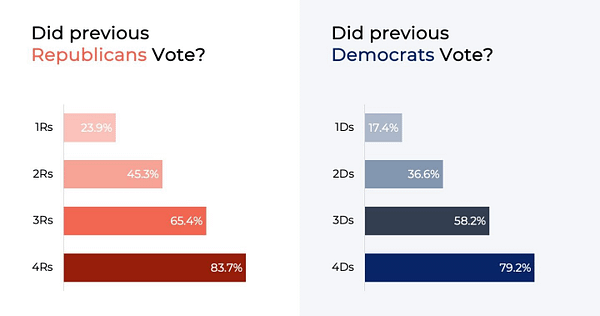
More than 70% of voters were over the age of 50, even though Texans over 50 account for roughly one-third of the population. More than 80% had voted in the previous four primaries.
 Source: Ryan Data & Research
NOTE: The numbers and letters in the chart above refer to the number of previous primaries and the primary contest. For example, 2R means two previous Republican primaries.
The Big Picture: Texas has become larger and younger. But primary voters remain older than the general population.The big question for the next decade is whether participation will begin to reflect the state it represents.
Texas Voter Poll: Results Resonate with Voters

In our latest Texas Voter Poll, we asked registered voters:
If a candidate expressed the following positions, would you be more or less likely to vote for them in the primary you plan to participate in?
Across party lines, the strongest motivators were practical and focused on cost of living:
Cost pressures lead:
• Reducing health care prices (82% more likely)
• Cutting homeowner insurance costs (79%)
• Reducing property taxes (78%)
Stability and system performance follow closely:
• Improving disaster response (78%)
• Strengthening education accountability (78%)
• Providing reliable, affordable energy (77%)
• Building water infrastructure (75%)
Education and workforce also rank high:
• Aligning schools with workforce needs (75%)
• Boosting college affordability and outcomes (74%)
The throughline was affordability, reliability and long-term performance.
Imagine if turnout in March matched the breadth of these shared priorities, creating a stronger mandate for action on these issues over the next several years.
📊 Learn more about what our poll found:
- Texas voters want candidates focused on everyday challenges
- From the Left: What democratic voters want Texas leaders to focus on
- From the Right: What GOP voters want Texas leaders to focus on
Show up for Texas. Get Election-Ready!

In Texas, March shapes what comes next. Make sure your voice is counted.
What to know: Early voting is underway and will continue through Feb. 27. Tuesday, March 3, is Election Day.
You can prepare in minutes. Here’s what you need:
- Verify registration.
- Review the ballot. You can generate a sample ballot at VoteTexas.gov or your county election office online.
- Plan when and where to vote, making sure to double check your polling location before heading to the polls.
Want to learn more? View our Texas Checklist to ensure you’re election ready.