
AI is reshaping how some Americans get health information
Key Takeaways
- One in three adults (32%) have used AI for health information in the past year, with higher rates among younger adults (36%) and the uninsured (40%).
- For many younger adults, AI is becoming an alternative to a health care system they struggle to access or afford. Adults under 30 were six times more likely than those 50 and older to cite not having a regular provider or being unable to get an appointment (38% vs. 6%) as a major reason for using AI. And they were more than twice as likely to cite cost (29% vs. 12%).
- A majority of AI users are satisfied with the responses they receive and many view AI positively. Among users, 92% were at least somewhat satisfied, and 65% said they felt AI was as reliable as a health care provider.
Several technology companies, such as Microsoft, Amazon, OpenAI and Anthropic, are entering the health care space, collecting health data and offering direct feedback to help individuals track their health. As consumer use of artificial intelligence (AI) tools and chatbots have grown rapidly, more adults are turning to these tools for information about their physical and mental health. A recent Kaiser Family Foundation poll shows how many adults are using AI for health purposes, which groups are most likely to do so, and why.
Who is Using AI for Health Information
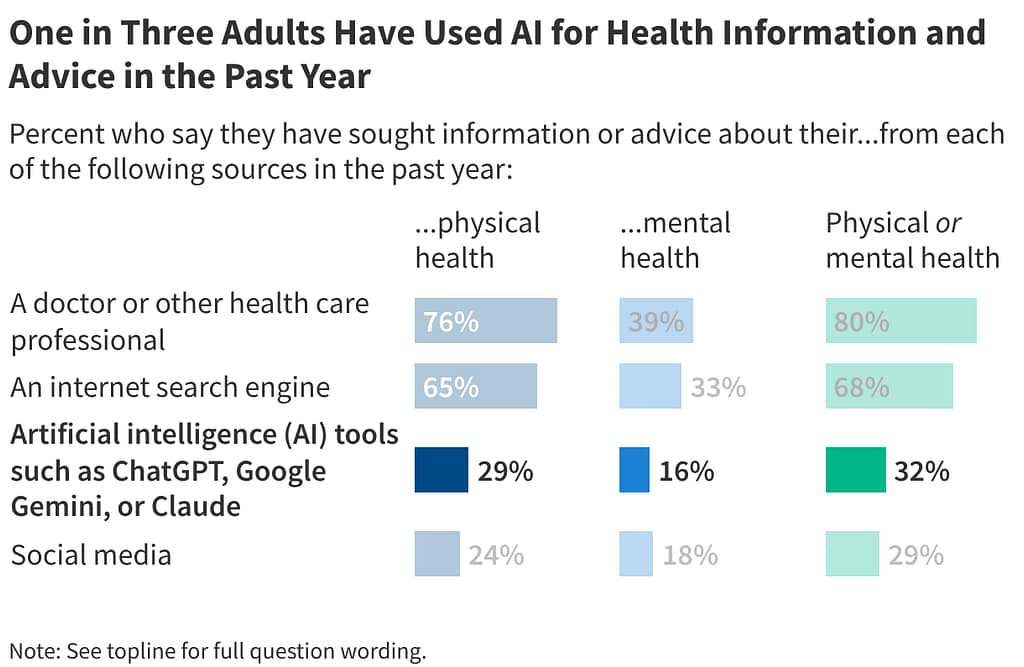
For some, the draw of the tools is convenience. But for others, AI is filling a gap left by a health care system they cannot easily access or afford. About one in three adults (32%) have used AI for health information and advice in the past year. Doctors and other health care professionals remain the most common source, with 80% of adults seeking information from a provider in the same period. AI use was higher among younger adults, with 36% of those ages 18 to 29 reporting using those tools. Individuals who were uninsured were more likely to seek information about their physical or mental health from AI at 40%, compared to 31% for insured individuals.

Source: KFF Tracking Poll on Health Information and Trust (Feb. 24-March 2, 2026)
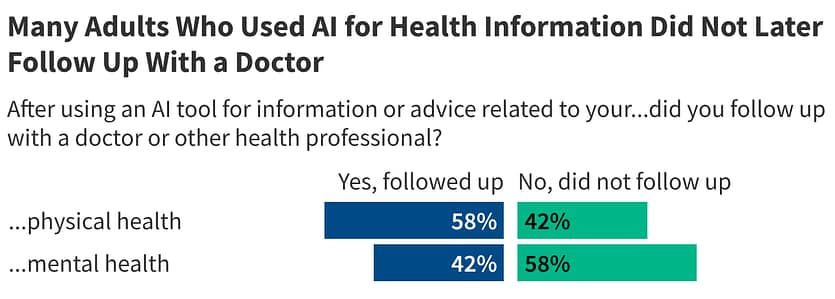
People are using AI tools for health information, but they are not always following up with a provider, especially for mental health. About six in 10 (58%) adults followed up with a doctor or health care provider after consulting an AI tool, but only about four in 10 (42%) followed up with a mental health professional.
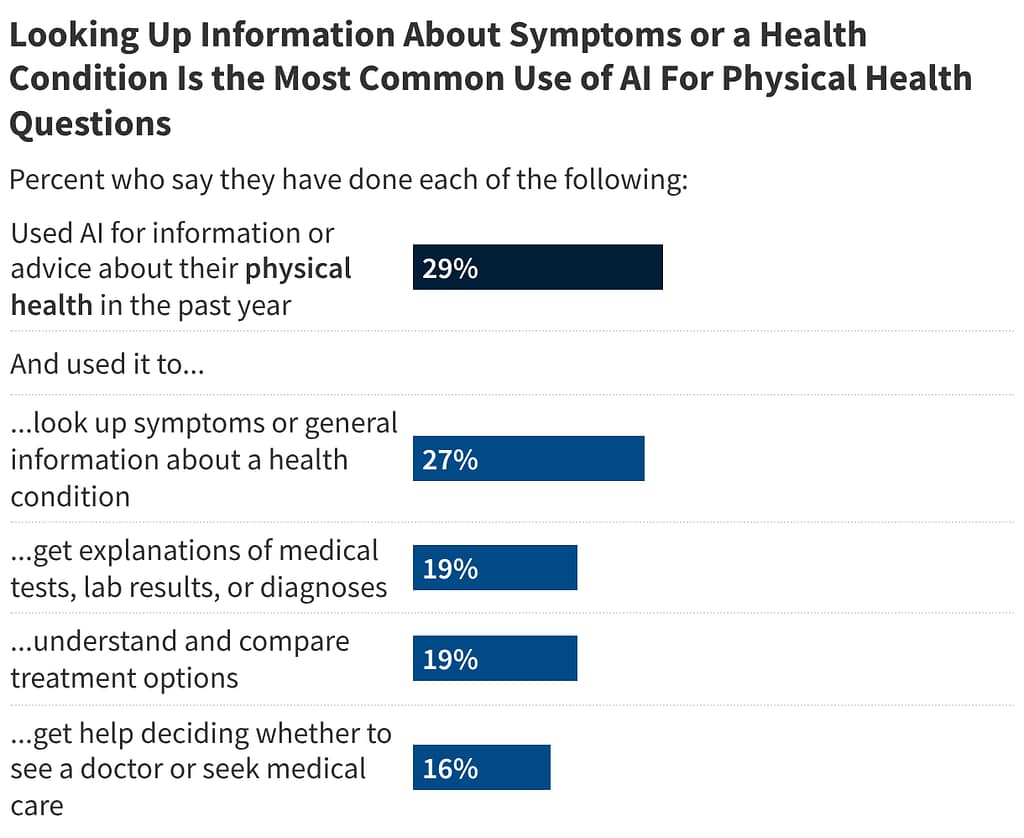
Source: KFF Tracking Poll on Health Information and Trust (Feb. 24-March 2, 2026)
Why are People Turning to AI? Access and Affordability
The KFF poll data suggests that for many adults, turning to AI for health information is not simply a matter of convenience. It is a response to real barriers in the existing health care system.
Adults under age 30 were six times as likely as users 50 and older to cite not having a regular health care provider or being unable to get an appointment (38% v. 6%) as a major reason for turning to AI. They were also more than twice as likely to cite the cost of seeing a provider (29% v. 12%). These are not small gaps. They point to a generation of adults who are seeking health information from AI because they cannot find or afford traditional care.
And many do not take the next step to see a provider.
Only 58% followed up with a doctor after using AI for physical health questions, and just 42% did so for mental health. While the poll does not ask why users did not follow up, this finding takes on added significance given that many users, particularly young adults, cited cost and access barriers as major reasons for turning to AI in the first place.
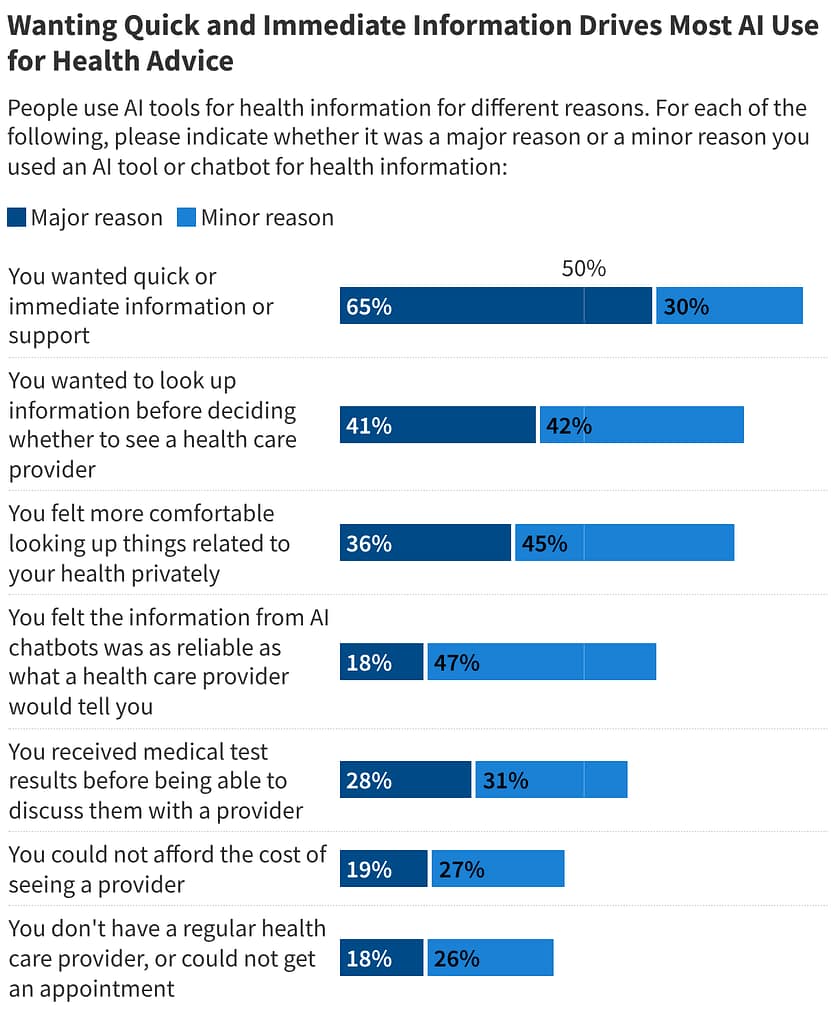
The top major reason people gave for using AI was wanting quick or immediate information. But behind that desire for speed are structural factors. Fully 41% said they wanted to look up information before deciding whether to see a provider. Another 36% said they felt more comfortable looking up health-related topics privately, and 28% said they have received medical test results before being able to discuss them with a provider. For younger adults, AI is stepping into gaps that the health care system has left open.
Source: KFF Tracking Poll on Health Information and Trust (Feb. 24-March 2, 2026)
These patterns raise an important question. If people are turning to AI because they cannot access or afford a provider, addressing that trend means looking beyond the technology itself and toward the underlying access and affordability challenges driving it.
People May Be Viewing AI as a Substitute, Not a Supplement, for the Doctor
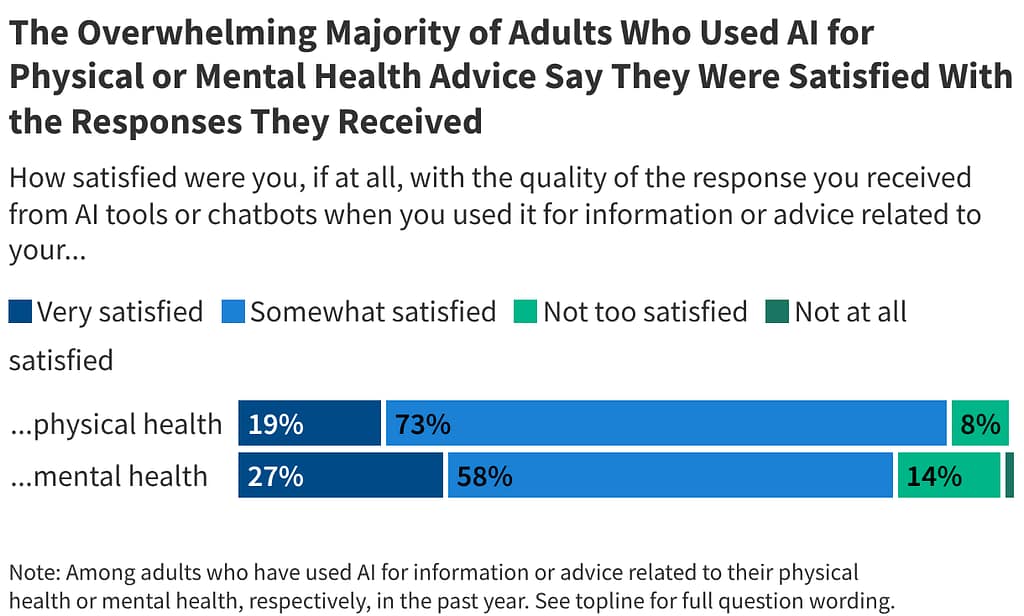
On satisfaction, adults who used AI for health information were at least “somewhat satisfied” with the quality of responses related to their physical health (92%) and mental health (85%), though relatively small shares said they were “very satisfied” (19% and 27%, respectively).
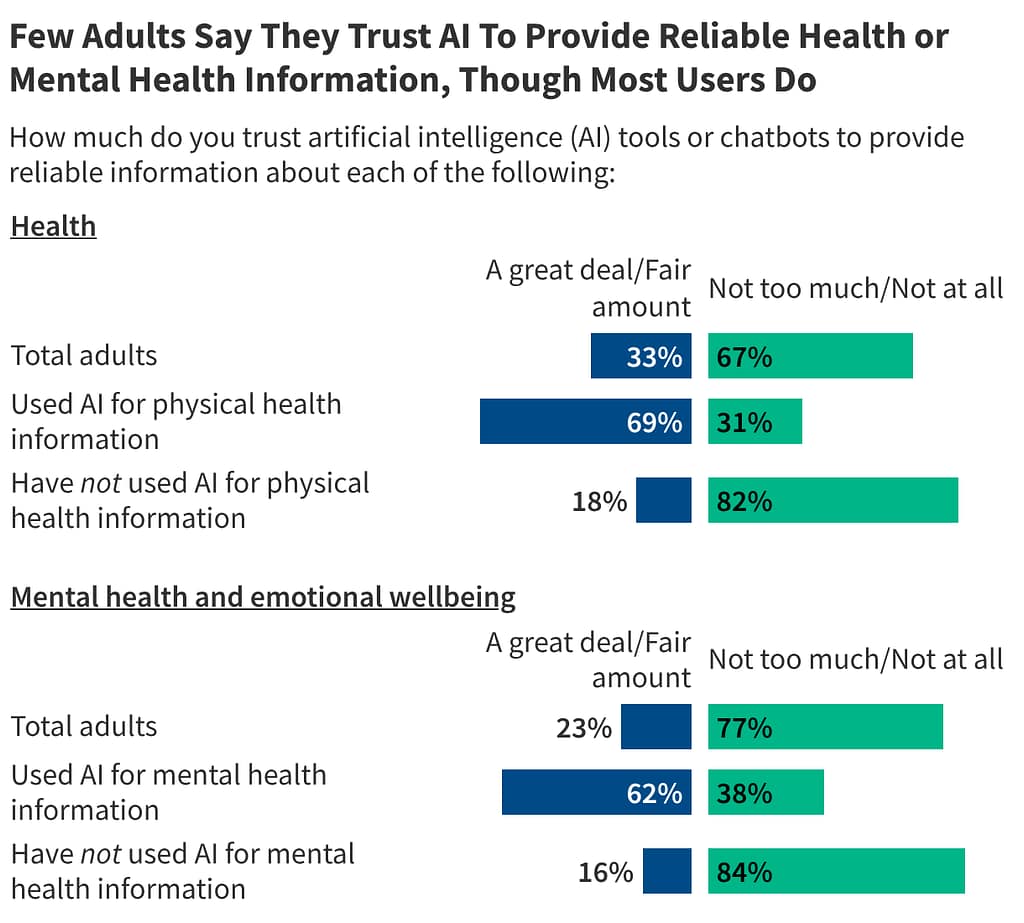
Even as doctors remain a trusted source of health information, that trust has slipped in recent years. According to another KFF survey, the share of adults who trust their doctor “a great deal” or “a fair amount” to make the right health recommendations fell from 93% to 85% between 2023 and 2025. At the same time, among adults who have used AI for health information, 69% say they trust AI tools to provide reliable information about physical health and 62% say they trust AI tools for reliable information about mental health. These numbers measure different populations (all adults vs. AI users), but taken together, they show trust in doctors declining while a growing share of people are placing confidence in AI tools.
Additionally, 65% of AI users said that a reason they turned to these tools was that they felt the information from AI tools was as reliable as what a health care provider would deliver. When cost or access is already a barrier to seeing a provider, and users perceive AI responses as comparable in quality, AI may not just be supplementing professional care, it may be replacing it.
Source: KFF Tracking Poll on Health Information and Trust (Feb. 24-March 2, 2026)
Privacy Concerns Persist
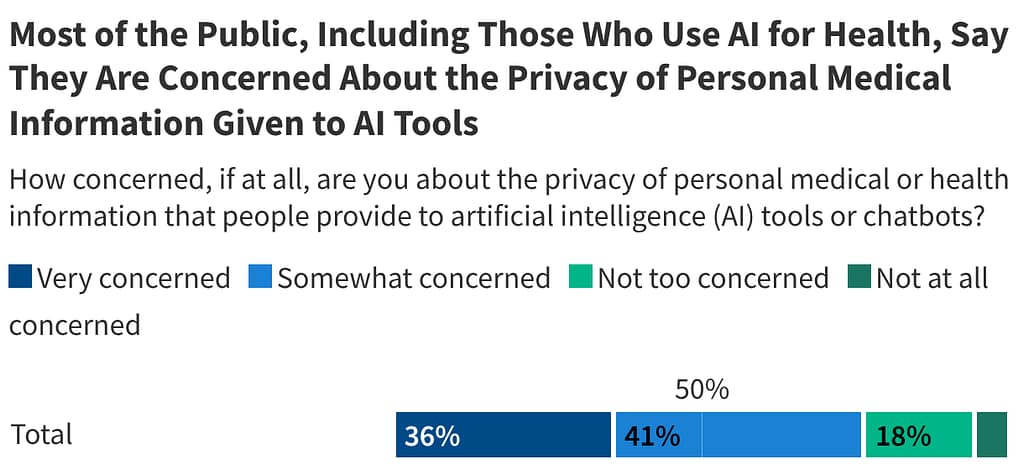
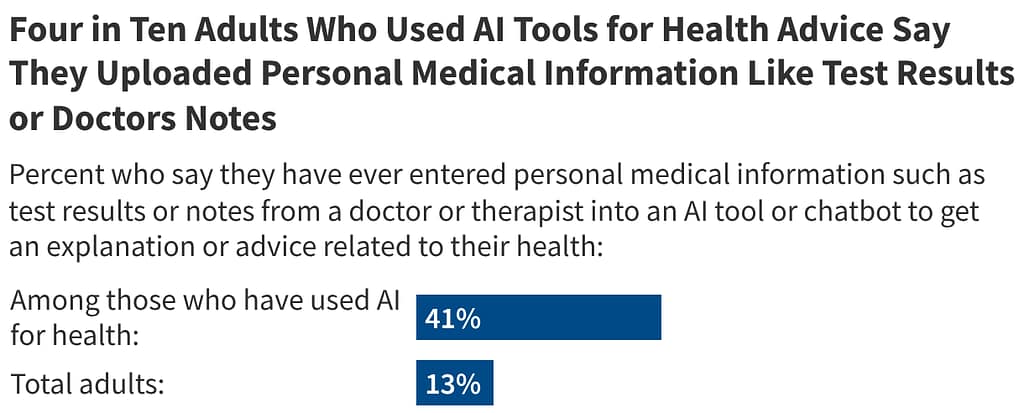
Even as AI use for health grows, Americans are raising concerns about privacy. About three in four adults (77%) say they are very or somewhat concerned about privacy. Despite these concerns, about 41% of adults who have used AI for health say they have uploaded medical information, such as test results or doctor’s notes, into an AI tool. There is no comprehensive regulatory framework governing how personal health data shared with AI tools is stored, used or protected.
Source: KFF Tracking Poll on Health Information and Trust (Feb. 24-March 2, 2026)
Why This Matters for Texas
AI in health care is not a future possibility. It is here. More than four in five physicians across the U.S. now use AI in their practices, more than double the rate in 2023. Patients are turning to AI for health information and the doctors treating them are increasingly using it too. As AI tools become a more common part of how people seek and receive health care, Texas has an opportunity to get ahead of the curve.
The KFF data makes clear that AI adoption is not just a technology story. It is also an access story. When younger adults turn to AI because they cannot find a provider or afford one, that is a signal that the health care system is not meeting the needs of people it serves. It is worth considering not only how to ensure AI-generated health information is accurate and private, but also how to address the access and affordability gaps that are driving people toward these tools.
These questions are too consequential to address only after problems emerge. Being proactive now will put Texas in a stronger position as AI’s role in health care continues to expand.