
A look at what’s next for Texas courts
This is a preview of our Texas 2036 newsletter launching the fifth episode of our Future of Texas podcast with our guest, Wallace B. Jefferson, on the future of Texas courts in our rapidly growing state. To receive this weekly look at our work, sign up here.
Episode 5: The Future of Texas’ Court System

(Left to right) Host Brad Swail talks with Chief Justice Wallace B. Jefferson and Luis Soberon in episode five of the “Future of Texas” podcast series.
Texas’ future depends not just on how fast we grow, but on whether our institutions keep up. Courts sit at the center of where business happens, disputes are resolved and public trust is earned or lost.
As demand rises, the challenge is not just volume. It is delivering justice that is fast, fair and consistent at an unprecedented scale.
The Future of Texas series continues with a look at what is shaping Texas courts.
Our Guest: Chief Justice Wallace B. Jefferson
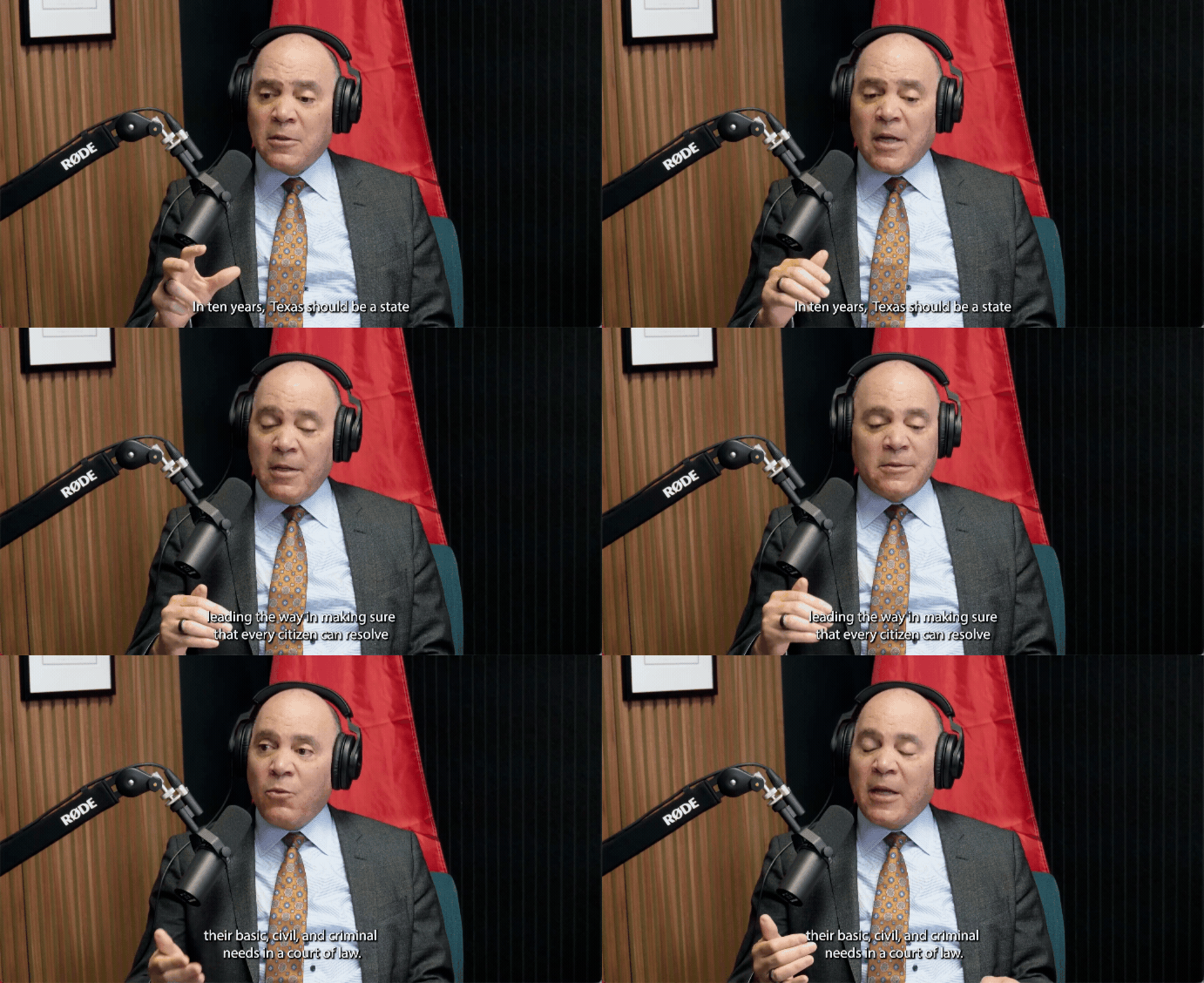
Former Chief Justice of the Texas Supreme Court Wallace B. Jefferson joins Texas 2036’s Luis Soberon to explore what it takes to build a court system capable of serving a state of more than 35 million people in the decade ahead.
Chief Justice Jefferson has long focused on how courts evolve alongside the people they serve. Today, those questions are becoming more urgent and more complex.
“Courts are the backbone of a functioning society. If people can’t rely on them — if justice is delayed or inaccessible — everything else begins to erode.” — Wallace B. Jefferson
📺 Watch the full episode on YouTube
🎙️Listen on Spotify or Apple Podcast
A System Under Pressure, and Changing Fast
Trends in Texas Civil Cases Filings (1995-2024)
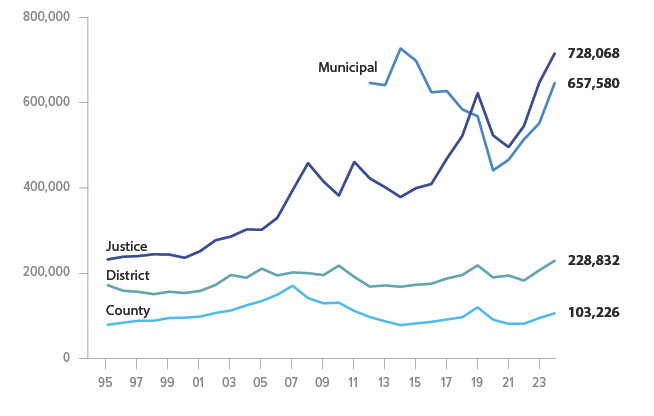
All Charts Sourced: Office of Court Administration
Texas operates one of the largest and most complex court systems in the country, with more than 2,000 courts at the state and local level.
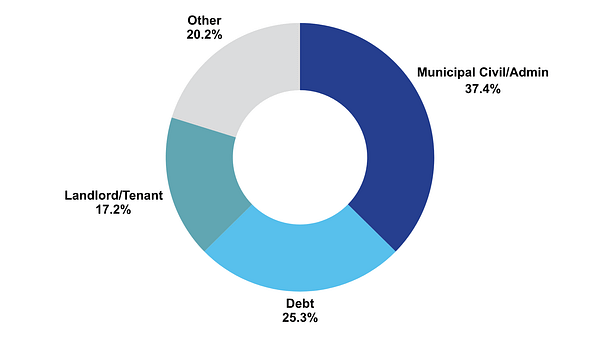
In FY 2024, Texas courts recorded 7.9 million new filings, with civil filings reaching an all-time high across nearly every court level. Of the 1.8 million new cases, 80% were filed in municipal and justice courts, where everyday disputes such as debt claims, evictions and small claims are concentrated.
New Texas Civil Cases Filings (2024)
A Look At Criminal Cases
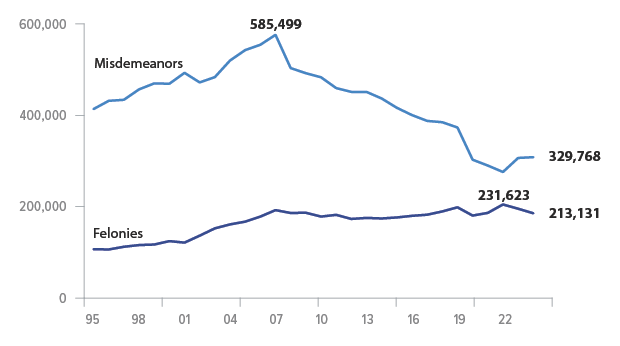
Although statewide statistics for 2025 showed a decline of 4% in felony cases due to missing data from Dallas County, new felony cases increased by 6% when excluding Dallas.
Violent and person-based offenses, including assault and family violence, are rising, while new misdemeanor drug cases have fallen to their lowest level since 1993.
8 Million Cases, 100,000 Lawyers
Texas has one of the largest legal workforces in the country, with more than 100,000 active licensed attorneys and a steady pipeline from its 10 law schools.
But that workforce is not evenly distributed. Legal services are concentrated in major metros, leaving some counties with few or no attorneys and creating “legal deserts,” especially in rural and fast-growing regions.
Today, People Access Texas Courts With AI
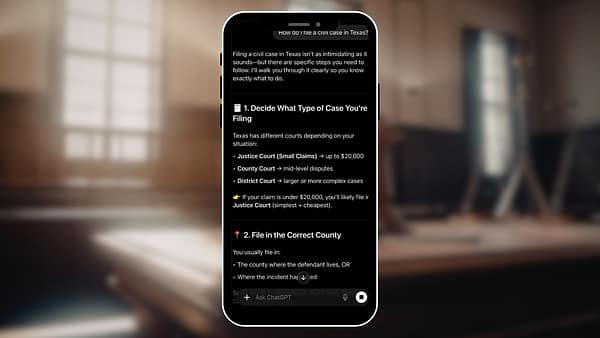
Gaps in access to legal representation have left many Texans navigating the legal system on their own. Now, AI is becoming a tool to draft motions and streamline research.
As a result, judges have seen a growing number of AI-generated filings with errors. By mid-2025, the problem increased from roughly two cases per week to two or three cases per day. Some Texas courts have issued sanctions for AI-generated fake citations and fabricated legal arguments.
“AI is a tool…not a replacement for human judgment …It’s a way to enhance the practice of law, but also to transform the access of ordinary people to legal jargon that they can’t understand.” – Chief Justice Wallace B. Jefferson
An Economic Advantage: Texas Business Courts
The 2023 establishment of a system of specialized business courts signals Texas understands that complex business disputes can benefit from an efficient, consistent and technically proficient legal forum before specialized judges.
The recent announcement that ExxonMobil is moving its legal headquarters to Texas is an example of the pull of Texas’ business-friendly legal environment.
🗳️ Did you know? Texas is one of about nine states that uses partisan elections to select most of its judges, including general jurisdiction courts, appellate courts and the state’s highest courts.
What Texas 2036 Is Watching
Over the next 10 years, Texas 2036 will follow how courts evolve as part of the state’s broader systems. That includes supporting efforts to:
- Implement case-level data collection and create new cloud-based case management software systems for over 200 specialty courts and appellate courts.
- Integrate judicial data with improved prosecution data alongside existing law enforcement and criminal justice data systems.
- Continue investing in technology solutions that improve Texans’ interactions with the judicial system like text-based reminders for court appearances.
Three Big Questions: Future of Texas Courts

1. Can Texas attract the best and brightest to the bench?
Access to the justice system depends on Texas’ ability to attract talented jurists to the bench.
Chief Justice Jefferson has consistently cited pay as a barrier, noting that first-year attorneys at major firms in Dallas and Houston often earn more than district judges. He has also warned that highly qualified judges can be removed due to partisan shifts rather than performance.
2. Can Texas deliver justice at the speed and scale of its growth?
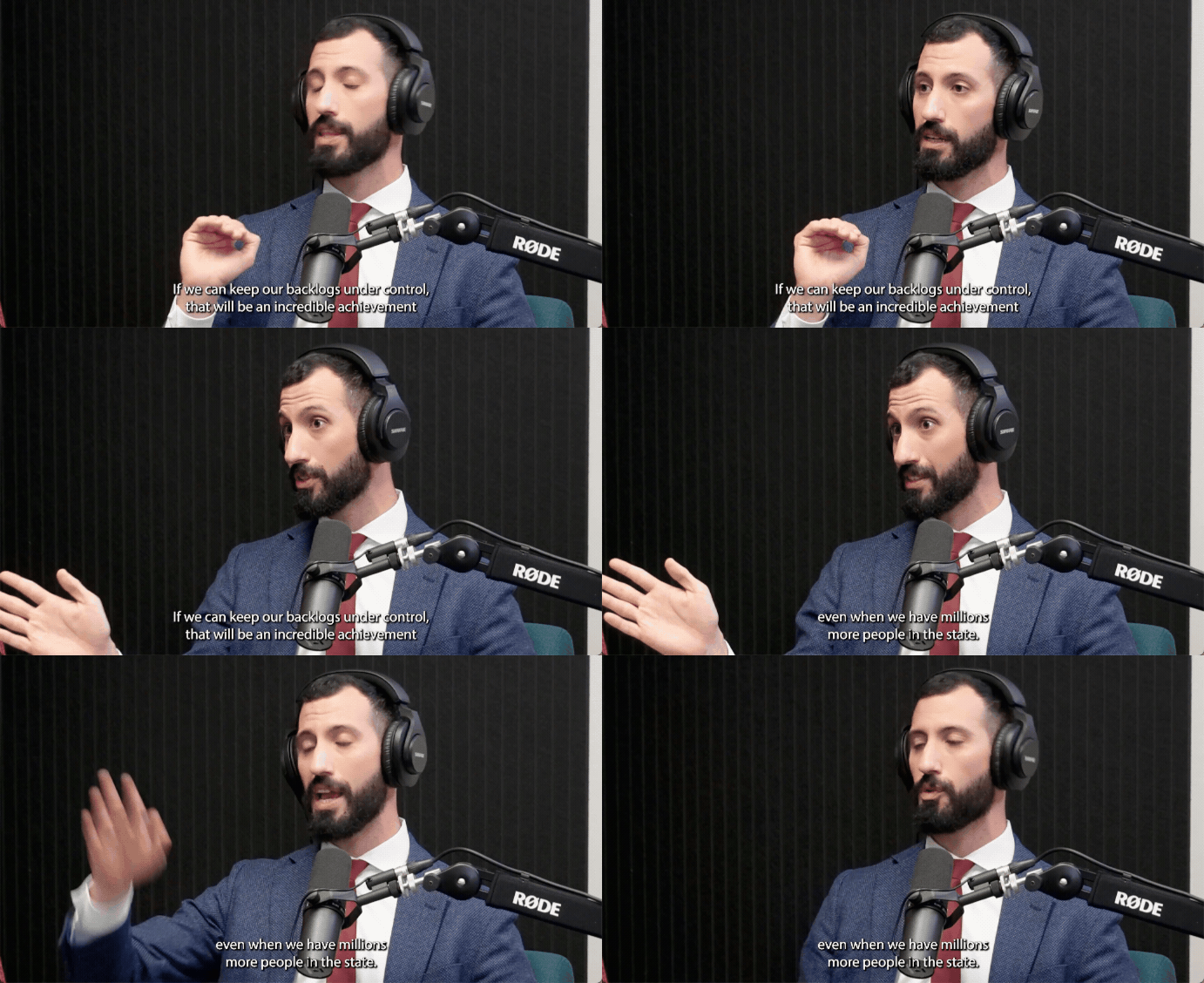
As Texas adds millions of people, courts are under pressure to deliver justice at the speed and scale of that growth.
The opportunity is clear: With better statewide data, more consistent processes and targeted investment in high-growth areas, Texas can build a court system that keeps pace with its economy.
3. Can Texas ensure every Texan no matter where they live has meaningful access to justice?
Access remains uneven, especially in rural areas and for Texans navigating the system without a lawyer. Expanding legal aid, using technology wisely and strengthening the legal workforce will determine whether justice is within reach statewide.
“It’s true that justice is the system by which you protect your rights. But not everyone has access to it, and that’s the problem,” Chief Justice Jefferson said.