

Texas’ economic story is often told through big numbers: jobs created, businesses moving here and the size of the state’s economy.
But there is another way to measure economic success: Do Texans feel like that growth is reaching them?
Our 10th Texas Voter Poll suggests the answer is yes for many Texans, but far from all of them.
Just over half of Texas voters (52.3%) agree that Texas’ economic growth has benefited them personally. Another 32.9% disagree, while nearly 15% are unsure.

Voters are somewhat more optimistic looking ahead. Nearly six in 10 (59.4%) are confident that the economy and job market will provide good opportunities for people like them to use their skills, earn a living and get ahead. But voters aren’t overwhelmingly confident: 34.3% are somewhat confident, compared with 25.1% who are very confident.
What changes the picture?
Household income reveals some of the biggest differences in how voters experience Texas’ economy.
Among voters in households earning less than $60,000, just 34% say Texas’ economic growth has benefited them. That rises steadily with income, reaching 73% among voters in households earning $160,000 or more.
The same pattern shows up when Texans think about the future. About 48% of voters earning less than $60,000 are confident there will be good opportunities for people like them to get ahead, compared with 73% of those earning at least $160,000.
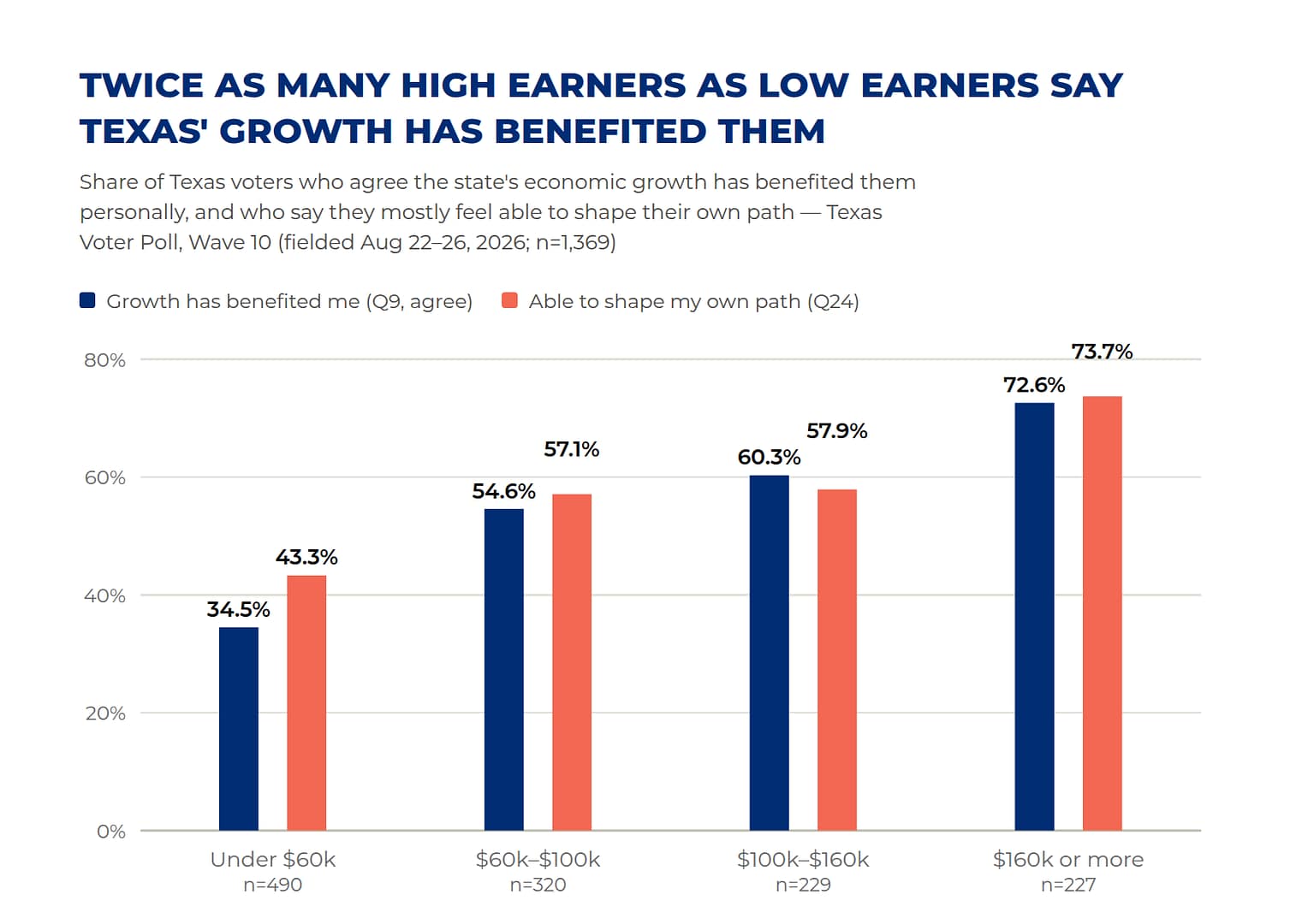 And the gap is especially striking when voters are asked about their own sense of control.
Statewide, 55.4% say they mostly feel able to shape their own path even when things are difficult, while 36.9% feel pushed by circumstances beyond their control.
Among voters earning less than $60,000, the two answers are split: 43.3% feel able to shape their path, and 47.6% feel pushed by circumstances, well below the 55.4% statewide who feel able to shape their path. Among those earning $160,000 or more, nearly three-quarters (73.7%) feel in control of their path.
Interestingly, for a state as geographically diverse as Texas, the differences between voters in large metros, smaller metropolitan areas and rural counties are relatively modest on these three measures. Income separates Texans on economic agency much more than geography does.
Partisanship matters too, though it is not the whole story. Republicans say Texas’ growth has benefited them at more than twice the rate of Democrats (70.7% to 32.2%), and 72.0% of Republicans are confident about future opportunities, versus 46.1% of Democrats.
A national comparison: A 2026 Gallup-Walton Family Foundation survey found 67% of U.S. adults felt able to shape their own path. When the Texas results are calculated on a comparable two-choice basis, that figure is 60%. Differences in the populations and survey methods mean the comparison should be viewed as directional, not apples-to-apples.
The takeaway is more nuanced than whether Texans are optimistic or pessimistic. Majorities still see opportunity ahead and feel some control over their futures. But those feelings become much less common as household income falls.
Texas may have a strong economic story. The results of the 10th Texas Voter Poll show that Texans’ experiences within that economy can look very different.