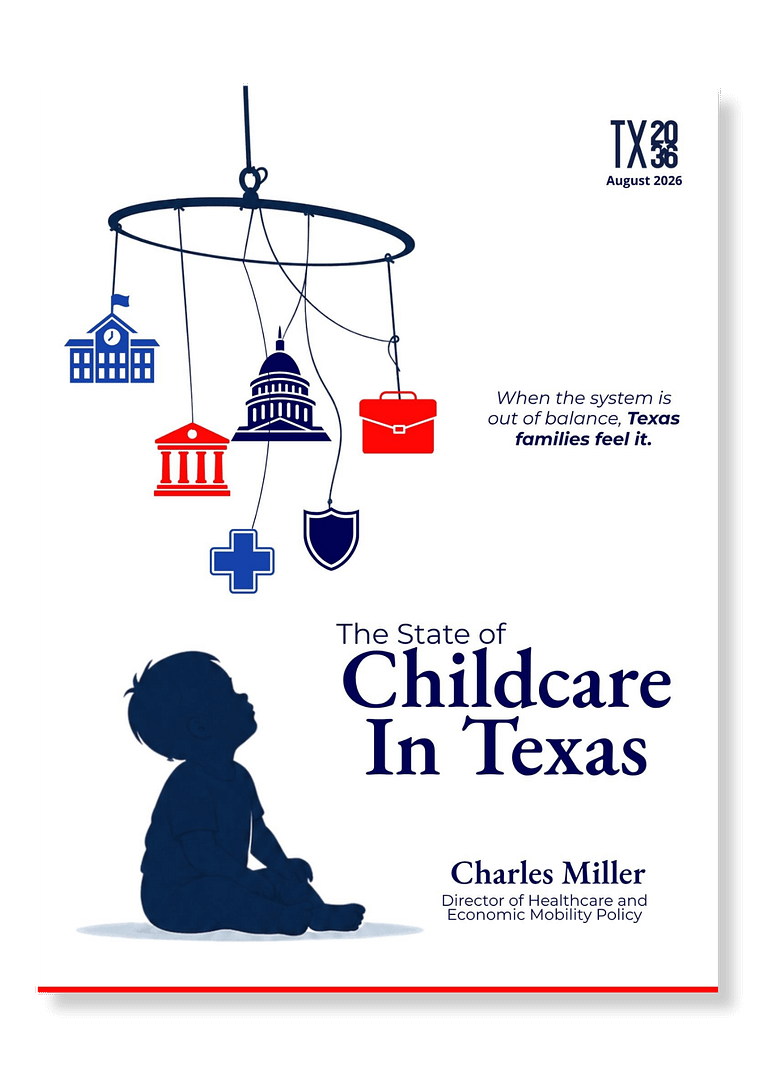
Texas invests billions of dollars each year in childcare and early childhood programs, but oversight is divided among at least five state agencies, with no single entity accountable for whether the system works. This report examines the consequences for families, employers and providers and outlines a parent-centered path forward.
Key Findings
- Only 1 in 6 Texas children under 6 is reached by a public early childhood program, including pre-K, Head Start or a childcare subsidy. The other five in six rely on private pay, family care or a parent staying home.
- At least 95,000 children were on childcare subsidy waiting lists as of late 2024. Texas cannot determine whether children receiving subsidies have better long-term educational outcomes than those who do not.
- Families earning less than $35,000 a year spend about 19% of their income on childcare.
- 46% of Texas parents paying for childcare say they have sacrificed quality to find care they could afford.
Childcare Oversight has Many Authorities, but No Owner

Each agency executes against its own mission, while none is responsible for whether the system as a whole works for families of the roughly 2.4 million Texas children under age 6.
For example:
- A provider can pass one agency’s licensing inspection and get cited by another for the same practice.
- A childcare center can sit at just 65% capacity while a working parent nearby cannot easily find available care with necessary hours.
- And the state still can’t answer a basic question: Do the subsidies it pays for actually help kids arrive at kindergarten ready to learn?
That fragmentation isn’t just an inefficient government problem. It has real consequences: families face rising costs, employers lose workers, providers struggle to stay open and the state can’t determine which of its investments are delivering results.
Viewed together, the report finds these aren’t separate problems. They’re symptoms of a system with no single entity responsible for its overall performance.
What Families, Employers and Providers Are Up Against
Texas’ childcare challenges ripple across families, workplaces and communities.
Families balance affordability with quality, location and the hours care is available.
Employers face missed work, turnover and hiring challenges when employees cannot find dependable care.
Providers navigate staffing shortages and financial pressure while trying to keep care available
Together, these pressures reveal a system that leaves Texans to solve interconnected problems on their own.

A 2027 Window To Reform Texas Childcare System
The report calls for consolidating oversight of Texas’ childcare system under a single accountable entity with the authority to coordinate regulation, funding and outcome measurement around what Texas parents need.
Policymakers have an opportunity to begin this work. The Governor’s Task Force on Early Childhood Care and Education is already meeting, while the Texas Workforce Commission and Health and Human Services Commission are undergoing Sunset review. The 90th Texas Legislature will consider policy recommendations in 2027.
Methodology
Texas 2036 produced this report in collaboration with research partner DARO. The analysis combines the direct perspectives of Texas voters, families, childcare providers and employers with a review of state policies, regulations and agency plans.
The research included:
- A February 2026 statewide poll of 702 likely Texas voters.
- Surveys of 975 parents, 286 childcare providers and 138 employers, conducted from Jan. 14 through March 2, 2026. Parent results were statistically weighted to better reflect Texas parents of young children.
- 11 focus groups and additional interviews involving 120 Texans across Houston, Dallas–Fort Worth, East Texas, San Antonio and Amarillo, plus a virtual cohort.
- An analysis of Texas childcare licensing standards and the strategic plans of the five primary state agencies whose responsibilities intersect with childcare.
- Federal and state data, peer-reviewed research and outside policy analysis, with sources cited throughout the report.
Some findings use composite estimates or economic modeling. The report documents the underlying sources, calculations and limitations in its appendix.
About the Author

Charles Miller directs Texas 2036’s work in the area of health and economic mobility.