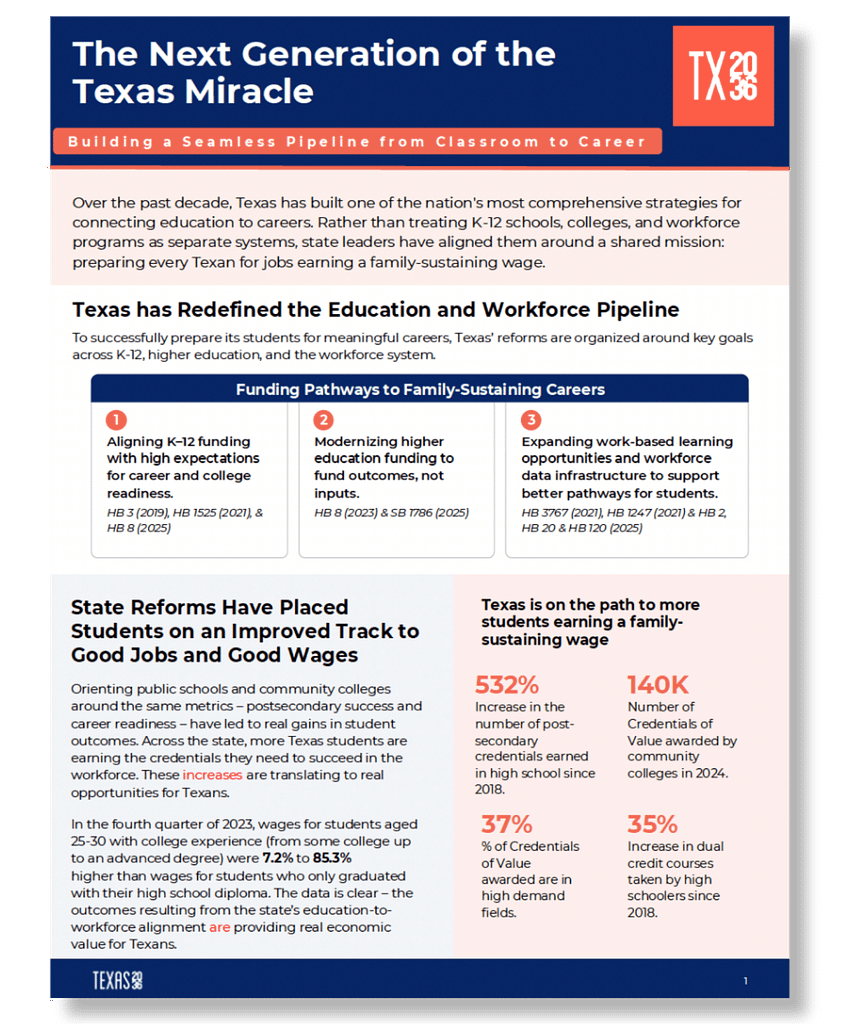
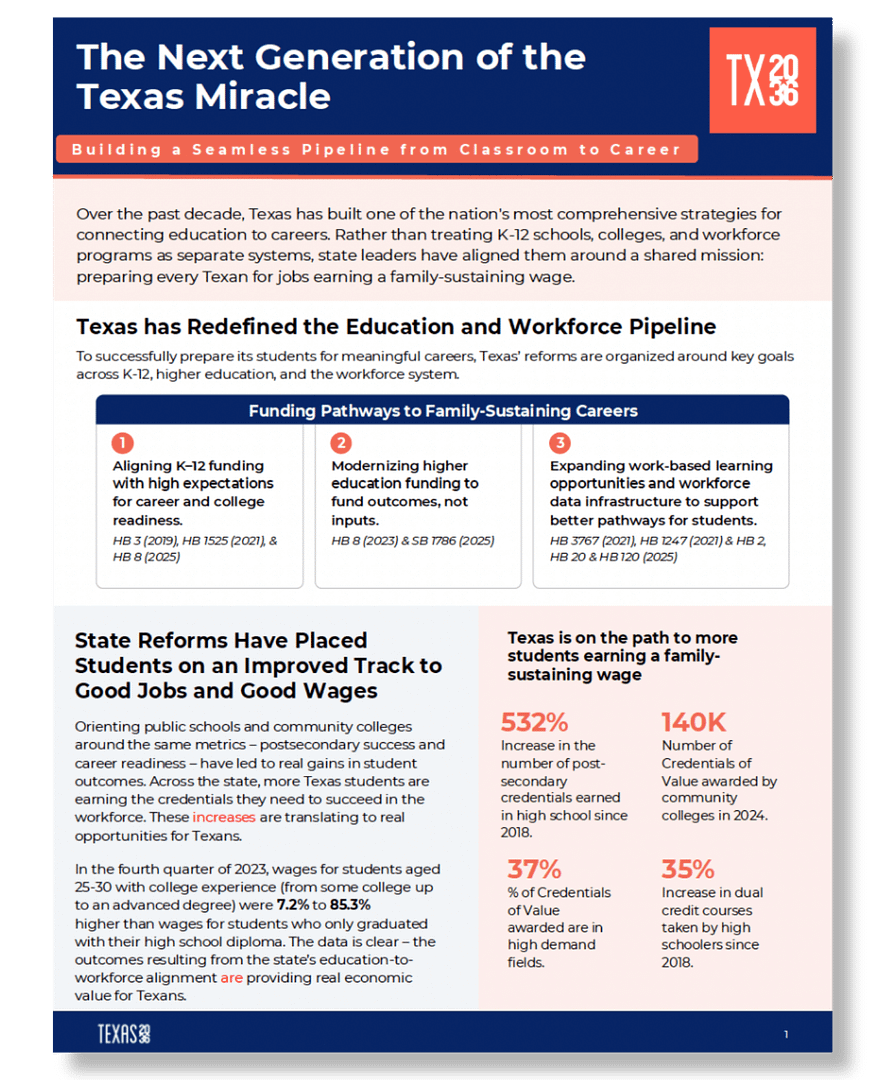
Texas has spent the past decade rebuilding the pipeline from classroom to career. Our report, The Next Generation of the Texas Miracle, shows where the state’s education-to-workforce reforms are working, where gaps remain and what comes next.
Key Findings
- Postsecondary credentials earned in high school have increased 532% since 2018.
- Texas community colleges awarded 140,000 Credentials of Value in 2024.
- Dual credit course-taking among high school students has grown 35% since 2018.
- Students with college experience earn 7.2% to 85.3% more than peers with only a high school diploma.
- Rural students completing blended college and career pathways— like earning both dual credit and an industry certificate— can see a $17,170 wage premium six years after graduation.
How Texas is Building a Stronger Education-to-Workforce Pipeline
Texas has spent years aligning K-12, higher education and workforce programs around a shared goal: helping more students earn credentials that lead to good jobs and ensuring Texas families thrive.
This report shows how those reforms are changing school funding, college funding and workforce planning, while identifying the gaps Texas still needs to close.
Three Systems: One Workforce Goal
Texas has redefined the education-to-workforce pipeline by changing what each part of the system is designed to produce.
K-12

Prepares students for college and career readiness.
Did you know? College, career and military readiness accounts for roughly 40% of a high school’s A-F rating.
Higher Education

Rewards credentials with proven value.
Did you know? 95% of community college funding is outcomes-based.
Workforce

Connects pathways to employer demand.
Did you know? Texas workforce programs serve 4.5 million Texans annually.
Texas Community College Funding Reform
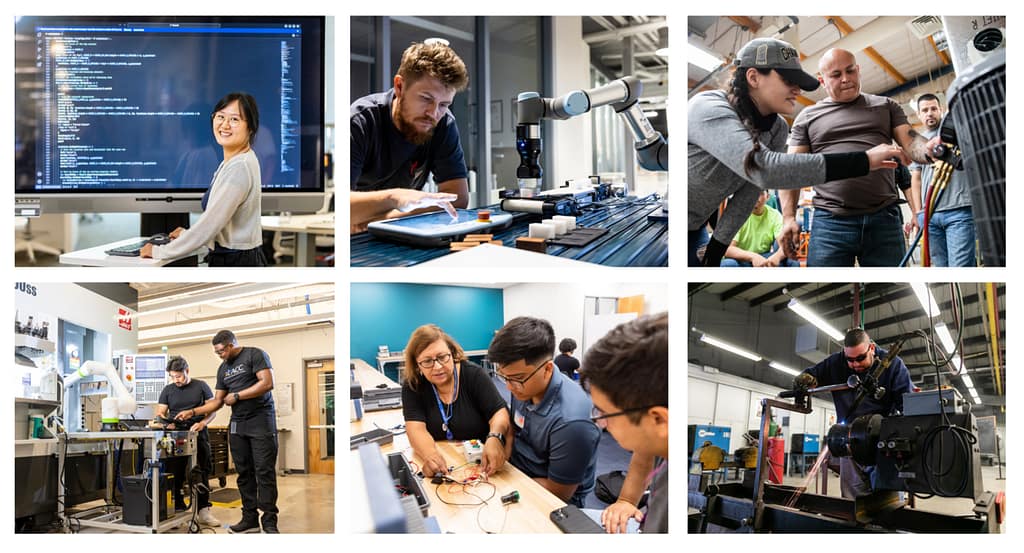
Texas community colleges educate the largest share of the state’s postsecondary students. In 2023, House Bill 8 shifted community college funding from a model based largely on instructional volume to one tied to student outcomes, including credentials of value, transfers to four-year universities and meaningful dual-credit completion.
The report details this reform and the policy decisions that will shape its next phase.
Turning Readiness into Results
Texas’ accountability system gives major weight to college, career and military readiness, but not every readiness measure leads to the same college and career outcomes for students.
Our report shows why the state is moving toward a system that gives more credit to pathways with stronger postsecondary outcomes, including dual credit, career and technical education and credentials with proven workforce value.
Degree or Certificate Completion Likelihood by CCMR Indicator
Note: Values represent percent differences in the likelihood of each outcome for students who met a given CCMR indicator, compared to
otherwise similar students who met no CCMR indicators.
Texas is working hard to weigh CCMR measures based on their connection to postsecondary success.
Better Data Can Help Texas Track What Leads to Good Jobs
Texas has made a major shift toward funding education and workforce programs based on outcomes, not just enrollment or participation. But that approach only works if the state can clearly identify which programs are helping students move into good jobs.
Today, Texas still lacks the workforce data needed to fully understand whether credentials are meeting employer demand across regions, industries and communities. Better data would help the state see which programs are paying off for students, where labor market gaps remain and how education investments can better support Texas families and employers.
The 2026-27 Sunset review of the Texas Workforce Commission gives lawmakers a rare opportunity to strengthen the data systems that make outcomes-based funding work.

Methodology
The Next Generation of the Texas Miracle examines Texas’ education-to-workforce reforms across K-12, higher education and workforce systems.
The analysis draws on student outcome data, wage data, credential production, dual credit and career and technical education participation, community college funding changes and workforce data infrastructure.
The bar charts on college and career pathway outcomes in this report draw on independent academic research conducted by J. Jacob Kirksey and colleagues at Texas Tech University, the University of North Texas, Texas A&M University and UT San Antonio. Their findings on the postsecondary and labor market outcomes associated with CCMR indicators are forthcoming in peer-reviewed publication.
About the Authors
Texas 2036’s Education and Workforce team works to strengthen the connections between K-12, higher education and the workforce so more Texans can move from education to opportunity.
Mary Lynn Pruneda
Director of Education and Workforce Policy
Rahul Sreenivasan
Director of Government Performance and Fiscal Policy
Renzo Soto
Deputy Director of Education and Workforce
Carlo Castillo
Senior Research Analyst
Grace Atkins
Policy Advisor, Higher Education and Workforce
Trip Davis
Policy Advisor, K-12